

Will the U.S. Ban on AI Accelerator Cards Choke China's Medical AI Industry?
NVIDIA
Artificial Intelligence Computing Service Provider

Xishi Yigou Medical
Medical Artificial Intelligence Technology R&D, Equipment Manufacturer
On October 7 (U.S. local time), the U.S. Department of Commerce's Bureau of Industry and Security (BIS) announced new restrictions on the export to China of advanced artificial intelligence (AI) and supercomputing chip manufacturing, production equipment, and certain required tools. According to media reports, the new rules require U.S. chip manufacturers to obtain a license from the U.S. Department of Commerce to export semiconductors and chip manufacturing equipment to Chinese companies, with the aim of preventing China from accessing high-performance computing capabilities that rely on advanced semiconductors.
AI (Artificial Intelligence) has become a strategic industry that every country is striving for, continuously taking root in practical scenarios. Among this, China's AI technology development is particularly rapid, occupying a very important position on the global AI map.
According to statistics, in 2021, the scale of China's AI industry reached 404.1 billion RMB (approximately 56.84 billion USD), accounting for 15.7% of the global AI industry's total scale of 361.9 billion USD that year; the amount of industry investment and financing was 20.12 billion USD, accounting for as much as 28.2% of the global total of 71.47 billion USD in investment and financing that year.
In recent years, to further promote the development of China's artificial intelligence industry, significant policies have been frequently introduced. Not long ago, the Ministry of Science and Technology and five other departments jointly issued the "Guiding Opinions on Accelerating Scenario Innovation to Promote High-Quality Economic Development with High-Level Applications of Artificial Intelligence." Subsequently, the Ministry of Science and Technology announced the "Notice on Supporting the Construction of New Artificial Intelligence Demonstration Application Scenarios," delivering a policy "combination punch" that uses scenario innovation to drive the development of artificial intelligence.
In the scenario of combining artificial intelligence with healthcare, the Notice explicitly proposes "for the treatment needs of common diseases, chronic diseases, and frequently-occurring diseases, to establish a new model of AI-enabled medical services based on the large-scale construction of medical databases and knowledge bases, training of large-scale medical artificial intelligence models, and other intelligent medical infrastructure, applying key AI technologies for evidence-based clinical decision-making."
However, while the domestic medical AI industry is celebrating the boost from policy support, the news of "technical export restrictions" from across the ocean has cast a shadow over the future of China's medical AI.
Is the burgeoning medical AI industry in China a "skyscraper built on sand," and will it face bottlenecks? VCBeat (WeChat ID: VCbeat) interviewed industry professionals to provide readers with insights for reference.
In fact, the technical restrictions on October 7 can also be considered as a continuation and upgrade of the relevant policies from August 26. On that day, NVIDIA issued an announcement stating that the U.S. government required it to immediately implement new licensing requirements for certain products, which must receive U.S. government approval before being sold to customers in China (excluding Taiwan Province).
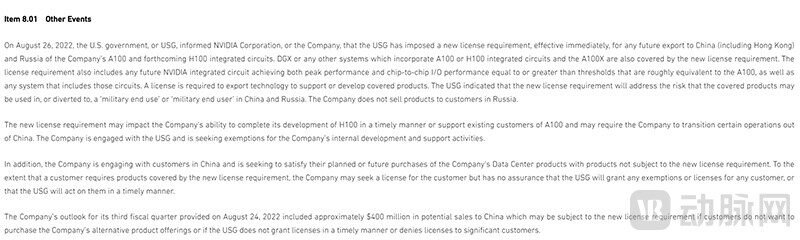
The announcement pointed out,The affected products include two types of accelerator cards, the A100 and the upcoming H100, as well as DGX and other complete systems equipped with A100, A100X, and H100. In addition, any future NVIDIA accelerator cards with peak performance and inter-chip throughput equal to or greater than the A100, along with all complete systems equipped with such accelerator cards, will also need to comply with licensing requirements.
NVIDIA Announcement Content (Screenshot from SEC Public Filing)
On August 31, NVIDIA issued a supplementary announcement clarifying that the U.S. government had authorized exports, re-exports, and domestic transfers to continue its development of the H100. Additionally, the U.S. government also authorized NVIDIA, through its branch established in Hong Kong, to fulfill orders and logistics for the A100 and H100 until September 1, 2023.At the same time, the company will actively help affected customers obtain licenses from the U.S. government. Although there is no guarantee of approval, NVIDIA's sincerity towards its customers is self-evident.
In the announcement and the semi-annual financial report released afterwards, NVIDIA predicted that the new licensing regulations might affect approximately $400 million in sales revenue, accounting for about 10% of its data center product business revenue, which is relatively controllable. However, since China also needs to undertake the peripheral development tasks of the H100, the license will slow down the development progress and increase costs.
According to foreign media reports,AMD, NVIDIA's largest competitor in the accelerator card field, has also received corresponding notifications, involving the MI250 series products and complete systems equipped with these accelerator cards.However, as of the time of writing, AMD has not issued an official announcement.
Following the news, NVIDIA's stock price was immediately and significantly impacted. The closing price on that day was $162.6, a sharp 9.8% drop from the closing price of $179.13 on August 25, and it continued to decline. As of October 5, its stock price was $132.09, nearly 20% lower than the price of over $160 before the incident, resulting in a significant loss of market value.
Although NVIDIA emphasizes that it can still help domestic customers apply for licenses from the U.S. government, based on recent years’ experience, the possibility is almost zero, equivalent to a de facto "sales ban." Given that NVIDIA is the main supplier of AI acceleration cards and holds a near-monopoly position in AI computing power supply, this new licensing regime will undoubtedly have a certain impact on medical AI in China.
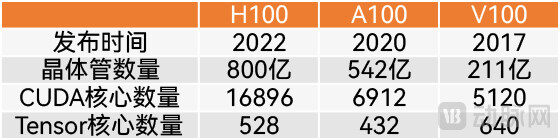
The A100 and H100, which have been placed under restrictions, are NVIDIA's high-end products designed for data centers. Currently, NVIDIA has three main products in this field: V100, A100, and H100. In terms of specifications, H100 > A100 > V100. The V100 has not yet been required to have a license, but there is still a considerable gap between it and its successor in terms of chip specifications.
NVIDIA Data Center Accelerator Card Specifications Comparison
In fact, this incident involving the acceleration card is not an isolated case; similar incidents have occurred multiple times recently, with market panic gradually accumulating. For instance, not long ago, the United States launched the National Biotechnology and Biomanufacturing Initiative to ensure that the U.S. can domestically manufacture everything invented in the U.S. The initiative aims to change the current situation where the U.S. biopharmaceutical industry is overly reliant on raw materials and bioproduction outside the U.S., establishing a stronger supply chain within the country.
Despite the plan not including mandatory measures and its effectiveness being questioned, it still had a significant impact on China's burgeoning CXO industry, with the share prices of leading domestic CXO companies affected. Take Wuxi AppTec, the most closely watched company, as an example—its market value dropped by 20.5 billion yuan in a single trading day.
On October 5, the U.S. government added BGI to the "Chinese Military Companies list" (abbreviated as CMC). However, companies listed on the CMC do not currently face specific sanctions. On October 8, the first day back to work after the National Day holiday, the U.S. government further escalated the technology control measures mentioned at the beginning of this article.
There is no doubt that in the foreseeable future, similar events may become increasingly common.
So, in which aspects are AI acceleration cards mainly used in medical AI? Song Jie, CEO of Xishi Yigou Medical, provided an interpretation to VCBeat.
At present, medical AI can be mainly divided into two categories. One category is closely related to imaging, collectively referred to as medical imaging. The development approach primarily involves using artificial intelligence to form certain algorithms based on imaging data such as MRI, CT, and ultrasound, which are then applied to the recognition of medical images. The other category includes applications of artificial intelligence in fields outside of medical imaging, such as speech recognition, AI genomics, and AI drug discovery.
In AI imaging, GPU and its derivative accelerator cards are mainly used in the training (R&D end) and inference (application end) of medical AI. The hardware requirements for these two stages differ significantly.
"In clinical application, what is actually used is the inference end, also known as the application end. Its role is to load the trained model onto a device platform for use. The computing power or graphics acceleration capability it requires is actually not high, only relatively mid-to-low-end products are needed, and the performance requirements are not on the same scale as the training end," said Song Jie.
"As far as I know, such products have not been restricted. In fact, from another perspective, I personally believe that the reasoning end will not put much pressure on domestic medical AI, as there are many alternative solutions," he added.
"The training end is based on a large amount of medical data — this data can be in the form of images or other formats for training, with the aim of obtaining an excellent model (algorithm). Subsequently, the completed model needs to be deployed to the inference end. This training process requires significant computing power, and may even necessitate the establishment of a supercomputing center to enhance the efficiency of model training and iteration, or to reduce development costs," introduced Song Jie.
According to NVIDIA's official introduction, the H100, which has been restricted from sale this time, performs 7 times faster than the A100 in gene sequencing. Simply put, a model that requires 7 days of training time on the A100 would take approximately only 1 day to complete on the H100, a significant difference indeed.
Song Jie admitted that in this area, China's reliance on foreign accelerator cards is relatively strong. However, he also stated that the restrictions on product imports will not temporarily have a significant impact on the development of medical AI in China.
First, even on the training side, the current demand for medical AI in China will not temporarily require such high-end products.
Taking Xishi Yigou Medical as an example, it established "Shennong No.1" (SINOSEEDS), the strongest computing platform dedicated to AI imaging R&D in China at that time, as early as 2018. "We used the highest-performing V100 at that time, which had very strong processing power. We built a lot of redundancy into the system when we set it up, and even now, our computing power is more than sufficient for handling medical data," he explained.
Secondly, he stated that China has placed particular emphasis on the construction of infrastructure such as computing power in the past five years, achieving remarkable results.
A latest example is in February 2022, when China launched the "East Data West Computing" project. By constructing a new type of computing power network system that integrates data centers, cloud computing, and big data, the project orderly guides the computing power demands of the eastern region to the western region, optimizes the layout of data center construction, and promotes coordinated interaction between the east and west. This project is similar to the famous "West-to-East Electricity Transmission" plan, with the difference being that it mainly transmits computing power.
Subsequently, the country launched the construction of national computing power hub nodes in eight regions: Beijing-Tianjin-Hebei, Yangtze River Delta, Guangdong-Hong Kong-Macao Greater Bay Area, Chengdu-Chongqing, Inner Mongolia, Guizhou, Gansu, and Ningxia, and planned 10 national data center clusters.
"So, even if you don't build your own dedicated supercomputing center like we do, you can still use the computing power of third-party supercomputing centers or cloud-based computing power. In terms of the requirements for medical image data processing, the computing power in China is sufficient. Unless there is a disruptive technology emerging recently, the current computing power alone will be enough to meet the industry's demand for computing power in the next few years," said Song Jie.
"Of course, if you look at it with a forward-thinking perspective, such technical restrictions will also prevent us from accessing new products from abroad. If there are disruptive new technologies, we won't be able to use them. Moreover, these technical restrictions will have a lasting impact — for instance, projects like 'East Data West Calculation,' as well as supercomputing centers and cloud computing power, will be affected to some extent. That's a different matter altogether."
Industry insiders also agree with this view. A well-known AI drug discovery company in China told VCBeat that the current policies would not impact its business.
A researcher from a well-known AI chip company also told VCBeat that, due to the fact that existing equipment can still be used at present, the impact would not be significant. However, potential effects might arise during future capacity expansion or routine equipment replacement. Nevertheless, if the scope of the license is further extended to more products, the industry may be affected to a certain extent in the future.
One piece of good news is that, after witnessing the technical limitations faced by other industries in previous years, the AI industry in China has been exploring alternative solutions.At present, in addition to GPU-based acceleration card solutions, AI acceleration also includes three hardware types: CPU acceleration, ASIC-based AI chips, and FPGA acceleration.。
The versatility of the CPU solution is the strongest, but its efficiency is the lowest. Most critically, reliance on foreign enterprises for high-performance CPUs is even higher than for GPUs. Foreign giants like Intel and AMD have long constructed countless patent barriers around the X86 architecture, making breakthroughs extremely difficult. As a result, this solution is being used less and less in AI acceleration.
GPU-based acceleration solutions are the most widely applied. It is predicted that GPU acceleration will account for nearly 60% of all AI accelerations by 2025. This is also the key reason why NVIDIA's stock price continues to rise.
However, GPU acceleration does not have advantages in all scenarios. For instance, when compared with ASICs customized for a specific purpose, such as AI chips bundled with AI algorithms, the GPU solution may not necessarily be advantageous. Considering the potential technical limitations and risks, leading artificial intelligence companies in China have increasingly opted to either independently develop or collaborate with AI chip companies to develop AI chips in recent years.
Data shows that in 2021, there were 109 investment and financing events in China's AI chip industry, with a total amount reaching 39.636 billion yuan. Globally, the number of investment and financing events for AI chip startups was 170, with a cumulative investment amount of approximately $9.9 billion, which is three times that of the same period last year. The popularity of AI chips among investors is evident.
However, China's AI chips have just been released, and there is still an order-of-magnitude gap in theoretical computing power compared to GPU acceleration. In addition, there are no practical applications of AI in healthcare that have been implemented yet, and the specific application effects remain to be seen.
In addition to proprietary ASIC-based AI chip solutions, FPGAs paired with dedicated algorithms have become another choice for AI companies due to their flexible configurability and performance in specific environments that can rival GPUs. Simply put, before software is written, FPGAs offer greater versatility than CPUs, and after software is written, they exhibit performance similar to ASICs.
A researcher from a well-known AI company introduced to VCBeat that the current technical fields of artificial intelligence are mainly divided into deep learning and machine learning. In the medical field, deep learning primarily achieves auxiliary image diagnosis and pathological analysis through CV technology. In recent years, deep learning has also begun to be applied in new drug development and molecular prediction. Currently, deep learning mainly uses GPUs for model training.
Another category is machine learning, which can assist in disease diagnosis, such as chronic disease screening and risk assessment. Machine learning can predict the future risk of disease by learning from past data of chronic disease patients. These scenarios are limited by factors such as data and are not as widely implemented as imaging AI. However, these scenarios are less affected by GPU-based acceleration cards, and domestically produced FPGA acceleration cards can fully enhance the efficiency of model training and inference.
Even in the GPU field, where foreign giants have an absolute advantage, the concept of domestic substitution has rapidly emerged in recent years. Of course, the theoretical performance of these products can only reach a fairly entry-level stage, and the real-world performance remains to be seen.
"We have been exploring alternative solutions. The performance requirements for the product end are not particularly high, and we have at least two or more alternative options. As for the R&D end, the computing power of the supercomputing center we built earlier has always been sufficient, so there is no immediate need for alternatives," Song Jie introduced.
It is not difficult to see that although there are several alternative technical routes, the progress of domestic alternatives is still far from mature and will require more time. If there are no mature alternative solutions in the next few years and the industry faces further technological restrictions, it may have an adverse impact on the industry.
At the same time, in response to restrictions imposed by the U.S. government, NVIDIA is also trying to take measures. After all, the Chinese market is one of NVIDIA's three major markets, and no one would turn their back on money. Meanwhile, various negative impacts such as high inventory levels of gaming graphics cards—one of its main revenue sources—poor sales performance, and a sluggish stock price have placed tremendous pressure on NVIDIA's operations.
According to Reuters, NVIDIA CEO Jensen Huang mentioned at the press conference after the GTC on September 21 that the previously disclosed chip restrictions have specific thresholds related to chip performance and the ability of chips to connect with other chips. NVIDIA still has a wide range of products available for sale in China. By reasonably utilizing the rules and providing architecture-compatible products within the restriction limits, NVIDIA can still ensure "market space" for its products in China.
One practical approach is to achieve the same computing power as restricted products by stacking more lower-performance products that meet the restrictions, or by precisely developing "special edition" products based on existing ones. Of course, this may also involve the split supply of a series of supporting solutions. Although relatively cumbersome and requiring extra cost, it is theoretically not impossible to achieve.
Another approach has a somewhat long history in the semiconductor industry. Occasionally, there are instances where a product can be transformed into another simply through minor modifications in software or hardware. In earlier times, a simple hardware jumper adjustment or driver change could turn a gaming graphics card worth several hundred yuan into a professional graphics card costing over ten thousand yuan.
At the same time, products positioned in other fields may not necessarily be unsuitable for AI acceleration. For example, graphics cards originally intended for the gaming market became powerful "mining" tools in the hands of "miners" a couple of years ago, driving the price of gaming graphics cards that were originally worth 2000 yuan to nearly 10,000 yuan.
From the current situation, the impact of this licensing system on domestic medical AIs is limited for the time being. On one hand, the computing power required for medical artificial intelligence is not as high as imagined. Coupled with the key construction of computing power in China in recent years, the industry still has sufficient computing power available.
VCBeat believes that although there has been no significant impact so far, with the tightening of U.S. policies toward China, the industry needs to prepare in advance and plan for alternative solutions, so as not to be caught off guard if the scope of relevant restrictions expands.
Somewhat reassuringly, although the difficulty is significant, the industry has acknowledged this issue and is actively seeking alternative solutions. Demand has always been a major driving force for industry development, much like how the earlier chip embargo spurred substantial growth in China's semiconductor sector. Perhaps this unexpected demand will trigger rapid development in related industries. Viewed in this light, it might not necessarily be a bad thing.
After all, history has taught us that it's better to have core technologies in our own hands.
References:
Xie Weiqun, Shen Wenmin, Huang Xiaohui, People's Daily: Artificial Intelligence Accelerates Empowerment of the Real Economy
Xing Xiaojun, Jin Huizhen, Global Times: The US government imposes another chip restriction to suppress Chinese companies! Experts: Fearful of China's high-tech industry becoming stronger
Stephen Nellis,Reuters:Nvidia CEO sees 'large space' for China sales despite U.S. restrictions
Stephen Nellis,Jane Lanhee Lee,Reuters:U.S. officials order Nvidia to halt sales of top AI chips to China