

Bioray Bio Announces Development of ABE9, a Novel High-Precision and Safe Adenine Base Editor, Published in Nature Chemical Biology

BRL Medicine
Cell and Gene Therapy Drug Developer

East China Normal University
A National Key University under the direct administration of the Ministry of Education and jointly established with the Shanghai Municipal Government
ShanghaiOctober 15, 2022/PR Newswire/ -- Base editing technology was first developed by David R. Liu's team at Harvard University and is mainly divided into two types: Cytosine Base Editor (CBE) and Adenine Base Editor (ABE). These are derived from the fusion of cytosine deaminase or engineered adenine deaminase with a Cas9 nickase mutant protein (nickase Cas9). Currently, while CBE and ABE have been widely used in multiple species, many experimental studies have shown that they still exhibit significant random off-target effects, which have not been completely resolved.
October 14, 2022Shanghai BRL Medicine Inc., Focusing on Gene and Cell Therapy(hereinafter referred to as "BRL Medicine") announced a collaboration with the team of Professor Li Dali and Professor Liu Mingyao from East China Normal University.Developed and named a precise and safe new adenine base editor -- "ABE9", which can effectively solve ABEVarious off-target risks and safety issues in clinical applications,Theoretically, it will be nearly 50%.Genetic PathogenicitySNVsProvides new precise targeting tools for correction.This research achievement was officially published in an international academic journal on October 13.Nature Chemical BiologyPublished on. It can be said that,This discovery is of great significance for enhancingABEThe safety of the tool, broadening its scope of application, and promoting its use in gene therapy and subsequent clinical translation are all of great significance.
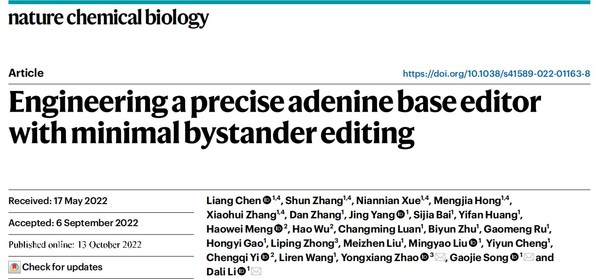
Nature Chemical Biology Article
Paper link:https://www.nature.com/articles/s41589-022-01163-8
It is worth mentioning that,ABE9As the most clinically applicable product of the new generation, core patent applications have been completed in advance, and future patent layouts will cover mainstream markets worldwide.Currently, BRL Medicine has a continuous and deep accumulation of patent layout in the ABE technology field, with multiple families of base editor patents authorized worldwide.
Novel Adenine Base Editor "ABE9: Precise and safe, with great potential for clinical application
DNA base editors hold great promise for germplasm improvement and gene therapy due to their ability to efficiently catalyze base conversions without causing DNA double-strand breaks (DSB) or requiring donor DNA templates. However, the editing efficiency of the first-generation ABE7.10 developed by David R. Liu's team is unsatisfactory for many targets. Although David Liu and other research groups have obtained higher-activity ABE8 (ABE8e and ABE8s) through molecular evolution, some inherent defects of ABE remain unresolved. For example, the substantial random RNA off-target editing caused by ABE, bystander effects resulting from non-target base changes due to a wide editing window, and cytosine base conversions induced by ABE in specific TCN motif base sequences.
This study first demonstrated that the highly active ABE8e induced more severe bystander effects, as well as Cas9-independent DNA and RNA off-targeting, and significantly improved the editing efficiency of cytosine. To address the precision issue of ABE8e, the study rationally designed and screened based on the cryo-EM structure of ABE8e. It was found that introducing key mutations L145T and N108Q (ABE9) in the active pocket of TadA-8e deaminase could retain high editing activity while significantly narrowing the editing window to the adenine at positions 5-6 of the sgRNA, eliminating the editing activity for cytosine (Figure 1).
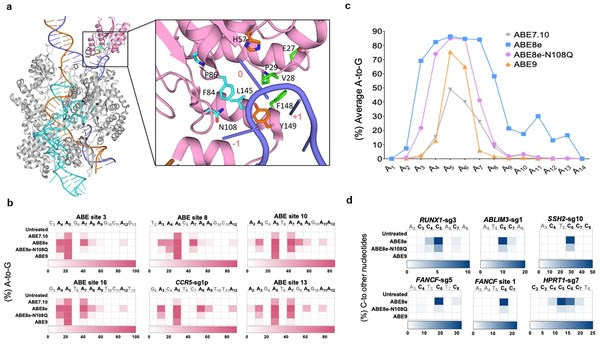
Figure 1: TadA-8e Protein Structure and ABE9 Editing Characteristics Evaluation
Through the identification of Cas9-independent off-target R-Loop detection and RNA off-target transcriptome deep sequencing,DiscoveryABE9Hardly causes random DNAand RNAOff-target editing (Figure 2)), demonstrating extremely high application safety.Moreover, ABE9 demonstrated extremely high in vivo editing precision and activity in mouse and rat embryos. In all F0 generation mice, the control group ABE8e edited A5The target site simultaneously triggered a large amount of A8Position of bystander editing (18/19), precise editing A5Only 5.1% of the mice were affected. Meanwhile, ABE9 can precisely edit A.5(14/16), with 25% of the mice showing editing efficiency over 80%, and the average efficiency across all F0 mice reaching 54.3%. Similarly, ABE9 could precisely target the Gaa gene to generate the D645G mutation, inducing Pompe disease in rats, with only the intended site A present in the F0 generation.6-to-G mutation reached 48.41%, while the precise editing of ABE7.10 only accounted for 2.76%. In vivo experiments in rodentsOnce again proved thatABE9The high-precision feature also highlights its potential in the precise construction of animal models (Figure 3).)。
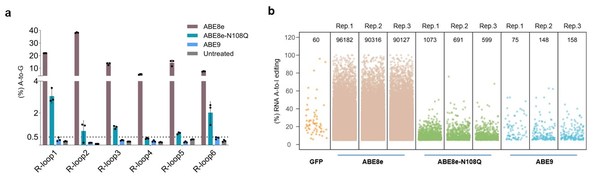
Figure 2: Evaluation of Cas9-independent DNA off-target and RNA off-target
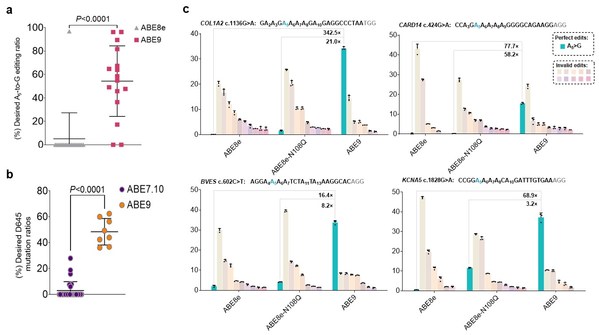
Figure 3: In vivo editing of ABE9 in animals and correction of human pathogenic SNVs
Moreover, to further evaluate the potential of ABE gene therapy, the researchers constructed cell lines containing human pathogenic SNVs, where the adenine to be corrected was located at the fifth position of the sgRNA and within multiple consecutive adenines. The results showed that even in such extreme sequences rich in bystander bases, ABE9 could precisely edit the fifth position of the sgRNA to induce A-to-G conversion. Its accuracy in correction improved up to 342.5 times compared to ABE8e (Figure 3).
Co-corresponding author of the paper, Co-founder of BRL Medicine &Vice President Professor Li Dali said:"In this study, to analyze the precise editing characteristics of ABE9 in a vast number of targets without bias, a library of more than 8,000 sgRNAs paired with target sites was used for analyzing the editing window. It was found that ABE9 primarily edits A with high precision and without sequence preference."5-A6Two bases, demonstrating its broad and precise editing characteristics.In general,ABE9Narrow the editing window to 1-2nt, almost completely eliminating off-target editing of cytosine, and more importantly, DNA/RNAOff-target events have been reduced to background levels, achieving high-precision, low off-target base editing. In the future, it can also be combined with recognition of different PAMs.The CasVariant fusion further expands the targeting range, not only bringing new base editing tools for fundamental research but, more importantly, potentially greatly enhancing the safety of future clinical applications."
Deeply Engaged in the Gene Therapy Field, BRL Medicine Continues to Breakthrough
As one of the earliest companies globally to engage in the research and application of gene editing technology, BRL Medicine has adhered to technological innovation since its establishment. It not only continuously overcomes industry barriers with a multi-pipeline strategic layout but also is committed to developing world-leading gene editing tools, acquiring core technologies with independent intellectual property rights. Looking back on BRL Medicine's pioneering journey, it has undoubtedly been a process of continuous breakthroughs and innovations.Currently, the team of scientists at BRL Medicine is engaged in the development of gene editing tools and gene therapy for thalassemia, as well asCAR-TIn the field of technological innovation, many significant and groundbreaking advances have been made:
March 2019,Nature MedicineIt was found that using gene editing technology to target and edit the BCL11A erythroid enhancer reactivates γ-globin expression, replacing defective β-globin, which is expected to achieve a curative effect for β-thalassemia.
January 2020,Cell ResearchPublished, being the first to prove the feasibility and effectiveness of using single-base editor technology to target the HBG promoter and activate fetal hemoglobin expression for treating β-thalassemia.
March 2020,Nature MedicinePublished, proving that single-base editing technology can target the erythroid enhancer element of BCL11A to activate fetal hemoglobin, or edit specific mutations in the β-globin gene, offering hope for treating inherited blood disorders, including β-thalassemia, by editing autologous hematopoietic stem cells.
May 2020,Nature Cell BiologyReport: The self-developed hyCBEs series tools have higher editing activity and a wider editing window, offering greater advantages for the treatment of β-hemoglobinopathies.
In June 2020, Nature Biotechnology published an article on the development of a novel, highly specific, and safe bifunctional base editor, A&C-BEmax.
August 2022,Nature MedicinePublication revealed detailed clinical data: BRL Medicine's BRL-101 gene therapy has enabled children with thalassemia to live without blood transfusions for over two years, and provided a more comprehensive analysis of the efficacy and safety profile of BRL-101 in treated patients.
August 2022,NaturePublication demonstrates the outstanding clinical safety and efficacy of BRL Medicine's BRL-201 non-viral PD1-targeted CAR-T therapy, enabling NHL patients to achieve cancer-free survival for over 2 years.
In this regard, the founder of BRL Medicine &Chairman Professor Liu Mingyao stated,"The development of the new adenine base editor ABE9, which is highly efficient and precise, provides a novel approach for the simultaneous optimization of the single-base editing tool ABE in terms of active window and RNA off-target risks. Since 2020, BRL Medicine has made a series of breakthrough advancements in base editors and their application in gene therapy for genetic diseases, adding another powerful tool to gene therapy. Currently, BRL Medicine has collaborated with multiple medical institutions in China, achieving excellent clinical outcomes in projects such as gene-editing treatment for β-thalassemia, non-viral PD1 site-specific integration CAR-T, and UCART. In the future, through continuously accelerating the translation and implementation of innovative drugs, it will benefit patients with rare genetic diseases and malignant tumors, including thalassemia, worldwide!"