

Cardiovascular Intervention Firm HeartCare Medical Reports Soaring Revenue and Core Product Maturity, Files for A-Share IPO

HeartCare
Neurointerventional Medical Device Developer
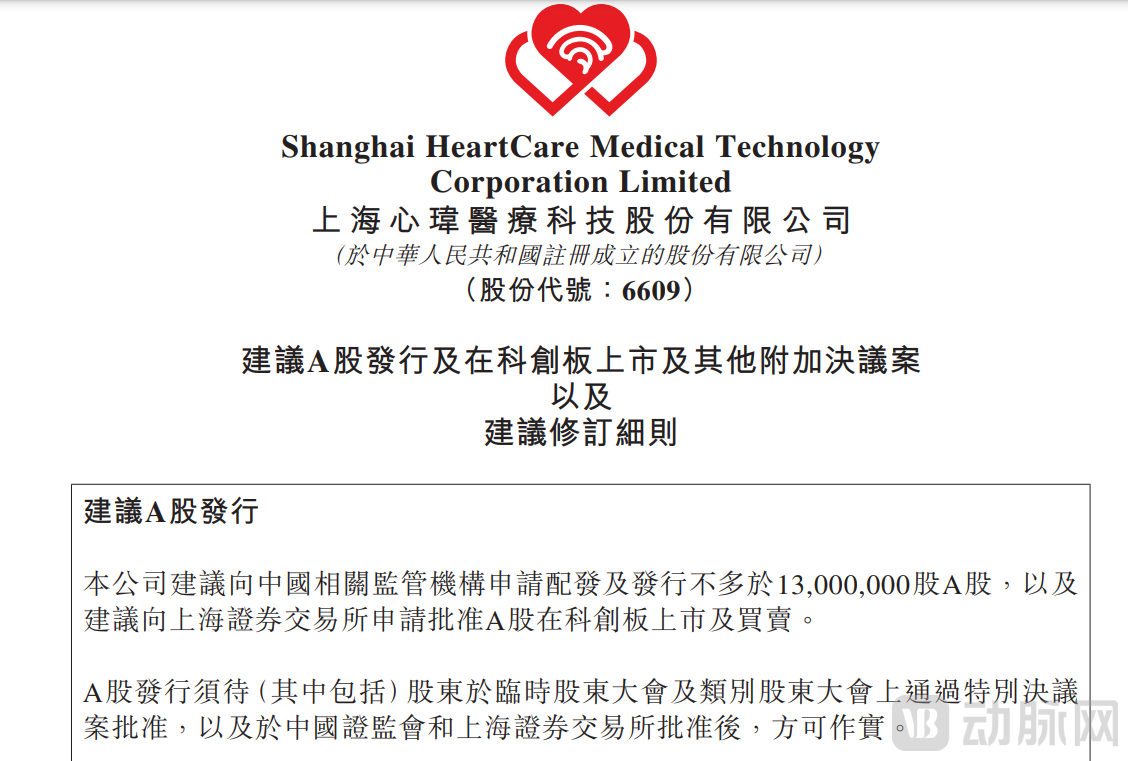
On October 10, HeartCare, a vascular intervention enterprise listed on the Hong Kong Stock Exchange's 18A chapter, announced that it plans to apply to the Shanghai Stock Exchange for approval to list and trade on the STAR Market, with an application to allocate and issue no more than 13 million A-shares.
In this planned issuance on the A-share STAR Market, HeartCare intends to raise 1.431 billion yuan, of which 839 million yuan will be used for the HeartCare headquarters & advanced medical device R&D and industrialization project, 192 million yuan for marketing services and brand building projects, and the remaining 400 million yuan for replenishing working capital.
During the same period, due to the moderated price reduction in centralized procurement and the continuous introduction of favorable policies such as interest-subsidized loans for medical equipment, market confidence in the medical device sub-industry is also recovering. The pharmaceuticals sector has seen a wave of limit-up surges, led by the medical device segment.
Among the high-value consumable medical devices that have regained favor in the secondary market, neurointervention, where HeartCare operates, also falls under the most crucial segment of vascular intervention — a sector second only to cardiovascular intervention in terms of market size. Neurointervention in China remains an underdeveloped market, but becoming the true leader in this field is highly challenging. Neurointervention companies were once aggressively pursued by institutions in the primary market, but their stock performance in the secondary market has been weaker than expected.
When the industry development returns to rationality, the industry also begins to face the challenge of weakened valuation under the previous capital injection. At this stage, HeartCare, which plans to return to the A-share market, has welcomed an opportunity for value reassessment. As a leader in China's neurointervention field, to what extent has HeartCare honed its internal capabilities? VCBeat (WeChat ID: vcbeat) conducted an analysis.
Previously, the medical device industry encountered a cold spell in the secondary market, with the healthcare sector experiencing more than a year of decline. Valuations dropped to historical lows, and the neurointervention sector also faced an inversion of valuations between the primary and secondary markets.
After the bubble in extrusion and market confidence returned to rationality, the neurointervention track is welcoming an opportunity for valuation recovery. Was neurointervention overestimated in the past?
The neurointerventional track has previously been favored by multiple capital entities, with two core rationales: First, cerebrovascular diseases are the leading cause of death in China, and the development of interventional treatments in China lags behind that of Europe and the U.S.; Second, the market for neurointerventional products is dominated by imported brands, leaving significant room for domestic substitution.
From the fundamentals of the neurointerventional market, the 2021 surgical volume data showed relatively rapid growth despite the impact of the pandemic.
In 2021, there were over 3 million new cases of stroke, and the disease burden caused by cerebrovascular diseases remains significant. In the field of cerebrovascular diseases with a large patient population, how is the growth of interventional treatment procedures?
In the development of the global market, the mechanical thrombectomy market has experienced explosive growth after 2015. Penumbra, a leading overseas neurointervention company, also generated substantial revenue in the neurointervention market, with a total income of $747.6 million in 2021, representing a 33.4% increase from the previous year.
In the ischemic market, the number of mechanical thrombectomy procedures in 2015 was only 5,000 cases in China. By 2019, the number of thrombectomy procedures had increased to 45,800 cases, and by 2021, the number of neurointerventional thrombectomy procedures reached 80,000 cases.
Some industry insiders have indicated that the application of neurointerventional procedures in clinical practice in China is also very active. However, due to the more complex cerebrovascular diseases among Chinese patients and the higher surgical difficulty, the penetration rate has not experienced the explosive growth seen in the global market after 2015.
"Physicians in China are highly proactive in adopting neurointerventional surgeries. The lack of the latest clinical data abroad has driven Chinese practitioners to explore this field more actively. Neurointervention is hailed as the jewel in the crown, with significant variations among patients suffering from neurovascular stenosis—differences in plaque location and degree of occlusion result in diverse treatment approaches. There are considerable differences in device selection for treating various patient conditions. Against this backdrop, last year still saw 60,000 stenosis surgeries, with potential for even more growth in the future. As physicians in China accumulate more clinical data and continue their exploration, it is expected to lead global advancements and potentially revolutionize treatment methods."
From the perspective of domestic substitution, stroke is the leading cause of death in China, with sudden onset, severe symptoms, and high rates of mortality and disability. Whether from an industry or macroeconomic health perspective, it is essential for us to have our own medical device products. Otherwise, the lack of market competition under foreign monopolies would only result in a significant drain on residents' wealth and medical insurance funds through highly overpriced products. The industrial value of domestic substitution is evident. Since 2021, with the rise of domestic manufacturers, market competition has already driven down the cost of consumables for neurointerventional surgeries by more than 30%, significantly reducing the medical burden on residents. According to publicly available data from the first half of 2022, the revenue from neurointerventional products of five listed companies exceeded 500 million yuan. The substitution of domestically produced devices has only just begun.
In terms of pipeline progress and product performance, companies in China have already possessed the strength to compete with imported enterprises. Taking HeartCare as an example, in terms of product performance, HeartCare's core product, Captor, is the first domestically produced multi-point imaging thrombectomy stent in China, which selected Medtronic’s Solitaire FR as the device for the clinical trial control group. The core criteria for thrombectomy stents are vascular recanalization rate, recanalization time, and safety. Captor has performed excellently in all aspects.
From the perspective of payment policies, neurointervention has previously been affected by centralized procurement. However, after two years of implementing medical device centralized procurement, price reductions have gradually become more moderate, allowing companies to retain some profit margins. At the same time, medical insurance policies clearly state that innovative products will not be included in centralized procurement. As a result, early-stage commercialization cycles for neurointerventional life products are longer.
These two logics remain correct, but an undeniable fact is that the penetration rate of neurointervention, as a new surgical technique, is taking longer than expected; the path to domestic substitution is also not an overnight achievement, and the requirements for the capabilities of domestic enterprises are even higher.
In China's neurointerventional market, which has a complex market structure and a wide variety of products, "Without accumulating small streams, one cannot form a great river or sea." Domestic companies must patiently refine their products while also participating in the cultivation of China’s neurointerventional market. Only then can they establish a firm foothold in this market, which is still in its early stages of development.
What is the scarcity of HeartCare among vascular interventional enterprises in China?
First, it has a full product pipeline covering stroke prevention and treatment.Unlike the coronary intervention track, the neurointervention track is not a field where commercial profits can be achieved by relying on a single product. Its uniqueness lies in the need to form a rich and diverse product portfolio across细分产品领域 such as ischemia, hemorrhage, access, and stenosis to address the wide variety of cerebrovascular diseases. In such unique clinical scenarios, a single product cannot deliver effective treatment outcomes nor build a competitive moat for enterprises.
HeartCare has products in multiple fields, including ischemic stroke treatment and prevention, neurovascular stenosis treatment, interventional access devices, and hemorrhagic stroke treatment.
For multiple products, HeartCare's pipeline portfolio exhibits strong synergy. Taking the core ischemic market in neurointervention as an example, HeartCare's flagship product is a combination of thrombectomy stent and aspiration pump, integrating both aspiration and thrombectomy techniques.
Acute Ischemic Stroke (AIS) accounts for nearly 80% of all stroke cases. Thrombectomy stents in the field of ischemic stroke are a highly contested area, with multiple domestically produced products having been approved. HeartCare's advantage in the field of ischemic stroke lies in combining aspiration products with stent products. In the United States, approximately 50% of ischemic stroke cases use combined intervention techniques, while the rest rely solely on aspiration catheters. Chinese patients have finer blood vessels, resulting in a lower rate of direct aspiration recanalization. Moreover, a distinct characteristic of the Chinese patient population is the higher prevalence of concurrent stenosis; after using stents combined with aspiration catheters, there is better vascular compliance, easier access to blood vessels, and a higher rate of vascular recanalization. The combination of thrombectomy stents and aspiration pump products can better meet clinical needs in China.
The second major scarcity point of HeartCare lies in the fact that HeartCare has been exploring global innovation instead of staying in imitative iteration.
Currently, HeartCare's intracranial drug-coated balloon has the potential to become the world's first rapamycin drug-eluting balloon approved for the treatment of neurovascular stenosis. The product has received expedited review status from the NMPA and has successfully completed clinical follow-ups, with excellent results across all follow-up metrics.
Choosing to develop the world's first intracranial drug-coated balloon was driven by clinical needs. China has the highest global proportion of patients with intracranial stenosis, and there is currently a lack of effective device products. The restenosis rates for bare stents and plain balloons are relatively high. Through its innovative intracranial drug-coated balloon, HeartCare aims to elevate the recommendation level for balloon use in guidelines.
In addition to focusing on BIC, HeartCare is also attempting to address industry bottlenecks by achieving upstream self-research and development.
As Chinese neurointerventional companies obtain certifications one after another, the domestic neurointerventional market has entered the second phase of competition. Stable supply and production capabilities are key to expanding market share and increasing gross profit margins. Whether a company possesses proprietary technology platforms and processing platforms, demonstrates excellent operational capabilities after streamlining production and supply chains, and can truly enable shared and collaborative operations of its technology platform will be the core competitiveness required for long-term development.
HeartCare has always emphasized the construction of supply chain capabilities, with the yield rate of new products continuously improving. Today, over 95% of the company's product categories can achieve self-control and supply using domestically produced raw materials.
HeartCare also values the enhancement of professional market education capabilities. Amid the pandemic, offline academic conferences were impacted, and HeartCare actively participated in online academic activities, particularly focusing on the education and training of grassroots doctors. The company advanced online initiatives in sync with operators and overseas KOL hospitals. For the promotion of new products, HeartCare engaged in interactive discussions and learning with stroke centers at various levels. After an in-depth exploration of the clinical promotion of new procedures, it developed the latest concepts related to these procedures, which in turn further stimulated and shaped new R&D ideas for its own products.
HeartCare's commercialization performance in the year of its listing on the Hong Kong Stock Exchange also delivered satisfying results to the market. In the first half of 2022, revenue reached 76.71 million yuan, a year-on-year increase of 154.6%, with a gross profit of 50.86 million yuan, marking a year-on-year growth of 167%.
HeartCare's strategy remains clear: adhering to a development model that equally emphasizes commercialization, supply chain, and R&D, focusing on the unmet needs of clinicians and patients in China, and striving to improve the accessibility of innovative medical technologies.
Since its listing just over a year ago, HeartCare has received approval for nearly 10 neurointerventional device products. In 2022 alone, it obtained approval for five new products. Currently, its portfolio of 15 products can cover various mainstream neurointerventional procedures, including thrombectomy, stenosis, hemorrhage, and prevention, as well as the access devices required for these surgeries.
This planned listing on the A-share market will allow HeartCare to not only further consolidate its advantages in the neurointervention field but also aim to provide comprehensive solutions for cardiovascular, cerebrovascular, and pulmonary vascular diseases.
The company focuses on an efficient R&D platform targeting unmet clinical needs, actively expanding its R&D pipeline beyond neurointervention. Its products include a series of cutting-edge innovative devices such as cardiac intervention, pulmonary intervention, and robotic assistants for coronary intervention. Recently, the brain-computer interface developed in collaboration with Nankai University completed the first animal trial in China.
In the future, the harvest from these tracks will surely become HeartCare's second growth curve, enhancing the valuation of HeartCare.
It is undeniable that the flood of capital in the primary market once overheated the neurointerventional device industry, but it also practically drove the industry forward in terms of R&D investment, talent attraction, and product commercialization.
When the industry development gradually returns to rationality, enterprises that have consolidated and expanded their core competitiveness in the early stage will surely be able to go through cycles and create long-term value for the industry.