

EU CHMP Recommends Approval of PSMA-Targeted Radioligand Therapy Pluvicto for Advanced Prostate Cancer with Demonstrated Survival Benefit

Novartis
Drug Development and Manufacturing

Committee for Medicinal Products for Human Use
Committee for Medicinal Products for Human Use (CHMP)The Committee for Medicinal Products for Human Use (CHMP) is the committee within the European Medicines Agency (EMA) responsible for human medicines. The CHMP replaced the former Committee for Proprietary Medicinal Products (CPMP) in May 2004.The CHMP plays a vital role in the authorization of medicines in the European Union (EU). In the centralized procedure, the CHMP is responsible for: 1) conducting initial assessments of marketing authorization applications across the EU; assessing modifications or extensions to existing marketing authorizations (“variations”); considering recommendations from the Agency’s Pharmacovigilance Risk Assessment Committee regarding the safety of medicines on the market, and, where necessary, advising the European Commission to amend the marketing authorization of a medicinal product, or to suspend or withdraw it from the market.The CHMP also evaluates medicines authorized at the national level that are referred to the EMA, with the aim of maintaining a harmonized position throughout the EU.Furthermore, the CHMP and its working groups promote the development of medicines and pharmaceutical regulation by: providing scientific advice to companies researching and developing new medicines; developing scientific and regulatory guidelines to assist pharmaceutical companies in preparing marketing authorization applications for human medicines; and collaborating with international partners to harmonize regulatory requirements.

Image Source: Shutterstock
News / BIOON / -- Novartis recently announced that the Committee for Medicinal Products for Human Use (CHMP) of the European Medicines Agency (EMA) has issued a positive opinion, recommending approvalTargeted Radioligand Therapy Pluvicto (INN: lutetium[177Lu] vipivotide tetraxetan, formerly known as 177Lu-PSMA-617): In combination with androgen deprivation therapy (ADT), with or without androgen receptor (AR) pathway inhibitors, for the treatment of adult patients with prostate-specific antigen-positive (PSMA+), metastatic castration-resistant prostate cancer (mCRPC) who have been treated with AR pathway inhibitors and taxane chemotherapy and have progressed.
Now, the CHMP opinion will be submitted to the European Commission (EC) for review, which typically makes a final decision within two months. If approved, Pluvicto will become the first commercial radioligand therapy (RLT) in Europe for advanced prostate cancer.
In March 2022, Pluvicto was approved by the U.S. FDA., for the treatment of adult patients with specific types of advanced prostate cancer, specifically: PSMA+mCRPC patients whose disease has metastasized and who have received other anticancer therapies (androgen receptor pathway inhibitors and taxane-based chemotherapy).Pluvicto is the first targeted radioligand therapy approved by the U.S. FDA for the treatment of progressive PSMA+ mCRPC.Previously, the U.S. FDA granted Pluvicto Breakthrough Therapy Designation (BTD) for the treatment of mCRPC.The prognosis of metastatic prostate cancer is poor, with a 5-year survival rate of approximately 30%.
Phenotypic Precision Medicine in Advanced Prostate Cancer:More than 80% of prostate cancer patients highly express a phenotypic biomarker – prostate-specific membrane antigen (PSMA)., making it a promising diagnostic (via positron emission tomography imaging) and therapeutic target for radioligand therapy. This differs from "genotype" precision medicine, which targets specific genetic alterations in cancer cells.
Pluvicto is a radioligand therapy (RLT), which combines a targeting compound (ligand, capable of binding to markers expressed by tumors) with a therapeutic radioisotope (radioactive particle), leading to DNA damage in tumor cells and inhibiting tumor growth and replication. This treatment method enables precise delivery of radiation to tumor cells while limiting damage to surrounding normal tissues.
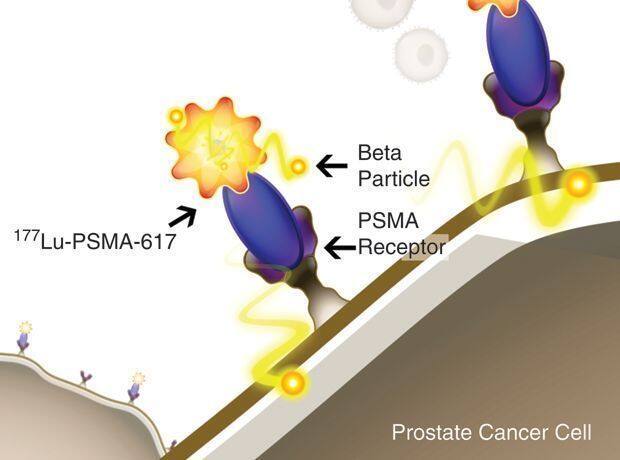
177Lu-PSMA-617 (Image source: embs.org)
The positive review opinion of the EU CHMP on Pluvicto is based on the results of the pivotal Phase 3 VISION study. This is an international, prospective, randomized, open-label, multi-center study conducted in patients with mCRPC who have progressed after prior treatment with androgen receptor (AR) pathway inhibitors and taxane chemotherapy and are PSMA-PET scan positive. The study evaluated the efficacy and safety of Pluvicto (intravenous infusion of 7.4 GBq every 6 weeks for up to 6 cycles) in combination with best standard of care (BSoC) and compared it with SOC alone.
The study results have been published in the international medical journal "The New England Journal of Medicine" (NEJM), see details at:Lutetium-177–PSMA-617 for Metastatic Castration-Resistant Prostate Cancer. The results showed,Compared with the BSoC treatment group, patients in the Pluvicto+BSoC treatment group showed a significant extension in overall survival (OS) (median OS: 15.3 months vs 11.3 months), a significant 38% reduction in the risk of death (HR=0.62, p<0.001), and a statistically significant 60% reduction in the risk of radiological disease progression or death (rPFS).
In addition,Among patients with evaluable disease at baseline, approximately one-third (29.8%) treated with Pluvicto + BSoC showed an overall response (according to RECIST 1.1), compared to only 1.7% of those treated with BSoC.In the Pluvicto+BSoC group of this study, the most common adverse events (all grades) were fatigue (43%), dry mouth (39%), nausea (35%), anemia (low red blood cell count) (32%), decreased appetite (21%), and constipation (20%).
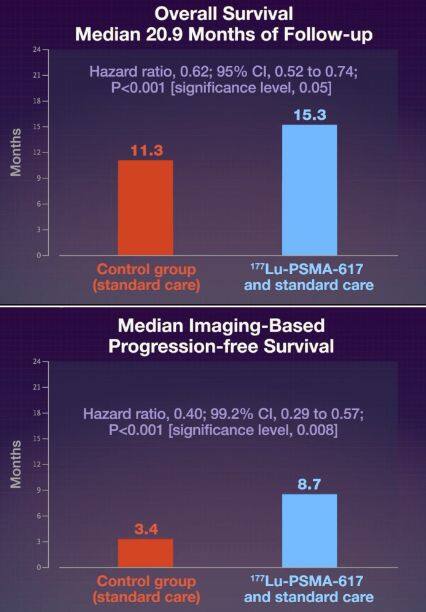
VISION Study Results (Image Source: NEJM)
Prostate cancer is a type of cancer that occurs in the prostate, a small walnut-shaped gland in the male pelvis. In castration-resistant prostate cancer (CRPC), despite hormone therapy aimed at lowering testosterone, the tumor still shows signs of growth, such as elevated levels of prostate-specific antigen (PSA). In metastatic CRPC (mCRPC), the cancer spreads to other parts of the body, such as nearby organs or bones, and remains unresponsive to hormone therapy. The 5-year survival rate for patients with mCRPC is approximately 15%.
Despite advances in prostate cancer treatment, there remains a significant unmet medical need for new targeted therapies for patients with mCRPC. More than 80% of prostate cancer tumors highly express a phenotypic biomarker known as prostate-specific membrane antigen (PSMA), making it a promising diagnostic target (through positron emission tomography [PET] scan imaging) and a therapeutic target for radioligand therapy.
Pluvicto (177Lu-PSMA-617) is a PSMA-targeted radioligand therapy developed for the treatment of metastatic castration-resistant prostate cancer (mCRPC). The drug is a precision cancer treatment that combines a targeting compound (ligand) with a therapeutic radioisotope (radiation particle). After being injected into the bloodstream, 177Lu-PSMA-617 binds to prostate cancer cells expressing PSMA (a transmembrane protein), resulting in a higher uptake of the drug by tumors compared to normal tissues. Once bound, radiation from the radioisotope (beta particles) damages tumor cells, disrupting their ability to replicate and/or triggering cell death. The radiation from the radioisotope acts over a very short distance to minimize damage to surrounding cells.
Currently, Novartis is also conducting two additional clinical studies to evaluate Pluvicto for the earlier treatment of metastatic prostate cancer, including its use in mCRPC before taxane treatment (PSMAfore) and in metastatic hormone-sensitive mCRPC (PSMAddition). In addition, Novartis is also assessing the potential for using Pluvicto in the earlier treatment of prostate cancer. (Bioon.com)
Source: Novartis receives positive CHMP opinion for Pluvicto® for patients with progressive, PSMA-positive metastatic castration-resistant prostate cancer