

Bayer Launches Phase III OASIS 4 Trial of First-in-Class Non-Hormonal Therapy Elinzanetant for Vasomotor Symptoms in Breast Cancer and High-Risk Patients

Bayer
Pharmaceutical Product R&D Developer

Image Source: Shutterstock
October 20, 2022 /BioValleyBIOON/ -- Bayer recently announced the expansion of the Phase 3 clinical development program OASIS, launching a Phase 3 clinical trial, OASIS 4, which will be conducted inBreast CancerConducted among patients and women at high risk for breast cancer,Evaluation of elinzanetant as a non-hormonal therapy for the treatment ofBlood VesselSymptoms of contraction and relaxation.The trial plans to include approximately 95 centers across 15 countries globally.400 patients with vasomotor symptoms induced by endocrine therapyRandomly divided into two groups,One group is high-risk women for breast cancer, and the other group is breast cancer patients.In this trial, elinzanetant was administered orally at a dose of 120 mg once daily to evaluate its efficacy and safety.
Elinzanetant is a first-in-class, non-hormonal, once-daily, oral neurokinin-1,3 receptor (NK1R, NK3R) antagonist currently being developed for the treatment of menopausal vasomotor symptoms (hot flashes).In September 2020, Bayer completed the acquisition of KaNDy Therapeutics Ltd, a UK-based clinical-stage biotechnology company, fully integrating elinzanetant into its women's healthcare development pipeline.
Breast cancer is the most common cancer among women worldwide, with 2.3 million new cases in 2020.Nearly 70% of breast cancers are hormone receptor-positive (HR+). The majority of patients receive at least 5 years of adjuvant endocrine therapy (aimed at reducing hormone levels) to decrease breast cancer recurrence and improve related mortality.。Endocrine therapy can also serve as a primary preventive measure for women at high risk of breast cancer.。
Vasomotor symptoms (VMS, also known as hot flashes) are a known adverse reaction to endocrine therapy., seriously affectingQuality of LifeAnd treatment persistence.In breast cancer patients and women at high risk of breast cancer,There is an urgent need for effective non-hormonal therapies for VMS caused by endocrine therapy, as there are currently no available treatment options.
Christian Rommel, Ph.D., Member of the Executive Committee of Bayer's Pharmaceuticals Division and Global Head of Research and Development, said: "For women receiving endocrine therapy for breast cancer, vasomotor symptoms can persist for many years, significantly impacting their quality of life and treatment adherence, which in turn may affect the effectiveness of their cancer treatment and survival rates. By adding the OASIS 4 trial to our elinzanetant Phase 3 clinical development program, our goal is to help patients experiencing vasomotor symptoms due to endocrine therapy and improve their quality of life."
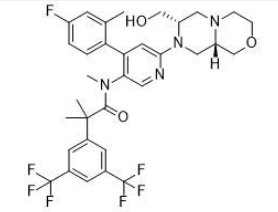
Elinzanetant Chemical Structure (Source: medkoo.com)
Vasomotor symptoms (VMS, also known as hot flashes) are caused by the overactivation of thermoregulatory pathways mediated by hypertrophy of KNDy neurons due to estrogen withdrawal, which may result from natural menopause, bilateral oophorectomy, or pharmacological interventions such as endocrine therapy leading to progressive decline in ovarian function.
It is reported that up to 80% of women experience VMS (hot flashes) at some point during the menopausal transition, which is the primary reason for seeking medical care during this specific phase of a woman’s life. More than one-third of women report severe symptoms, which may persist for 10 years or longer after the final menstrual period. Vasomotor symptoms can negatively impact sleep, mood, and quality of life. Vasomotor symptoms induced by endocrine therapy affect quality of life and treatment adherence, and currently remain unresolved due to the lack of treatment options.
Elinzanetant is a first-in-class, non-hormonal, oral, neurokinin-1,3 receptor (NK1R, NK3R) dual antagonist currently in clinical development for the treatment of menopausal vasomotor symptoms.Elinzanetant addresses vasomotor symptoms by modulating a group of estrogen-sensitive neurons (KNDy neurons) in the brain's hypothalamus. In menopausal women, the lack of estrogen causes KNDy neurons to become overactive, disrupting the body's temperature control mechanism and worsening vasomotor symptoms such as hot flashes.
In August 2021, Bayer announced the initiation of the OASIS Phase III clinical development program to evaluate the efficacy and safety of elinzanetant in treating menopausal vasomotor symptoms (hot flashes). Currently, the OASIS program includes four Phase III clinical trials: OASIS 1, 2, 3, and 4. The design and dosing of the OASIS Phase III clinical development program are based on positive data from two Phase II studies (RELENT-1 and SWITCH-1).These two studies confirm the efficacy and good safety of elinzanetant.Among them, RELENT-1 is a Phase 1b/2a study investigating the safety, pharmacokinetics, and preliminary efficacy of elinzanetant. SWITCH-1 is a Phase 2b study evaluating the efficacy and safety of four different doses of elinzanetant compared to placebo in patients with vasomotor symptoms.
AboutMenopause:By 2030, the global population of postmenopausal and menopausal women is expected to increase to 1.2 billion, with an additional 47 million people each year.Menopause is an inevitable process as ovarian aging typically occurs in women in their 40s or 50s.The decline in ovarian hormone secretion can lead to various symptoms, which significantly impact women's health, quality of life, healthcare consumption, and work efficiency.The most common and troublesome symptoms during the menopausal transition are hot flashes, sleep disturbances, and mood changes.With the extension of life expectancy, menopauseManagementIt is becoming increasingly important as this is a period when women are at the peak of their personal and professional lives. Therefore, maintaining functional capacity and a good quality of life is crucial from both healthcare and socio-economic perspectives. (Bioon.com)
Source of the original text:Bayer expands development program for elinzanetant with Phase III study in breast cancer patients with vasomotor symptoms caused by endocrine therapy