

Teva Reports Positive Three-Year Data for AUSTEDO (Deutetrabenazine) in Huntington’s Disease-Associated Chorea: Sustained Efficacy, Safety, and High Tolerability

Teva
Drug Developer
News on October 25, 2022 /BioValleyBIOON/ -- Teva Pharmaceutical Industries recently announced the results of the ARC-HD clinical trial. This is an approximately 3-year open-label, single-arm, two-cohort, multicenter extension study that is evaluatingAustedo (Chinese brand name: Antetan, generic name: deutetrabenazine, Deutetrabenazine Tablets) Long-term Treatment Safety and Tolerance Related to Huntington's Disease (HD) Chorea. This study was conducted in collaboration between Teva and the Huntington Study Group (HSG).
Results of the ARC-HD study show:The safety and tolerability of Austedo treatment were comparable to those in the First-HD randomized, double-blind, placebo-controlled 12-week study.In the ARC-HD study,During the approximately 3-year open-label extension period, the medication adherence rate among patients was greater than 90%.According to the Total Motor Score (TMC) of the Unified Huntington's Disease Rating Scale (UHDRS),Throughout the study period, Austedo treatment improved and maintained chorea control in both the Rollover cohort and the Switch cohort.
Chorea is one of the most prominent physical manifestations of Huntington's disease (HD), occurring in approximately 90% of HD patients.Chorea can significantly impact the functional lives of HD patients and their caregivers. The data announced provide important insights into the long-term use of Austedo for treating HD chorea.
This analysis included a total of 119 patients: 82 patients completed the randomized, double-blind, placebo-controlled First-HD trial (Rollover cohort), and 37 patients were switched overnight from a stable dose of tetrabenazine to Austedo, followed by dose adjustment (Switch cohort). The mean daily dose of Austedo at the end of the study was 45.7 mg. The study results have been published online inCNS Drugs. (See details:The Safety of Deutetrabenazine for Chorea in Huntington Disease: An Open-Label Extension Study)
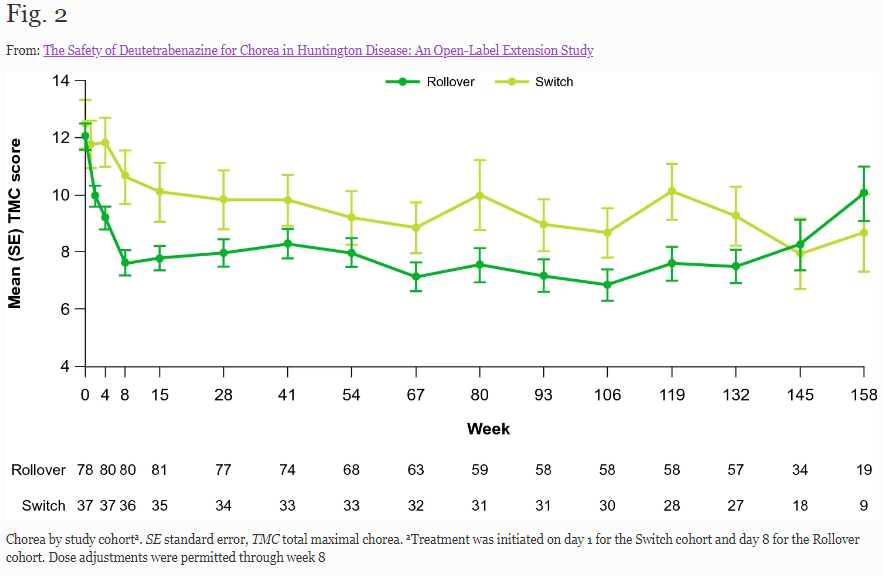
Results of the ARC-HD Clinical Trial (Image Source: CNS Drugs)
——3-Year Safety Results:Exposure-adjusted incidence rates (EAIRs) were used to compare the frequency of adverse events (AEs) in the long-term open-label extension study with those in the short-term First-HD study.The EAIR associated with AE is comparable to the EAIR in the pivotal First-HD trial.Common AEs (≥4% in each cohort) in the Rollover and Switch cohorts included: falls, depression, anxiety, insomnia, somnolence, and akathisia. No new safety concerns were identified.
——3-Year TMC and Total Motion Score (TMS) Results: Research shows,From baseline to Week 8, the mean TMC score decreased, and chorea control was maintained over approximately 3 years.Key results are as follows: (1)In the Rollover cohort of patients from the pivotal First-HD study, the mean chorea score decreased by 4.5 points (Standard Deviation [SD]: 3.1; 95% CI: -5.2, -3.7) from baseline to Week 8, and the mean TMS decreased by 7.1 points (SD: 7.3; 95% CI: -8.8, -5.5).(2)In patients switched overnight from tetrabenazine in the Switch cohort, the mean chorea score decreased by 2.1 points (SD: 3.3; 95% CI: -3.1, -1.0), and the mean TMS decreased by 2.4 points (SD: 8.7; 95% CI: -5.4, 0.5).(3)From Week 8 to Week 145 (or until the end of treatment, whichever is earlier), the reduction in TMC was maintained in all patients across the two cohorts (-0.5 [SD: 5.2; 95% CI: -1.9, 1.0]).
Austedo: The World's First Deuterated Drug
Huntington's disease (HD) is a rare and fatal neurodegenerative disorder., with a total prevalence rate of 0.40 per 100,000 people in Asia, and an average age of onset of 40 years.Chorea (involuntary, random, and sudden writhing and/or twisting movements) is one of the most prominent physical manifestations of the disease, appearing in approximately 90% of patients.Chorea can interfere with daily functions, cause social isolation, increase the risk of injury, and lead to HD patientsQuality of LifeDecline.
Austedo is the world's first approved deuterated drug.In the United States, Austedo was approved in April 2017.Used to treat chorea associated with Huntington's disease, approved in August 2017For the treatment of adult tardive dyskinesia (TD)。In China, Austedo (Antetan) was approved in May 2020 for the treatment of chorea associated with Huntington's disease (HD) and tardive dyskinesia (TD) in adults.In addition, Austedo (Antetan) was officially included in the "National Basic Medical Insurance, Work-related Injury Insurance, and Maternity Insurance Drug Catalog (2020)" in December 2020, which will greatly reduce the financial burden on patients and improve the accessibility of innovative therapies.
China is the second country in the world, after the United States, to approve Austedo.Austedo (Antetan) contains the active pharmaceutical ingredient deutetrabenazine, which is aSmall-molecule oral inhibitors targeting vesicular monoamine transporter 2 (VMAT2)VMAT2 is responsible for regulating the levels of chemicals such as dopamine, serotonin, adrenaline, and noradrenaline in the brain.Deutetrabenazine is a deuterated drug of the marketed Huntington's disease treatment drug tetrabenazine.。After deuteration, the pharmacokinetic characteristics are improved, the half-life is significantly prolonged, thus allowing for a lower therapeutic dose.
Austedo (Antite) uses deuterium technology, which provides the active ingredient with a favorable pharmacokinetic profile, thereby allowing for reduced dosing frequency. It has demonstrated efficacy and acceptable safety and tolerability in treating patients with Huntington's disease (HD) chorea and adult tardive dyskinesia (TD).
Teva: The Pioneer in the Field of Deuteration
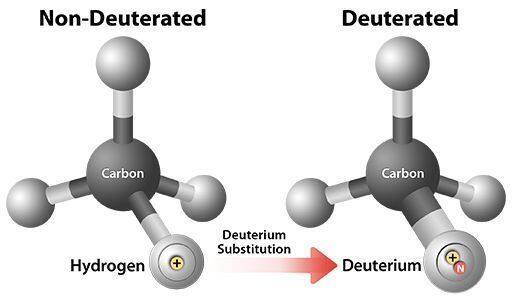
Deuteration Technology
Deuterium (D) is abundant in nature and can form stable molecular bonds with other elements. The average amount of D in an adult body is approximately 2g.Although D is basically the same as hydrogen (H) in terms of atomic size and shape, there is a fundamental difference between D and H, which is that D contains an extra neutron.. The result is,The chemical bond formed between D and carbon (C) is more stable than the bond formed between H and C.. Generally, the stability of the D-C chemical bond6-9 times higher than H-C chemical bonds, which has a very important impact on drug development becauseDrug metabolism often involves the cleavage of H-C chemical bonds.。
Traditional drug discovery methods are time-consuming and have high failure rates. In contrast, the deuterium chemistry approach, which typically starts with already marketed drugs, offers higher development efficiency and lower costs. Deuteration (deuterium substitution) can enhance certain drug properties: since D forms a more stable chemical bond with C, deuteration can, in some cases, alter drug metabolism by improving metabolic stability, reducing the formation of toxic metabolites, increasing the formation of desired active metabolites, or a combination of these effects. Compared with their non-deuterated analogs, deuterated compounds exhibit prolonged half-lives and increased systemic exposure in vivo, which may lead to therapeutic benefits such as improved safety, efficacy, tolerability, and convenience.
Typically, deuterated compounds are expected to retain biochemical potency and selectivity similar to their hydrogenated analogs.The impact of deuterium substitution on metabolic properties highly depends on the specific molecular position of D replacing H.However, the metabolic effects of deuteration (if any) are unpredictable, even among compounds with similar chemical structures.
Currently, multiple pharmaceutical companies are developing deuterated drugs of already marketed medications. For example, Concert is utilizingDeuterium Chemistry Technology Develops New Product CTP-543 from JAK1/JAK2 Inhibitor Ruxolitinib, Showing Strong Efficacy in Alopecia Areata TreatmentRuxolitinib has been approved in the United States for sale under the brand name Jakafi for the treatment of various blood diseases. Deuterium chemical modification of ruxolitinib can alter its human pharmacokinetics, thereby enhancing its use in the treatment of alopecia areata. (Bioon.com)
Source of Original Text:Teva Announces Results from 3-Year Study Assessing the Safety and Tolerability of AUSTEDO (deutetrabenazine) Tablets for the Treatment of Chorea Associated with Huntington’s Disease