

Ultomiris Achieves Zero Relapses in Phase 3 CHAMPION-NMOSD Trial with 73-Week Median Treatment Duration

AstraZeneca
Biopharmaceutical Manufacturer

Alexion
Developer of New Drugs for Rare Disease Treatment
Image Source: Shutterstock
October 28, 2022 /BioValleyBIOON/ -- AstraZeneca recently announced detailed positive results from the Phase 3 CHAMPION-NMOSD trial at the 38th Congress of the European Committee for Treatment and Research in Multiple Sclerosis (ECTRIMS 2022). The data showed,In adult patients with anti-aquaporin-4 (AQP4) antibody-positive (Ab+) neuromyelitis optica spectrum disorder (NMOSD), compared with the external placebo in the pivotal PREVENT clinical trial of the C5 complement inhibitor Soliris (eculizumab), the long-acting C5 complement inhibitor Ultomiris (ravulizumab) significantly reduced the risk of disease relapse by 98.6%.In addition, according to the Hauser Ambulation Index (a metric for assessing mobility),A lower proportion of patients treated with Ultomiris experienced clinically significant worsening.
NMOSD is a rare autoimmuneImmunitySexual diseases that affect the central nervous system (CNS), including the spine and optic nervesMost patients with NMOSD experience unpredictable relapses, characterized by the appearance of new neurological symptoms or the worsening of existing ones. These symptoms are often severe and tend to recur, potentially leading to permanent disability.
Soliris was approved by US and EU regulators in 2019 as the first drug for the treatment of NMOSD., applicable for the treatment of NMOSD adult patients who are positive for anti-aquaporin-4 (AQP4) antibodies (Ab+).Ultomiris is the long-acting version of Soliris and is a second-generation, long-acting C5 complement inhibitor., which has not yet been approved for the treatment of NMOSD.
CHAMPION-NMOSD is a global Phase 3, open-label, multicenter trial evaluating the safety and efficacy of Ultomiris in adult patients with NMOSD (n=58).Due to the potential long-term functional impact of NMOSD relapses and the availability of effective treatment options, a direct placebo control group was excluded for ethical reasons.. Therefore,Compared Ultomiris with the external placebo group from the pivotal Soliris PREVENT clinical trial。
Data shows,Median treatment duration was 73 weeks, with zero adjudicated relapses observed in patients treated with Ultomiris (relapse risk reduction: 98.6%, HR [95% CI] = 0.014 [0.000, 0.103], p < 0.0001). Furthermore, 100% of patients receiving Ultomiris were relapse-free at 48 weeks, compared to 63% in the external placebo group.
CHAMPION-NMOSD Trial AlsoAchieved key secondary efficacy endpoints, including the adjudicated annualized relapse rate during the trial period (total number of relapses in the study divided by total patient-years) and clinically significant changes in mobility (walking ability) from baseline as measured by the Hauser Ambulation Index (a scale assessing mobility).
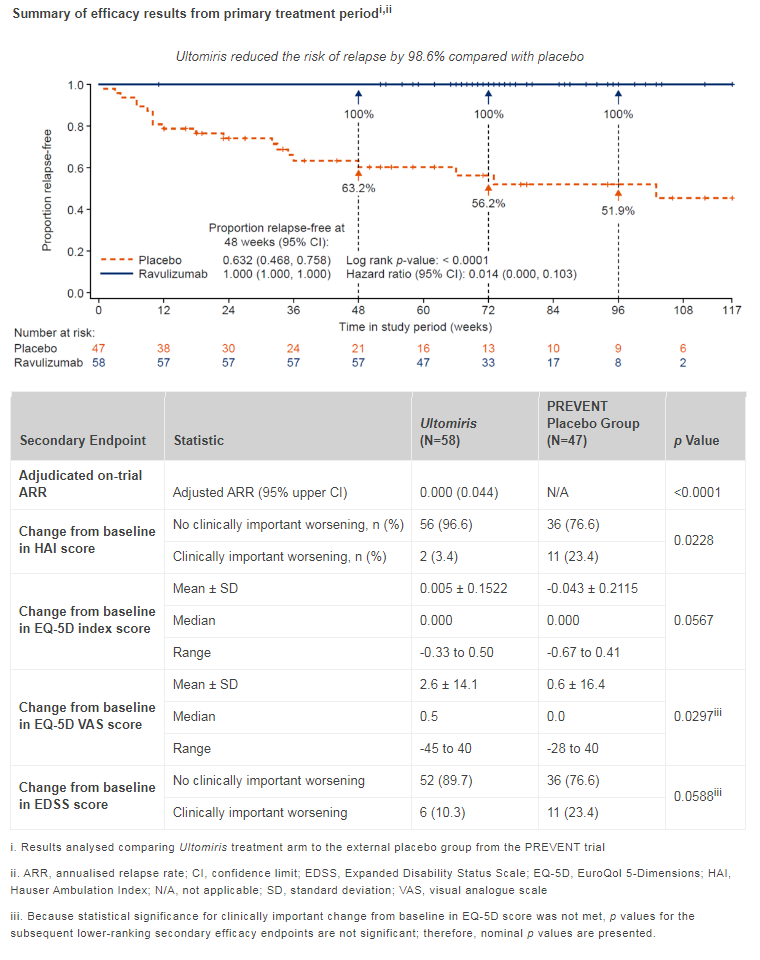
CHAMPION-NMOSD Trial Results (Source: AstraZeneca)
Overall, the safety and tolerability of Ultomiris were consistent with previous clinical studies and real-world use, with no new safety signals observed. The most common adverse events (AEs) (≥10%) wereCOVID-19(24%), headache (24%), back pain (12%), joint pain (10%), and urinary tract infection (10%). All COVID-19 cases were non-severe and considered unrelated to Ultomiris. There were two reports of meningococcal infections, with both patients fully recovering without sequelae, and one patient continuing in the trial. Fifty-six patients continued treatment during the ongoing long-term extension period.
Sean J. Pittock, principal investigator of the CHAMPION-NMOSD trial, director of the Mayo Clinic's Multiple Sclerosis and Autoimmune Neurology Center, and director of the Mayo Clinic's Neuroimmunology Laboratory, stated: "CHAMPION-NMOSD Trial Shows Zero Relapses with a Median Treatment Duration of 73 Weeks, Providing Evidence that Ultomiris, Administered Every Eight Weeks, Continuously Reduces the Risk of Relapse in Patients and Highlights the Efficacy of C5 Inhibition in Managing NMOSD.”
Gianluca Pirozzi, Senior Vice President and Head of Development & Safety at Alexion, AstraZeneca Rare Disease, stated: "CHAMPION-NMOSD is a remarkable example of the innovation required to design and conduct clinical trials for rare diseases., these trials are both scientifically rigorous and clinically significant. By seeking patients' opinions and coordinating with regulatory agencies,This Phase 3 trial puts patients' needs first, and evaluated the results and potential of Ultomiris, the measure most important to them, to promote care in the NMOSD community."
NMOSD is a rare and severe autoimmune disease that attacks the central nervous system without warning, causing progressive and irreversible damage to the brain, optic nerves, and spinal cord, which can lead to long-term disability.Complement activation triggered by anti-AQP4 antibodies is one of the main underlying causes of these damages, with approximately three-quarters (73%) of NMOSD patients testing positive for anti-AQP4 autoantibodies.Detection of anti-AQP4 autoantibodies can be used for NMOSDDiagnosisThe disease mainly affects women, typically during the prime of their lives.
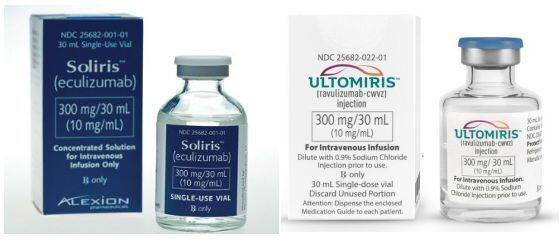
Soliris (eculizumab) is a C5 complement inhibitor, is the first drug approved by regulators for the treatment of NMOSD.Ultomiris is a long-acting C5 complement inhibitor and the long-acting version of Soliris.。Both drugs work by inhibiting the C5 protein in the terminal part of the complement cascade.The complement cascade is part of the immune system, and its uncontrolled activation plays a significant role in severe rare and ultra-rare diseases, including: paroxysmal nocturnal hemoglobinuria (PNH), atypical hemolytic uremic syndrome (aHUS), generalized myasthenia gravis (gMG), and neuromyelitis optica spectrum disorder (NMOSD).
Ultomiris and Soliris are two leading products of Alexion. In December 2020, AstraZeneca announced a $39 billion cash-and-stock acquisition of Alexion. This acquisition was successfully completed in July 2021. It is the largest acquisition carried out by AstraZeneca since its establishment in 1999 through the merger of two pharmaceutical companies from the UK and Sweden. The successful completion of this acquisition marks AstraZeneca's entry into the rare disease drug field, opening a new chapter for AstraZeneca.
Soliris was first approved for marketing in 2007 and has since been approved to treat various ultra-rare diseases, including: PNH, aHUS, gMG, NMOSD. Ultomiris is the long-acting version of Soliris and is a second-generation, long-acting C5 complement inhibitor that was first approved at the end of 2018. Its approved indications include: PNH, aHUS, gMG. (Bioon.com)
Source of the original text:Ultomiris showed zero relapses in adults with neuromyelitis optica spectrum disorder (NMOSD) with median treatment duration of 73 weeks