

AstraZeneca's Next-Gen Oral SERD Camizestrant Shows Significant Efficacy in Phase III Trials for HR+ Breast Cancer

AstraZeneca
Biopharmaceutical Manufacturer

Shutterstock
October 28, 2022 /BioValleyBIOON/ -- AstraZeneca recently announced positive high-level results from the SERENA-2 Phase II trial (NCT04214288). This is a randomized, open-label, parallel-group, multicenter Phase II trial, part of a large-scale clinical program focused on researchingCamizestrant (AZD9833), a potent next-generation oral selective estrogen receptor degrader (ngSERD) and pure estrogen receptor α (ERα) antagonist, is being developed as a monotherapy or in combination with other drugs to addressHormone Receptor Positive (HR+)Breast CancerUnmet medical needs in the field.
The SERENA-2 trial is evaluating the efficacy and safety of different dose levels of camizestrant compared to Faslodex (fulvestrant) in treating advanced estrogen receptor-positive (ER+), human epidermal growth factor receptor 2-negative (HER2-) breast cancer. The trial enrolled 240 postmenopausal female patients with histologically or cytologically confirmed metastatic or locally recurrent ER+/HER2- breast cancer who had previously received endocrine therapy for advanced disease.
In the trial, these 240 patients were randomly assigned to receive either camizestrant or Faslodex treatment until disease progression. The primary endpoint was progression-free survival (PFS) determined according to the Response Evaluation Criteria in Solid Tumors version 1.1 (RECIST v1.1): 75mg dose of camizestrant vs Faslodex (500mg), 150mg dose of camizestrant vs Faslodex. Secondary endpoints included: safety at 24 weeks, objective response rate (ORR), and clinical benefit rate (CBR).
The results showed,The trial met two primary endpoints of PFS: in postmenopausal women with ER+ locally advanced or metastatic breast cancer who had previously received endocrine therapy for advanced disease, both doses (75mg, 150mg) of camizestrant showed benefits compared to Faslodex (500mg).StatisticsStatistically significant and clinically meaningful PFS benefit.In the trial, camizestrant was well-tolerated, with a safety profile consistent with that observed in previous trials, and no new safety signals were identified.
Data from the SERENA-2 trial will be presented at an upcoming medical conference and shared with regulatory authorities worldwide. The results of the trial indicate that,Compared with Faslodex (fulvestrant), which has been used to treat HR+ breast cancer patients for nearly 20 years, camizestrant significantly improved progression-free survival (PFS).. These results are highly significant,Highlighted the potential of the next generation of oral SERD, and support ongoing research projects.
Susan Galbraith, Executive Vice President of Oncology R&D at AstraZeneca, stated: "The goal of our next-generation oral SERD therapy, camizestrant, is to provide an advance over currently available endocrine therapies in the treatment of early-stage and metastatic HR+ breast cancer. The exciting efficacy and compelling safety results from the SERENA-2 trial highlight camizestrant's potential to achieve this goal in the ER-driven breast cancer patient population, and we look forward to advancing our comprehensive Phase 3 clinical program for camizestrant."
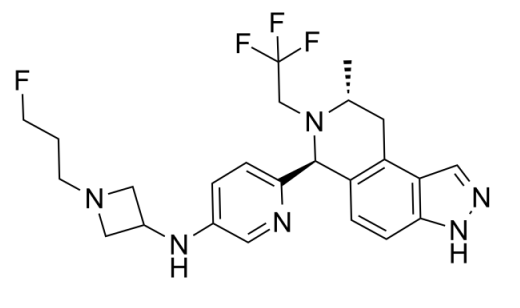
Chemical Structure of Camizestrant (Source: medchemexpress.cn)
HR-Positive (HR+) Breast Cancer (expressing estrogen or progesterone receptors, or both) is the most common subtype of breast cancer, and the growth of HR+ breast cancer cells is typically driven by estrogen receptors (ER).Endocrine therapies targeting ER-driven diseases are widely used as first-line treatments for advanced breast cancer, often in combination with cyclin-dependent kinase (CDK) 4/6 inhibitors. However, many patients with advanced disease develop resistance to CDK4/6 inhibitors and current endocrine therapies, leaving limited treatment options. Optimizing endocrine therapy and overcoming resistance in all treatment phases for patients with ER-driven breast cancer remains a key focus of breast cancer research.
Camizestrant is a potent, next-generation oral SERD and pure ERα antagonist that has demonstrated anticancer activity in a range of preclinical models, including those with ER-activating mutations.
SERENA-1 Phase I trial shows that camizestrant is well-tolerated and exhibits favorable anti-tumor properties when used alone or in combination with the CDK4/6 inhibitor Ibrance (Chinese trade name: Ai Bo Xin, generic name: palbociclib, Pfizer-developed). Combination testing of camizestrant with other drugs in the SERENA-1 trial is currently ongoing.
AstraZeneca has developed an extensive clinical development program for camizestrant, including the pivotal SERENA-6 Phase 3 trial, which is being conducted in HR+ metastatic breast cancer patients with detected ESR1 mutations in first-line treatment, aiming to evaluate the efficacy of camizestrant in combination with the CDK4/6 inhibitor Ibrance (palbociclib) or Verzenio (abemaciclib, developed by Eli Lilly). The SERENA-4 Phase 3 trial aims to assess the efficacy of camizestrant in combination with Ibrance from the start of first-line treatment in HR+ locally advanced or metastatic breast cancer. Among these, the indication developed in the SERENA-6 trial has been granted by the United States.FDAGranted Fast Track Designation (FTD). (Bioon.com)
Source of the original text:Camizestrant significantly improved progression-free survival vs. Faslodex in SERENA-2 Phase II trial in advanced ER-positive breast cancer