

Roche's Bispecific Antibody Vabysmo Demonstrates Positive Phase III Results in Retinal Vein Occlusion

Roche
Oncology Drug Research, Development, and Manufacturing

Genentech
Pharmaceutical R&D Manufacturer

Image Source: Shutterstock
October 31, 2022 /BioValleyBIOON/ -- Roche recently announced positive topline results from two global Phase III clinical studies (BALATON, COMINO). These studies evaluatedBispecific Antibody Vabysmo (faricimab) for the Treatment of Macular Edema Caused by Branch Retinal Vein Occlusion and Central Retinal Vein Occlusion (BRVO and CRVO)。RVO is a vision-threatening disease that affects 28 million people worldwide. Vabysmo is the first and currently the only bispecific antibody approved for ocular treatment.
The aboveBoth studies met the primary endpoint: In treating macular edema caused by BRVO and CRVO, patients receiving Vabysmo once every 4 weeks showed non-inferiority in vision improvement compared to those receiving Eylea (aflibercept) once every 4 weeks, with continuous treatment for 24 weeks.In addition, the change in central subfield thickness (CST) was measured.From baseline to Week 24, Vabysmo treatment also led to a rapid reduction in retinal fluid.In two studies, Vabysmo was generally well-tolerated. The safety profile was consistent with previous trials.
Detailed results from these two studies will be presented at upcoming medical conferences and submitted to regulatory authorities around the world. Levi Garraway, Chief Medical Officer and Head of Global Product Development at Roche, stated: "These encouraging data indicate that,Vabysmo has the potential to provide a new treatment option for patients with retinal vein occlusion (RVO)., which is a serious retinalBlood VesselDisease, may lead to irreversible vision impairment or vision loss. Today'sResults add to the broad evidence supporting the efficacy of Vabysmo in treating various retinal diseases."We look forward to submitting these data to the regulatory authorities."
Vabysmo is the first bispecific antibody approved for ocular treatment.. To date, Vabysmo has beenApproved in more than 40 countries worldwide: For the treatment of neovascular or "wet" age-related macular degeneration (nAMD or wet AMD) andDiabetesVision impairment caused by diabetic macular edema (DME).
Standard care for nAMD and DME typically requires eye injections every 1-2 months. While anti-vascular endothelial growth factor (VEGF) monotherapy injections can significantly reduce vision loss in patients with nAMD and DME, the treatment burden associated with frequent eye injections and doctor visits may lead to undertreatment and could result in less than optimal visual outcomes.
The approval and launch of Vabysmo marks a significant advancement in the treatment of nAMD and DME, with reduced injection frequency compared to current standard care. The long-term efficacy and safety of Vabysmo in treating nAMD and DME have been demonstrated through two-year data from four large-scale global studies involving over 3,000 patients.Vabysmo is the only injectable ophthalmic drug supported by Phase 3 clinical studies that allows treatment intervals of up to 4 months for patients with nAMD and DME.. As time goes by,Vabysmo may require fewer eye injections to improve and maintain vision and anatomical structure.Therefore, Vabymmo can provide a more relaxed treatment plan for patients, caregivers, and the healthcare system.
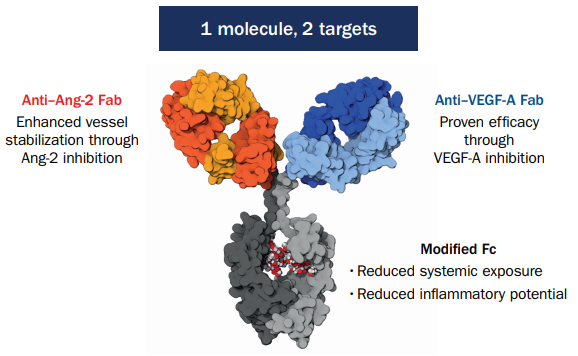
Structural Features of Faricimab (Source: Roche)
Retinal Vein Occlusion (RVO) is the second most common cause of vision loss due to retinal vascular disease, affecting approximately 28 million adults worldwide, primarily those aged 60 or older, and can lead to severe and sudden vision impairment.In RVO, the level of angiopoietin-2 (Ang-2) is elevated, and it is believed that increased Ang-2 expression contributes to disease progression.
RVO usually causes sudden painless blindness in the affected eye, as vein occlusion restricts normal retinal blood flow, leading to ischemia, hemorrhage, fluid leakage, and retinal swelling, known as macular edema. Currently, macular edema caused by RVO is typically treated with repeated intravitreal injections of anti-vascular endothelial growth factor (VEGF) drugs. There are two main types of RVO: (1)Branch Retinal Vein Occlusion (BRVO), affecting more than 23 million people worldwide, occurs when one of the four smaller "branches" of the central main vein of the retina is blocked; (2)Central Retinal Vein Occlusion (CRVO), affecting more than 4 million people worldwide, occurs when there is a central vein occlusion in the retina.
RVO, nAMD, and DME are retinal diseases, all of which are leading causes of vision loss, collectively affecting approximately 70 million people worldwide.
Vabysmo is the first drug designed to target two unique signaling pathways that drive retinal diseases, with its active pharmaceutical ingredient faricimab being the first bispecific antibody specifically designed for the eye. Unlike current DME and nAMD treatments that inhibit the VEGF pathway,Faricimab targets two different pathways—through angiopoietin-2 (Ang-2) and vascular endothelial growth factor A (VEGF-A), which drive multiple vision-threatening retinal diseases (including RVO, nAMD, DME).
Ang-2 and VEGF-A lead to vision loss by disrupting vascular stability, causing the formation of new leaky blood vessels, and increasing inflammatory responses.。By simultaneously blocking these two pathways, faricimab aims to stabilize blood vessels and reduce inflammation and leakage more effectively than inhibiting either pathway alone.This may improve vision more effectively than using anti-VEGF therapy alone, thereby reducing the frequency of required eye injections. (Bioon.com)
Source of the original text:Positive topline phase III results show Roche's Vabysmo improved vision for people living with retinal vein occlusion (RVO)