

Roche Showcases Subcutaneous Anti-HER2 Breast Cancer Therapies with 2–5 Minute Administration at CIIE

Roche
Oncology Drug Research, Development, and Manufacturing
Roche Collaborates with Multiple Parties to Showcase Scientific and Innovative Achievements in Breast Cancer in China
ShanghaiNovember 6, 2022PR Newswire -- Today, the event titled "A New Era of Healing Her: Release Conference on the Achievements of China's Breast Cancer Scientific Management" was successfully held at the Roche booth during the 5th China International Import Expo in Shanghai. In addition to presenting the interim results of China’s innovative breast cancer scientific management project, Roche's classic HER2-positive breast cancer drug, Herceptin, was also highlighted.®, and Herceptin®Combined with Perjeta®Two subcutaneous injectable formulations also made a collective appearance. These two new subcutaneous injectable formulations can reduce the current infusion time from one to several hours to about 5 minutes, greatly improving the treatment experience for breast cancer patients.
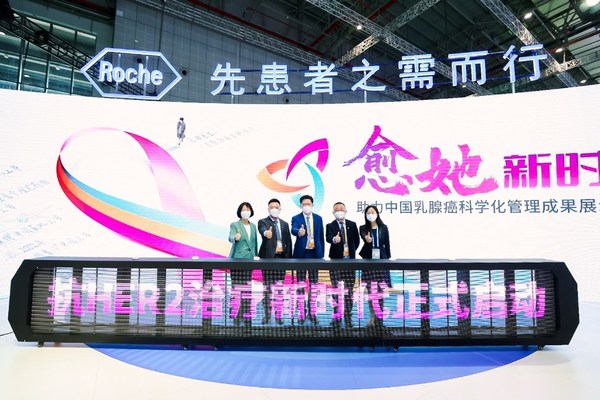
"New Era of Healing She" CIIE Launch Ceremony
"Her Healing" 20 Years: Driving the Continuous Development of Breast Cancer Diagnosis and Treatment in China
According to the latest statistics, breast cancer surpassed lung cancer in 2020 to become the cancer with the highest number of new cases globally, increasing at an annual rate of 0.5%. Breast cancer is also the malignant tumor with the highest incidence among women in China, with an incidence rate of 42.55 per 100,000 people, growing at an annual rate of 205%, and approximately 117,000 deaths from breast cancer each year.[1], and the age of onset of breast cancer in China (peak incidence 45-55 years old) is much earlier than in Western countries (after 65 years old).
HER2-positive is an important subtype of breast cancer, characterized by high malignancy, high recurrence and metastasis rates, and a propensity for lymph node metastasis, leading to a poor prognosis. It accounts for approximately 20% of all breast cancer cases. Twenty years ago, there were almost no effective treatments available for patients with HER2-positive breast cancer. In 1998, Herceptin (Trastuzumab)...®The development and introduction of [drug name] have transformed the treatment landscape for HER2-positive breast cancer, ushering in a new era of targeted breast cancer therapy. Over the past 20 years, advancements in technology have continuously improved anti-HER2 treatments, with innovative drugs constantly emerging, particularly in recent years with the advent of Perjeta.®、Hercelai®With the approval and launch of innovative drugs in China, new treatment options are gradually rewriting the fate of Chinese breast cancer patients and their families.
Although breast cancer has consistently ranked first among malignant tumors in women, advancements in technology and continuous upgrades in diagnostic and treatment models have made it possible to cure early-stage breast cancer. The management of mid- to late-stage breast cancer is increasingly resembling chronic disease care. Taking HER2-positive breast cancer as an example, current anti-HER2 targeted therapies can now cover neoadjuvant treatment before surgery, adjuvant treatment after surgery, and advanced-stage treatment for HER2 patients, providing comprehensive protection throughout the patient's journey.
Empowered by Healthy China, Guiding a New Direction for "Healing Her"
In June 2019, to accelerate the achievement of the goals and tasks for building a Healthy China proposed in the "Healthy China 2030" Plan Outline, the State Council issued the "State Council's Opinions on Implementing the Healthy China Initiative." Subsequently, the Healthy China Action Promotion Committee simultaneously released the "Healthy China Action (2019-2030)," introducing 15 special actions, including the popularization of health knowledge and cancer prevention and treatment. Former Health Minister Gao Qiang pointed out that health is an essential requirement for promoting the comprehensive development of humanity and a fundamental condition for economic and social development. The Communist Party of China has always placed the maintenance of people's health in an important position. Making Healthy China a national strategy reflects the high importance attached to people's health by the CPC Central Committee and the State Council.
Mao Qun'an, Deputy Director of the Office of the Healthy China Action Promotion Committee and Director of the Planning, Development, and Information Technology Department of the National Health Commission, stated that the Healthy China Action has proposed requirements to focus on the entire population and the entire life cycle of medical and health services. According to the principles of prevention first, moving the focus forward, and combining prevention with treatment, attention is paid to the main factors affecting health, and efforts are increased to prevent and control major chronic diseases, including cancer.
As Breast Cancer Treatment Options Increase, Promoting Standardized Treatment Nationwide—Especially Advanced Concepts Like Neoadjuvant Therapy and Breast-Conserving Surgery in Hospitals Across China—Is Key to Reducing Recurrence and Achieving Cure for Patients. In April this year, the Chinese National Health Association, Health News, and the Breast Cancer Professional Committee of the Chinese Anti-Cancer Association jointly launched the China Breast Cancer Scientific Management Promotion Project.
Wu Yingping, President of the Chinese National Health Association, stated: "Empowering Specialty Development, Co-creating Healthy China – The Breast Cancer Scientific Management Promotion Project" is a nationwide initiative guided by the Medical Administration Department of the National Health Commission, organized by the Chinese National Health Association and the Health News, and undertaken by the Breast Cancer Professional Committee of the Chinese Anti-Cancer Association and the Breast Cancer Expert Committee of the National Tumor Quality Control Center, with support from Roche Pharmaceuticals China. Since its launch in Beijing this April, the project has carried out standardized specialty development training and patient education activities across various regions in China, effectively enhancing healthcare professionals' awareness and proficiency in standardized breast cancer diagnosis and treatment, achieving remarkable results.
Deng Haihua, Publisher of Health News, stated: Currently, the public still lacks sufficient knowledge about breast health and the diagnosis and treatment of breast cancer. Therefore, it is the mission and responsibility of Health News to strongly advocate for healthy and scientific methods of breast cancer prevention and treatment across all of China, and to help implement standardized breast cancer diagnosis and treatment models nationwide, benefiting more breast cancer patients. It is hoped that through the promotion and dissemination of this project, it will contribute to guiding the orderly development of standardized breast cancer treatment in China.
Professor Wu Jiong, Vice President of Fudan University Cancer Hospital and Chairman of the Breast Cancer Professional Committee of the Chinese Anti-Cancer Association, shared the project achievements as the leading expert of the initiative: The Breast Cancer Scientific Management Promotion Project focuses on the improvement of medical diagnosis and treatment technologies across various regions. Currently, 300 hospitals from 30 provinces and municipalities in China are participating in this project. Through preliminary training, the capacity for breast specialty development in hospitals nationwide is gradually strengthening. Meanwhile, a national online platform for breast cancer disease education has been officially launched, supporting more than 10,000 breast cancer patients in China to receive standardized diagnosis and treatment, further enhancing the development of high-quality medical resources across the country.
Classic Renewal, Opening a New Chapter of "Healing Her"
At this year's CIIE, Roche's original classic anti-HER2 product Herceptin in subcutaneous injection form, as well as the subcutaneous injection form Phesgo combining Herceptin and Perjeta, were also collectively showcased.
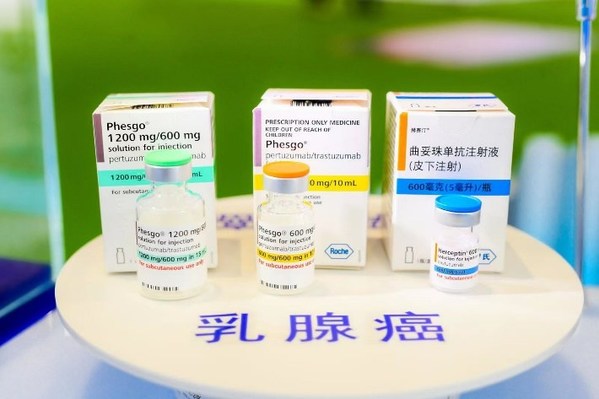
Subcutaneous formulation of Herceptin and subcutaneous formulation of Herceptin combined with Perjeta (Phesgo)
Breast cancer patients undergoing anti-HER2 therapy often experience long treatment courses. Currently, drugs such as Herceptin and Perjeta cover treatments from neoadjuvant therapy, adjuvant therapy, to first-line or second-line therapy for advanced stages. Prolonged hospitalization for intravenous infusion has brought significant inconvenience to many patients' treatment and increased the risk of potential in-hospital infections. In early October, with the launch of the new Herceptin...®(General Name: Trastuzumab Injection (Subcutaneous Injection)) has been approved in China, marking the beginning of a new treatment model in the field of breast cancer treatment.
Professor Wu Jiong, Vice President of Fudan University Cancer Hospital and Chairman of the Breast Cancer Professional Committee of the Chinese Anti-Cancer Association, emphasized: Trastuzumab remains the cornerstone of HER2-positive breast cancer treatment. The advantage of subcutaneous injection of Herceptin is that the hyaluronidase in the formulation can temporarily reduce the viscosity of the intercellular matrix, promoting rapid diffusion and absorption of the drug, with administration completed in just 2-5 minutes. Additionally, the subcutaneous formulation is a fixed dose, eliminating the need for dose calculations based on each patient’s weight every time, greatly facilitating patients and medical staff, and making outpatient treatment for breast cancer possible.
Currently, Phesgo, the world's first subcutaneous combination formulation for HER2-positive breast cancer containing pertuzumab, trastuzumab, and hyaluronidase, is undergoing Phase 3 clinical trials in China. The administration of the fixed-dose combination Phesgo is simple, significantly reducing injection time from several hours to about 5 minutes. While ensuring survival benefits for breast cancer patients, it greatly enhances the convenience and comfort of treatment, which is an advantage that becomes even more prominent in the context of the ongoing normalization of the pandemic.
Professor Jiajia Qiu, Deputy Director of the Nursing Department and Associate Chief Nurse at the Cancer Hospital Affiliated to Fudan University, stated: Compared with intravenous infusion of trastuzumab, which takes 30-90 minutes, subcutaneous administration is less invasive, reduces pain, and offers higher safety. Moreover, the subcutaneous administration time (2-5 minutes) and observation period (15 minutes) are shorter, reducing the risk of infection, thrombosis, and phlebitis associated with long-term indwelling venous access, significantly alleviating patient discomfort and easing the pressure on healthcare workers at infusion centers.
Qian Wei, General Manager of Roche Pharma China Customer Interaction Business Model - Oncology Division, stated: "Guided by the principle of 'acting on patients' needs first,' Roche has long been committed to the field of breast cancer. We are currently conducting drug research and development in HR-positive breast cancer and triple-negative breast cancer, including PI3Kα inhibitor Inavolisib, oral SERD Giredestrant, and PD-L1 inhibitor Atezolizumab. Moving forward, we will continue to collaborate with all parties, increasing innovation efforts across various subtypes of breast cancer treatment through personalized medicine to meet the unmet needs of a broad population of breast cancer patients."
[1] https://www.iarc.fr/faq/latest-global-cancer-data-2020-qa/All data in the article are from: International Agency for Research on Cancer, World Health Organization