Sotorasib Sales Rebound: Can KRAS Targeting Redefine the Future of Cancer Therapy?

Amgen
Developer of Treatment Drugs for Serious Diseases
Recently, Amgen released its third-quarter financial report for this year. After a brief slowdown in growth in the second quarter, the growth of Sotorasib in the United States rebounded, achieving a revenue of $61 million in Q3, a significant increase from $51 million in Q2.
On May 28, 2021, the U.S. FDA approved Amgen's Sotorasib for marketing, marking the first targeted KRAS drug available to humanity, breaking the long-held belief that the KRAS target was undruggable for nearly 40 years. This FIC new drug is naturally highly anticipated by Amgen as an important growth driver in the coming years.
As research progresses further, an increasing number of KRAS inhibitors are entering clinical trials. KRAS mutations were among the earliest discovered oncogenic factors, and the development targeting this site has faced repeated setbacks. The approval of Sotorasib undoubtedly marks a new era in the treatment of KRAS mutation-related cancers.
How do KRAS mutations cause cancer?
RAS is a member of the small GTPase superfamily. There are four RAS proteins in the human body: HRAS, NRAS, KRAS4A, and KRAS4B. Among them, KRAS4A and KRAS4B are two isoforms of KRAS, produced by alternative splicing of the same gene.
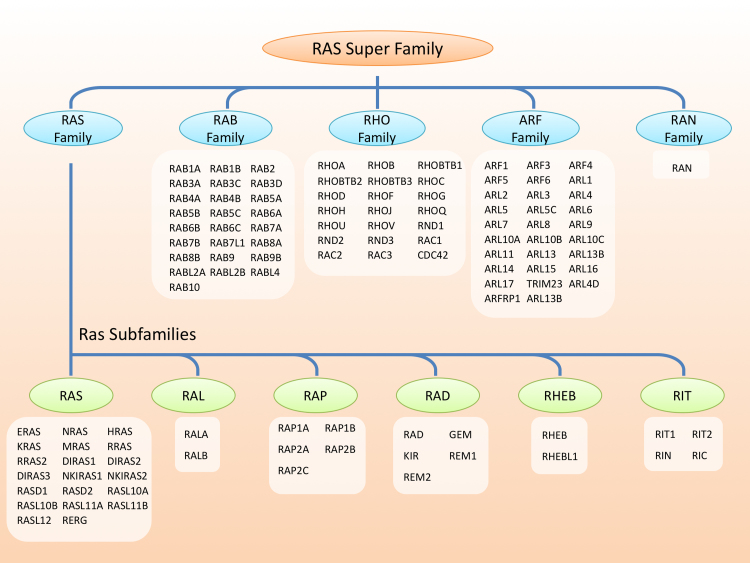
RAS Superfamily
Image source: Acta Pharm Sin B. 2018 Jul;8(4):552-562. doi: 10.1016/j.apsb.2018.01.008.
KRAS is a GTP-binding protein. KRAS cycles between the active KRAS-GTP state and the inactive KRAS-GDP state, a process activated by upstream RTKs and regulated by a series of cytokines. Guanine nucleotide exchange factors (GEFs, such as SOS) catalyze the binding of KRAS to GTP, thereby promoting KRAS activation; GTPase-activating proteins (GAPs) hydrolyze the bound protein on KRAS into GDP, thus inactivating KRAS.
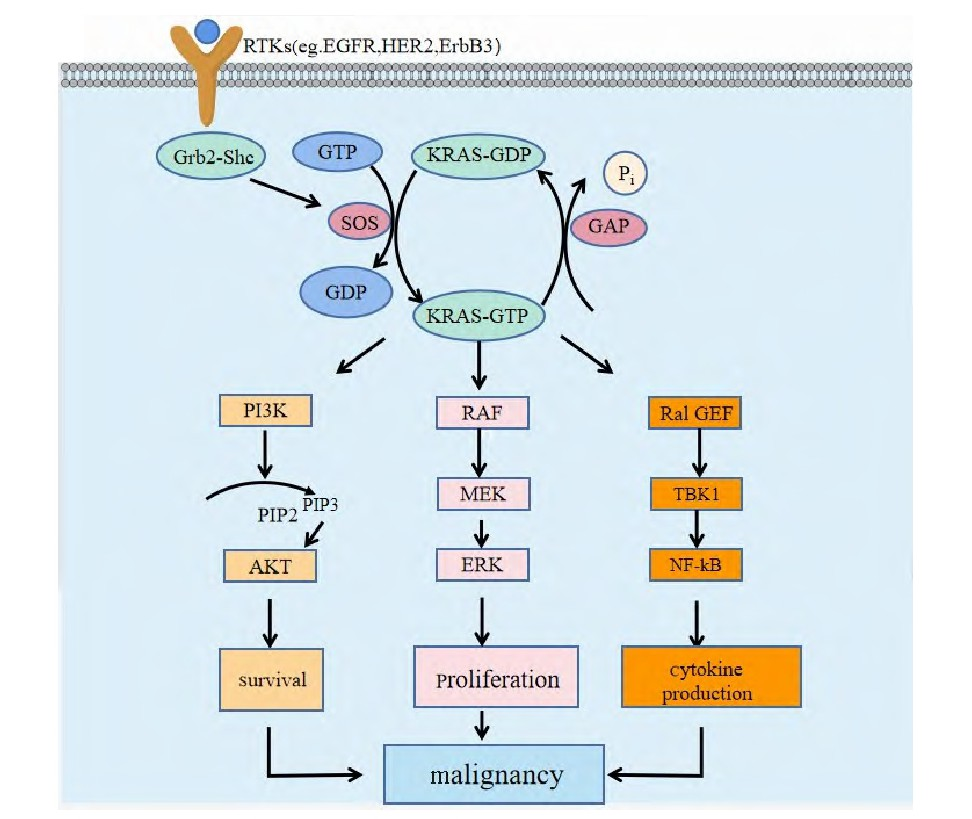
KAS-GTP Cycle and Its Downstream Signaling Pathway
Source of the image: Advances in Research and Application of KRAS Small Molecule Inhibitors [J]. Journal of Clinical Medication, 2022, 20(03): 13-21.
In normal cells, the activated state of KRAS can activate multiple downstream cellular signaling pathways such as PI3K, MAPK, and NF-κB. These signaling pathways play crucial roles in cell growth, differentiation, and proliferation. When the KRAS gene mutates, the binding of KRAS to GAP is affected, inhibiting the hydrolysis of GTP and leading to the continuous accumulation of GTP-bound KRAS. This results in the abnormal activation of multiple downstream signaling pathways, stimulating sustained cell growth and ultimately leading to tumorigenesis.
KRAS mutation is one of the most common drivers of human tumor development.
RAS mutations or amplifications are common in human cancers, with KRAS mutations being one of the most frequent drivers of human tumor development, first reported as early as 1982. KRAS mutations mainly concentrate on codons 12, 13, and 61. Approximately 17% of solid tumors harbor KRAS mutations, including about 90% of pancreatic cancers, around 50% of colorectal cancers, and roughly 25% of lung adenocarcinomas. NRAS mutations are more frequently observed in melanoma and hematologic malignancies. Due to the widespread presence of KRAS mutations in solid tumors, KRAS has become one of the potential targets for cancer therapy.
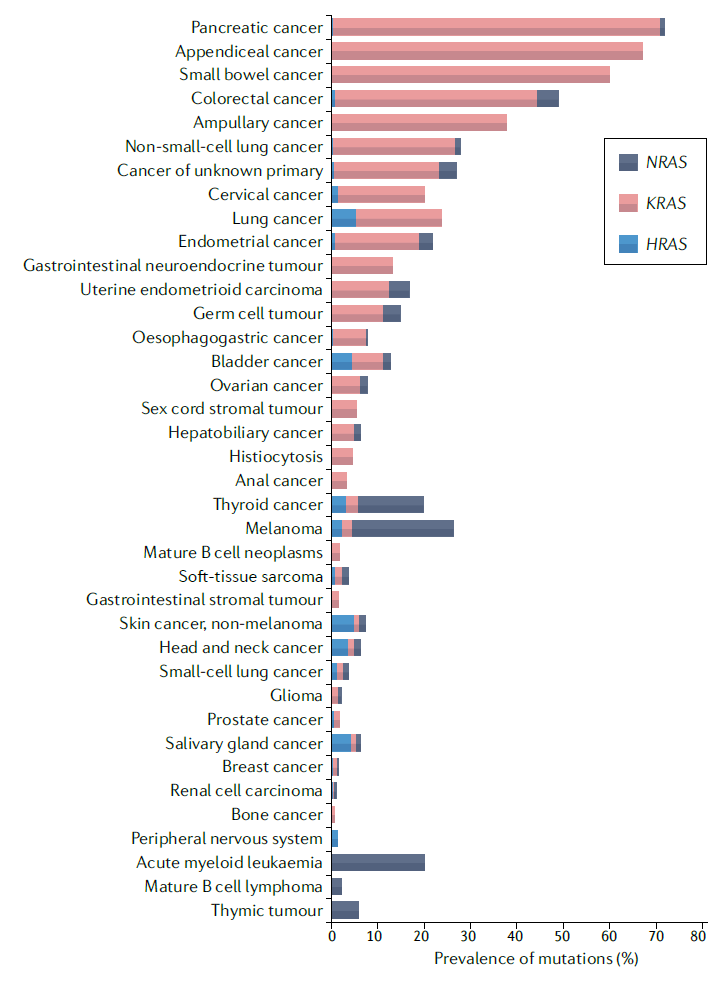
Proportions of Different RAS Mutations in Human Cancers
Image source: The current state of the art and future trends in RAS-targeted cancer therapies. Nature Reviews Clinical Oncology.
Why Is It Difficult to Target KRAS?
KRAS Mutation: The Driving Cause of Cancer Discovered 40 Years Ago
Structural Biology Breaks the Conclusion that KRAS is Undruggable
For decades, researchers have failed in the study of KRAS inhibitors. Discoveries in structural biology have brought new insights, and the analysis of the crystal structure of the KRAS protein has become more detailed. In 2013, Shokat et al. discovered an unknown "switch-II pocket" on KRAS. After binding to this region, inhibitors can induce KRAS to adopt an inactive conformation, thereby blocking intracellular signal transduction. The switch II region is highly deformable, and the cysteine in the KRAS G12C mutant protein provides a potential covalent binding site. The aspartic acid in the KRAS G12D mutant protein can form a salt bridge, making it possible to target KRAS mutations.
Current Status of KRAS(OFF) Allosteric Modulator Research and Development
Based on the aforementioned theory, ARS-853, ARS-1620, and all KRAS G12C inhibitors that have entered clinical trials, including sotorasib and adagrasib (the second KRAS G12C inhibitor to enter clinical trials, currently in the application stage for market approval), were developed. On May 28, 2021, the U.S. FDA approved Amgen's Sotorasib, marking the first targeted KRAS drug available to humanity.
In addition, Roche, Novartis, Eli Lilly, and Yifang Biotechnology all have drugs targeting KRAS G12C. A compound targeting KRAS G12D, MRTX1133, is currently in preclinical research.
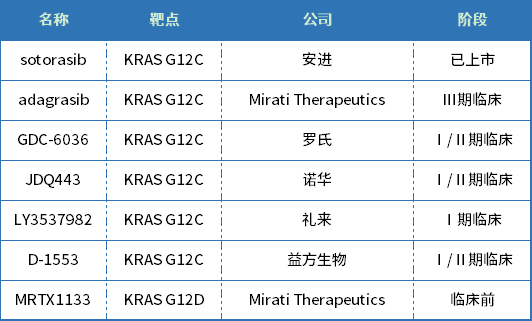
Data Source: Collated from public information
KRAS (ON) Inhibitors Might Be More Effective?
KRAS G12C inhibitors, including Sotorasib, all work by converting the active state of KRAS into an inactive conformation. However, during this transition, KRAS in the active conformation still exists. So, is it possible to directly target the active conformation of KRAS? Researchers have found that when KRAS in the active state binds with Cyclophilin A, it forms a temporary drug-binding pocket. Targeting this binding pocket can prevent the active conformation of KRAS from exerting its biological effects, thereby blocking downstream signal transduction.
Based on this strategy, Revolution Medcines' RMD-6291 is planned for IND submission. Research results show that 25 mg/kg of RMD-6291 is as effective as 100 mg/kg of Adagrasib. Although the mechanisms of the two drugs are different, it is possible that RMD-6291 could surpass Adagrasib.
How to Address Resistance to KRAS Inhibitors?
Tumor heterogeneity makes resistance to small molecule inhibitors inevitable, and the complexity of the KRAS pathway along with the diversity of KRAS mutations make KRAS inhibitors even more prone to resistance. The two inhibitors currently showing faster progress both bind to amino acid residues on KRAS G12C, and secondary mutations in KRAS can lead to acquired resistance to these two drugs more easily. The downstream MAPK signaling pathway of KRAS has self-regulating activation pathways, and the activation of other bypass signals such as MET and ALK can also lead to adaptive resistance. Resistance to Sotorasib monotherapy has already appeared in NSCLC patients.
PROTAC drugs for targeted protein degradation and combination therapies are two major directions to overcome KRAS resistance. Targeting RAF, MEK, and ERK downstream of RAS can significantly enhance the efficacy of KRAS inhibitors, and studies on combinations with PI3K, mTOR, and PD-1 inhibitors are also underway.
The上市 of KRAS inhibitors fills in the last piece of the puzzle for targeted KRAS signaling pathway anticancer therapy. In the future, combination therapies involving KRAS inhibitors with downstream target inhibitors or immune checkpoint inhibitors may become standard treatment options for KRAS-mutant tumors. We look forward to new treatment landscapes emerging as targeting KRAS technology continues to evolve.

Editor: Liuli
Disclaimer: The views expressed in this article are solely those of the author and do not represent the position of Pharma Intelligence. We welcome discussions and additional insights in the comment section; for reprints, please be sure to credit the author and source. If there are any issues related to the content, copyright, or other aspects of the work, please leave a message on this platform, and we will remove it promptly.