

Gepotidacin Demonstrates Significant Efficacy in Two Pivotal Phase 3 Trials for Uncomplicated Urinary Tract Infection (uUTI)

GSK
Pharmaceutical R&D Manufacturer

Image Source: Shutterstock
News on November 07, 2022 / BIOON / -- GSK recently announced, based on the recommendation of the Independent Data Monitoring Committee (IDMC), the evaluationNew TypeAntibioticsGepotidacin for the Treatment of Uncomplicated Urinary Tract Infections (uUTI, Acute Cystitis) in Adult and Adolescent FemalesThe pivotal Phase 3 EAGLE-2 and EAGLE-3 trials,Due to significant efficacy, the enrollment will be stopped early.This decision was based on the pre-specified interim analysis results of efficacy and safety data from more than 3,000 patients in these trials.
GSK Plans to Submit a New Drug Application (NDA) for Gepotidacin to the U.S. Food and Drug Administration (FDA) in the First Half of 2023.Gepotidacin has the potential to become the first new oral antibiotic for the treatment of uUTI in over 20 years.
EAGLE-2 and EAGLE-3 are two similar non-inferiority trials.,Conducted in adult and adolescent female patients diagnosed with uUTI and with urinary pathogens sensitive to nitrofurantoin, comparedGepotidacin (1500mg, orally twice daily for 5 days) versus the first-line antibiotic nitrofurantoin (100mg, orally twice daily for 5 days)The efficacy and safety. The patient trial lasted approximately 28 days. The primary efficacy endpoint was the overall response (clinical cure + pathogen eradication) at the Test-Of-Cure (TOC) visit in patients qualifying with uropathogens.
The results showed,Both trials met the primary efficacy endpoint: at the TOC follow-up, the gepotidacin treatment group demonstrated non-inferiority in overall response compared to the nitrofurantoin treatment group.IDMC review found no safety issues.
EAGLE-2 and EAGLE-3 trials have now stopped recruiting patients, with the final study visit and data collection expected in the first quarter of 2023. GSK will work with regulatory authorities to initiate regulatory submissions for gepotidacin in the first half of 2023.
GSK's Senior Vice President of Development, Chris Corsico, stated: "Uncomplicated urinary tract infection (uUTI) is the most common outpatient infection.More than half of women will experience uUTI in their lifetime, and over a quarter of women suffer from recurrent uUTI.For more than 20 years, there has been no new oral antibiotic for uUTI."With the increase in the number of uUTIs caused by drug-resistant bacteria, new antibiotic treatments are necessary. The IDMC recommended early termination of enrollment in the EAGLE-2 and EAGLE-3 trials due to efficacy, providing GSK with an opportunity to collaborate with regulatory authorities to bring a new antibiotic to patients with uUTIs."
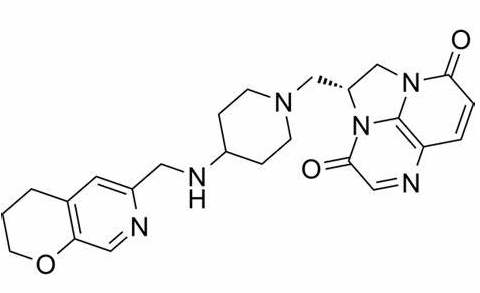
Gepotidacin Molecular Structure (Image Source: medchemexpress.com)
uUTI is one of the most common infections in the community.The annual incidence rate of uUTI (or acute cystitis) in women is 12%., about 20% of women over 65; 30-44% of uUTI episodes are recurrent.E. coli is the primary cause of uUTI., but it shows an increasing resistance to currently used antibiotics, which leaves healthcare providers with fewer oral treatment options for patients. Therefore, it is necessary to develop new oral antibiotics to help treat uUTI and potentially combat antibiotic resistance (AMR) in the community, especially considering that no novel oral antibiotics for uUTI have been marketed in over 20 years.
Gepotidacin is a novel oral antibiotic belonging to the triazaacenaphthylene bacterial topoisomerase inhibitors, which inhibits bacterial DNA replication through a unique mechanism of action. Gepotidacin works by selectively interacting with two key bacterial enzymes responsible for bacterial DNA replication — DNA gyrase and topoisomerase IV (both are type II topoisomerases).
Gepotidacin has a novel "dual-targeting" mechanism of action (MOA), distinct from any currently approved antibiotic.Gepotidacin can equally and independently bind to two different type II topoisomerases (DNA gyrase and topoisomerase IV), providing activity against most strains of *E. coli* and *S. saprophyticus*, including strains resistant to current antibiotics.Due to its equal and independent binding affinity for both enzymes, mutations in both type II topoisomerases in bacteria are required to significantly affect the sensitivity to tepotinib.
The development of gepotidacin is the result of a successful public-private partnership between GSK, the Biomedical Advanced Research and Development Authority (BARDA) under the U.S. Department of Health and Human Services, and the U.S. Department of Defense's Defense Threat Reduction Agency (DTRA). This collaboration, which began in 2013, aims to support the research and development of several antibiotics to combat antimicrobial resistance and bioterrorism. (Bioon.com)
Source: EAGLE-2 and EAGLE-3 Phase III Trials for Gepotidacin Stopped Early for Efficacy Following Pre-Planned Interim Analysis by Independent Data Monitoring Committee