

Novartis' Innovative 'Cholesterol-Lowering Injection' Leverages Nobel-Prize-Winning siRNA Technology to Benefit Chinese Patients Ahead of Schedule

Novartis
Drug Development and Manufacturing
Two injections a year * inject new vitality, supporting the management of cardiovascular disease risk factors
ShanghaiNovember 8, 2022PR Newswire -- The 5th China International Import Expo (hereinafter referred to as "CIIE") is in full swing. The innovative "cholesterol-lowering injection" at the Novartis booth, known as Inclisiran, the world’s first small interfering RNA (siRNA) cholesterol-lowering therapy, has attracted many visitors. Since its debut at last year’s CIIE, driven by the "spillover effects" of the CIIE and favorable national policies encouraging the "pilot adoption" of innovative drugs and medical devices, this groundbreaking cholesterol-lowering product has been introduced in Hainan Boao Lecheng International Medical Tourism Pilot Zone (hereinafter referred to as "Hainan Boao Lecheng") and multiple medical institutions in the Guangdong-Hong Kong-Macao Greater Bay Area, benefiting over a thousand Chinese patients with hyperlipidemia ahead of schedule.
10Ren Zhong4Abnormal Blood Lipids in Humans, Yet the Control Rate is Insufficient10%
Cardiovascular diseases are the "number one killer" that have long threatened the health of residents in China, and hyperlipidemia is one of the independent risk factors for atherosclerotic cardiovascular disease (ASCVD). The increase of low-density lipoprotein cholesterol (LDL-C) in blood lipids can lead to deposition on the vascular wall, easily forming vascular plaques, which is also one of the main reasons for triggering adverse cardiovascular events such as myocardial infarction and cerebral infarction.
Statistics from the National Center for Cardiovascular Diseases show that the population with dyslipidemia in China has exceeded 400 million. Meanwhile, the prevalence of dyslipidemia among people aged 18 and above is as high as 40.4%.[1], the issue of dyslipidemia is particularly prominent among entrepreneurs: The "2018 Chinese Entrepreneurs Health Green Paper" shows that in the sample group of entrepreneurs, the incidence of dyslipidemia is as high as 58.8%, far exceeding the national level.[2]。
However, the treatment rate and control rate of patients aged 18 and above with dyslipidemia in China are only 19.5% and 8.9%, respectively.[3]Professor Chen Zhenyue, Chief Physician of the Department of Cardiology at Ruijin Hospital, Shanghai Jiao Tong University School of Medicine, reminded: "The main components of blood lipids are cholesterol and triglycerides. For example, the threshold for total cholesterol to trigger coronary heart disease is 160 millimoles. Once it accumulates to 160 millimoles, coronary heart disease may be triggered. How to prevent or delay reaching this level? Lowering cholesterol levels can delay the onset of coronary heart disease by ten or twenty years, or even prevent it for life. The most important thing is to control the cumulative exposure of low-density lipoprotein cholesterol in total cholesterol, which is the culprit of the disease. This way, the onset of atherosclerosis, myocardial infarction, and cerebral infarction can be postponed."
Professor Chen Zhenyue further introduced, "Statins are the mainstream cholesterol-lowering drugs currently used, with moderate-intensity statins typically being the initial treatment. If the target is not met, other drugs can be combined or high-intensity statins can be used. However, the Chinese population is more prone to statin-related myopathy and elevated liver enzymes when using high-dose statins compared to other ethnic groups. Therefore, most people in China use moderate-dose statins for treatment, and medication adherence is also suboptimal. It is quite common for single-drug statin therapy to show unsatisfactory lipid control."
Nobel Prize Technology Empowers Innovative Therapy to Open a New Era of Lipid Management
For Chinese patients with dyslipidemia who require lifelong medication to prevent cardiovascular adverse events, there is a need for a novel disease management model that can effectively control blood lipids. Professor Yao Qiheng, Assistant Dean of the University of Hong Kong Shenzhen Hospital and Director of the Department of General Cardiology, explained: "Inclisiran, this innovative drug exhibited at the CIIE, has now been approved for use at the University of Hong Kong Shenzhen Hospital. It is the world's first small interfering nucleic acid drug for lowering cholesterol, which precisely targets the liver and continuously reduces LDL-C levels in the blood by initiating regulatory mechanisms within biological cells. After the initial injection and another at the third month, patients only need to receive treatment twice a year to achieve a sustained reduction of LDL-C by more than 50%."[4],[5]Inclisiran is expected to simplify the existing lipid management model and reduce the occurrence of cardiovascular and cerebrovascular events in patients.
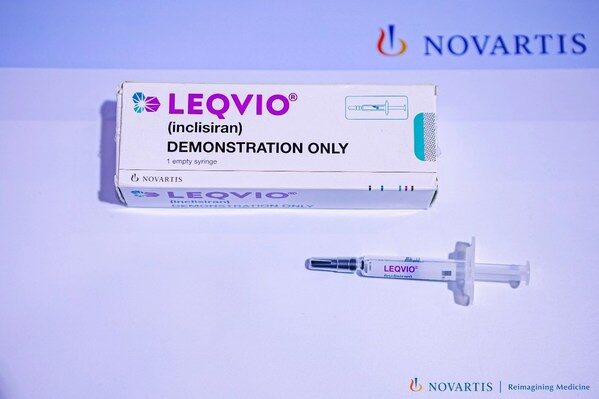
The World's First Small Interfering RNA (siRNA) Cholesterol-Lowering Innovative Therapy Inclisiran
Inclisiran was approved in the EU in December 2020 and gained widespread attention after its debut at the CIIE in November 2021. Benefiting from the early implementation pilot policy, it has now been implemented in several medical institutions, including Boao Super Hospital in Boao Lecheng, Hainan, Ruijin Hospital Hainan, Boao Yiling Life Care Center, as well as The University of Hong Kong Shenzhen Hospital, Guangzhou United Family Hospital, and Zhongshan Chen Xinghai Hospital in the Guangdong-Hong Kong-Macao Greater Bay Area.
Zhang Ying, President of Novartis Innovative Drugs China, emphasized: "The CIIE is an excellent two-way communication platform for us. On one hand, it showcases our commitment to ‘bringing global innovation to China,’ and on the other hand, it promotes collaboration and connectivity, advancing the development of China’s healthcare system and market. Inclisiran received significant attention at its debut at the CIIE. Thanks to the pilot policies in Boao and the Greater Bay Area, more than a thousand patients with abnormal blood lipids in China have already benefited in advance. We will also accelerate its market launch plan in China to help more Chinese people suffering from abnormal blood lipids enjoy a healthy life."
[1] Disease Prevention and Control Bureau of the National Health and Family Planning Commission. Report on the Nutritional and Chronic Disease Status of Chinese Residents (2015) [M]. Beijing: People's Medical Publishing House, 2016:56.
[2] 【Focus】Emphasize the Health Management of Entrepreneurs: "China Entrepreneur Health Green Paper" Released https://www.sohu.com/a/215472357_754763
[3] Pan L, Yang Z, Wu Y, et al. The prevalence, awareness, treatment and control of dyslipidemia among adults in China[J]. Atherosclerosis, 2016, 248: 2–9. DOI: 10.1016/j. atherosclerosis.2016.02.006.
* After the initial injection and the injection treatment at the third month, patients only need to receive treatment twice a year to reduce blood lipids.
[4] Raal F, Kallend D, Ray K, et al. Inclisiran for Heterozygous Familial Hypercholesterolemia. N Engl J Med. 2020;382(16):1520–1530.
[5] Ray K, Wright R, Kallend D, et al. Two Phase 3 Trials of Inclisiran in Patients with Elevated LDL Cholesterol. N Engl J Med. 2020;382(16):1507–1519.