Inhaled Vaccines Are Here—How Much Longer Until mRNA COVID-19 Vaccines Arrive?

BioNTech
Developer of Novel Biologics

BioNTech Pharmaceuticals Asia Pacific
Drug Developer

Novartis
Drug Development and Manufacturing
Since Shanghai officially launched the inhaled COVID-19 vaccine booster shot on October 26, the stock price of CanSino has been as volatile as a roller coaster, with a surge of 63.38% at times and a plunge of 34.75% at others.
The extreme expression of people's repressed and irritable emotions was showcased in the dramatic ups and downs: losing patience yet secretly hoping that this new COVID-19 vaccine could bring an end to the protracted COVID-19 pandemic.
In fact, in the race for COVID-19 vaccines, products based on various technological routes have basically made their debut. Entering the post-pandemic era, as the global vaccination rate slows down, most of the first-tier participants have already entered a decline phase, and those who failed to keep up—what will remain of them after the merciless wheels of time have passed?
Can it continue to shine?
The inhaled COVID-19 vaccine developed by CanSino has drawn significant attention primarily due to its unique method of administration.
Compared with intramuscular injection, inhalation can stimulate one more type of immune response, namely mucosal immunity. Previously, the World Health Organization (WHO) also recommended this method of immunization through mucosal immunity, stating that the development of vaccines inducing mucosal immunity is the future direction.
Inhaled vaccines can effectively enhance the level of neutralizing antibodies in body fluids while also inducing IgA antibodies in the mucosa of the respiratory tract, addressing the current limitation of vaccines being unable to prevent Omicron infections in the upper respiratory tract.
The reason why CanSino's adenovirus vector COVID-19 vaccine was the first to be developed into an inhalable vaccine is related to its self-developed characteristics: on the one hand, due to the use of an adenovirus vector, it can effectively enter target cells in the lungs and express the target antigen; on the other hand, due to its pharmaceutical properties, the vaccine formulation can be aerosolized using a mesh vibrating nebulizer without reducing the vaccine's activity.
Currently used inactivated vaccines require aluminum adjuvants, so they cannot form particles of appropriate size through aerosolization devices. Additionally, the structure of mRNA is relatively fragile and prone to deactivation during the aerosolization process, making it unfeasible for inhalation use in the short term.
This inhaled COVID-19 vaccine was approved by the National Medical Products Administration on September 4 for emergency use as a booster shot. According to previously disclosed information from CanSino, compared with common adverse reactions of intramuscular vaccines, such as headaches, fatigue, and fever, the total occurrence of these reactions significantly decreased in the inhaled vaccine, especially among the elderly. Severe adverse reactions, like fever, dropped to just a fraction of a percent. Twenty-eight days after using the inhaled COVID-19 vaccine as a sequential booster, the cross-neutralizing antibody titer against live Omicron virus was 22.8 times higher than that achieved by a homologous booster with an inactivated vaccine.
This gives the market enough room for imagination. So, will the inhaled COVID-19 vaccine bring another glorious performance to CanSino?
Previously, CanSino Bio successfully turned a profit thanks to the dividends from its COVID-19 vaccine "Convidecia." In 2021, CanSino Bio reported revenue of 4.3 billion yuan, with a net profit of approximately 1.914 billion yuan, and its cash reserves reached a record high of 7.5 billion yuan.
However, starting from 2022, CanSino's performance has seen a significant decline.
According to the recently released third-quarter report, CanSino's total revenue for the first three quarters of this year was 7.07 billion yuan, a year-on-year decrease of 77.08%; net profit was -4.74 billion yuan, a year-on-year decrease of 135.57%; and the non-net profit attributable to shareholders was approximately -5.83 billion yuan, a year-on-year decrease of 145.7%. The main reasons were a significant drop in demand for COVID-19 vaccines compared to the same period last year, product price adjustments, and provisions for inventory write-downs due to signs of impairment.
On November 1, CanSinoBIO announced that after Shanghai, the thirteen cities in Jiangsu Province had also started the deployment of inhaled COVID-19 vaccines. Among them, Wuxi City has set up 9 vaccination sites for the inhaled COVID-19 vaccine, and vaccinations can begin at outpatient clinics in mid-November; Huai'an City has 18 vaccination sites. On November 4, Yu Xuefeng, Chairman of CanSinoBIO, stated at the 2022 Yabuli Forum Innovation Annual Conference that the inhaled COVID-19 vaccine developed by CanSinoBIO has recently begun to be used nationwide in China.
As the first of its kind in China, CanSino's inhaled COVID-19 vaccine indeed has the potential to become a "blockbuster" and might even be the "game-changer" for COVID-19 vaccines. If that’s the case, could the prospects for those still in the research and development phase be worrisome?
How long until the mRNA COVID-19 vaccine?
On November 4, German Chancellor announced at a joint press conference with the Chinese Premier that the mRNA COVID-19 vaccine developed by the German company BioNTech would be available for foreigners living in China to receive in the country. Scholz described this as only the "first step" and expressed hope that the scope of beneficiaries of the vaccine in China would expand further in the future.
Indeed, the road to market in China for "Fosun Comirnaty," the mRNA COVID-19 vaccine introduced by Fosun Pharma through an $85 million licensing fee and 35% gross profit sales royalty under the cooperation terms, has been extremely tortuous. In December 2020, Fosun Comirnaty initiated Phase II clinical trials, enrolling a total of 950 participants, primarily studying the vaccine's safety among the healthy population in mainland China. Originally planned to conclude in December 2021, the trial was first postponed to April 2022, and then further delayed to October.
Now, the visit of the German Chancellor to China has made a "small step" contribution to the approval of Comirnaty in China, bringing this star product back into the market spotlight. Pfizer achieved a total revenue of $36.78 billion in 2021 with this vaccine product alone, reclaiming the top position in the global pharmaceutical industry; even though Comirnaty was previously only approved for marketing in Hong Kong, Macao, and Taiwan, it had already become one of Fosun Pharma’s three leading products with over 1 billion in revenue.
During the period when Comirnaty was lying low, we saw a number of vaccine companies in China pushing ahead rapidly with the development of domestically produced mRNA COVID-19 vaccines.
According to statistics, there are more than ten innovative companies in China focusing on mRNA drug development, mainly including Abogen Biosciences, Livanda Biologics, Bluebird Bio, and Stemirna Therapeutics; companies that have developed mRNA COVID-19 vaccines include Walvax Biotechnology, Amoytop Biotech, Stemirna Therapeutics, and CanSino Biologics.
Among them, Walvax Biotech is the fastest in progress.
On November 3, Walvax Biotech announced that the "mRNA Vaccine for SARS-CoV-2 Variants (S Protein Chimera)" jointly developed with Fudan University and Blue鹊 Biotech had recently received the "Ethics Review Approval" for Phase IIIb clinical trials.
And just in September, another mRNA COVID-19 vaccine co-developed by Walvax Biotech and Abogen Biosciences was granted Emergency Use Authorization (EUA) by Indonesia's National Agency of Drug and Food Control.
Amoy Vaccines did not benefit from the previous round of COVID-19 vaccine dividends, which likely caused some anxiety. Thus, in May 2021, it invested 1.042 billion yuan to acquire 50.1546% of Lifanda Bio's equity. Part of the payment was settled with a cash amount of 185 million yuan, while the rest was settled by issuing shares to relevant shareholders of Lifanda Bio.
Lifanda Bio is a star enterprise in the mRNA technology field, focusing on innovative products such as mRNA drugs for infectious disease vaccines, cancer, rare diseases, and other protein-deficiency-related conditions, as well as mRNA beauty and anti-aging solutions. In March 2021, Lifanda Bio's mRNA COVID-19 vaccine received clinical trial approval, becoming the third mRNA COVID-19 vaccine approved for clinical trials in China. It is currently undergoing Phase II clinical trials in China and launched its global Phase III clinical trial in June 2022.
The Phase III clinical trial of the mRNA COVID-19 vaccine (SW-BIC-213) independently developed by Stemirna Therapeutics officially started in Laos on October 16, 2022. This study is a randomized, controlled, double-blind trial designed to evaluate the immunogenicity and safety of the vaccine as a sequential booster shot for healthy individuals aged 18 years and above. Stemirna Therapeutics is the first Chinese company to conduct a Phase III clinical trial of an updated mRNA COVID-19 vaccine overseas. According to observations from Phase I and Phase II clinical trials in Laos, SW-BIC-213 demonstrated good safety, with no serious adverse events or adverse events of special concern reported. Fourteen days after two doses, the neutralizing antibody titers against Omicron were 2.0 times and 3.3 times higher than those in convalescent patient sera for the low-dose group (25 µg) and high-dose group (45 µg), respectively. Additionally, Stemirna Therapeutics has obtained approval for Phase I, II, and III clinical trials in Brazil.
CSPC Group announced in August 2022 that its self-developed mRNA vaccine targeting variants of the novel coronavirus has conducted six clinical studies, including one completed study on sequential booster immunization. The safety and immunogenicity have met expectations, and Phase II clinical trials have now commenced.
CanSino's mRNA COVID-19 vaccine development is proceeding according to plan and is currently in Phase II clinical trials, with the adult group having completed enrollment. A "3+1" sequential clinical trial has also been initiated. Meanwhile, CanSino is constructing an mRNA production base, with the first phase of the project designed for a capacity of 100 million doses, and validation and debugging are expected to take place by the end of this year.
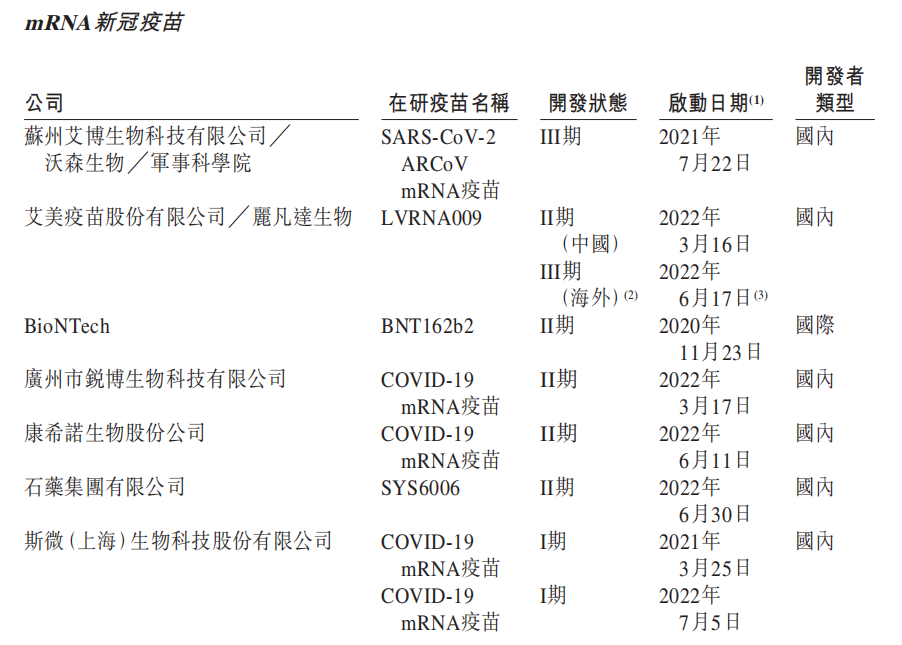
Status of mRNA COVID-19 Vaccine Development in China
Source: AIM Vaccine Prospectus
Such a huge investment also indicates that the approval of mRNA COVID-19 vaccines in China is now unstoppable.
However, according to the latest COVID-19 vaccine inoculation data, as of November 4, 2022, a total of 3.44 billion doses of the COVID-19 vaccine have been administered in 31 provinces (autonomous regions, municipalities) and the Xinjiang Production and Construction Corps. Basic immunization in China was largely completed in 2021, and since this year, the domestic COVID-19 vaccine market has been left with only the booster shot market. As the virulence of the coronavirus gradually weakens, the urgency for COVID-19 vaccine demand is no longer as high. The booster shot market presents certain opportunities but is far smaller than the basic immunization market.
In the face of limited market demand, the substantial investment in mRNA COVID-19 vaccine research poses another serious question for these vaccine companies: how will they recoup their costs in the future?
Conclusion
Currently, the proportion of asymptomatic infections worldwide is very high. Achieving herd immunity through infection or relying on a single vaccine is highly challenging. In terms of maintaining antibody duration and addressing variants, inhaled vaccines offer significant convenience advantages.
The enthusiasm of vaccine companies in China for mRNA vaccines, and their efforts to accelerate the progress of mRNA R&D platform technologies, may indicate ambitions that go beyond COVID-19 vaccines. These could subsequently be used as therapeutic vaccines for anti-tumor vaccines, protein replacement therapies, cell therapies, and more.
The virus is still mutating, and the epidemic prevention policies are also changing accordingly. Nothing is settled yet. We will continue to monitor the subsequent developments.
References:
1. Official websites, announcements, annual reports, etc. of major listed companies
2. "BNT162b2 Clinical Trials Delayed Again! Which Chinese-Produced mRNA Vaccine Will Break Through the Competition?", BioDiscovery, 2022-5-17
3. "A Small Step Forward for 'Comirnaty' Entering China: How Are China-produced mRNA Vaccines Progressing?", Caixin, 2022-11-4
4. "Science and Technology Daily | The World's First Inhaled COVID-19 Vaccine Begins Vaccination!" CanSino Official WeChat, 2022-11-2
5. "One CanSino, Can't Save the Future of COVID-19 Vaccines?", Local Red Sister Knows the World, 2022-10-29

Editor: Dadasiva
Disclaimer: The views expressed in this article are solely those of the author and do not represent the position of Pharma Intelligence Network. We welcome discussions and additional insights in the comment section; for reprints, please be sure to credit the author and source. If the content, copyright, or other issues are involved, please leave a message on this platform, and we will remove it promptly.