

Pfizer Collaborates with Multiple Stakeholders to Build a High-Quality County Healthcare Ecosystem under the 'Thousand Counties Initiative'

Pfizer
Pharmaceutical R&D Developer
ShanghaiNovember 9, 2022PR Newswire -- At the 5th China International Import Expo, Pfizer Global Biopharmaceutical Commercial Group ("Pfizer") held a series of project signings and roundtable forum activities themed "Building a New Ecosystem for High-Quality Development of County-Level Healthcare." In active response to national policies such as "Rural Revitalization" and the "Thousand Counties Project," Pfizer signed strategic cooperation memorandums with the National Health Commission's policy research institutions and the Beijing Science and Innovation Medical Development Foundation. Together, they focused on new opportunities and needs in county-level healthcare development. Initiatives include building the "Five Major Centers" for clinical services under the Thousand Counties Project and cultivating specialized talent. By launching projects like the "County-Level Cancer Prevention and Treatment Center Construction Project," the "China Oncology Young and Middle-Aged Physicians Talent Training Program," and the "High-Quality Development Project for Healthcare and Medical Insurance," Pfizer aims to jointly build a new ecosystem for high-quality development of county-level healthcare and help achieve the overall goals of the "Thousand Counties Project" by 2025.
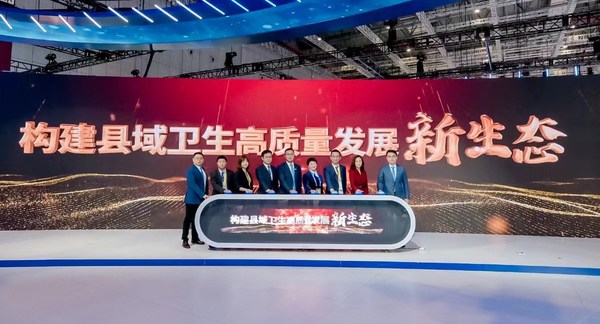
Leaders and experts from relevant departments of the National Health Commission, relevant departments of municipal/county health commissions, medical institutions, county hospitals, and Pfizer attended the signing ceremony and jointly launched the "Building a New Ecosystem for High-Quality Development of County-level Healthcare" initiative.
Peng Zhenke, President of Pfizer's Global Biopharmaceutical Commercial Group in China, stated: "At Pfizer, our mission is to 'bring breakthrough innovations that change patients' lives.' Pfizer is always committed to 'becoming an important part of China’s healthcare system,' and actively participates in promoting the development of China’s healthcare industry. We have carried out many strategic and innovative collaborations with relevant government departments and medical institutions in areas such as disease awareness, capacity building, and health promotion. We hope that by supporting these projects, we can further enhance the key specialty capabilities and operational management levels of county-level hospitals in China, contributing to the continuous improvement of comprehensive capabilities of county hospitals and providing better quality medical services for the people at the county level."
Building a county-level cancer prevention and control center to drive regional collaborative development
The situation of cancer incidence in China is becoming increasingly severe, with an average of 7 people being diagnosed with cancer every minute.[1], and the tumor burden varies significantly, mainly reflected in the higher incidence rate in urban areas than in rural areas, while the mortality rate is higher in rural areas than in urban areas. The reason lies in the lack of quality medical resources in rural areas and relatively poor diagnosis and treatment levels, leading to patients being diagnosed at a later stage, making it difficult to improve survival rates. Therefore, expanding the coverage of screening and early diagnosis and treatment for related tumors, promoting standardized and homogeneous clinical diagnosis and treatment of tumors has become the top priority of China's tumor prevention and control work.
Cancer Prevention and Treatment: "Prevention" Comes First, "Treatment" Follows. County-level hospitals are at the forefront of cancer prevention and screening, making grassroots healthcare play a significant role in the integration of diagnosis and treatment. Huang ErDan, a researcher at the Health Development Research Center of China’s National Health Commission, stated: "The goal of the 'Thousand Counties Project' to enhance the comprehensive capacity of county hospitals (2021-2025) is to promote the flow of provincial and municipal quality resources to counties, address deficiencies in medical services and management capacities of county hospitals, and gradually achieve the integration and sharing of medical resources within counties. Key tasks have been formulated from two dimensions. First, continuously improve medical service capabilities and act as the ‘gatekeeper’ for residents' health in the county, which includes establishing five major clinical service centers based on county hospitals, such as cancer prevention and treatment. Second, promote resource integration and sharing; the development of county hospitals is not just about one hospital but rather about driving the overall medical service capacity of the entire county, thus playing the ‘leading’ role of county hospitals."
"County-level Cancer Prevention and Treatment Center Construction Project" plans to explore a city-county collaborative integrated development model for cancer prevention and treatment. Through multi-dimensional collaborative development such as policy coordination, technical collaboration, and information technology cooperation, it aims to continuously improve the cancer diagnosis and treatment service capabilities of county-level hospitals, promote early diagnosis and treatment for patients, extend the overall survival period of patients, and enable county residents to access standardized cancer medical services.
Strengthen the construction of young and middle-aged talent echelons to comprehensively improve the level of diagnosis, treatment, and service.
Achieving the goal of "90% of serious illnesses treated without leaving the county" is one of the strategic objectives of China's healthcare reform. To achieve this goal, it is crucial to enhance the medical service guarantee capabilities at the county level, with professional talent being the key to improving diagnostic and treatment abilities in these areas. A shortage of talent has long been a weak point in the high-quality development of county-level hospitals, especially in highly specialized fields like oncology, where the lack of reserve talent, particularly outstanding young and middle-aged physicians, is even more pronounced.
Professor Jun Zhao from the Peking University Cancer Hospital stated: "The 'China Oncology Young and Middle-aged Physicians Talent Development Program,' guided by the Talent Exchange and Service Center of the National Health Commission, aims to serve as a bridge to build a platform for academic exchange and capacity enhancement. It seeks to select and cultivate more outstanding young and middle-aged oncologists across China. With government support and guidance, along with joint efforts from the industry, the program will help young and middle-aged talents in cancer prevention and treatment stand out. It will play a significant role in comprehensively improving the overall diagnostic and treatment standards of young and middle-aged physicians in the oncology field, optimizing the balanced allocation of cancer prevention and treatment resources, and promoting the balanced and full development of clinical specialties in China."
It is reported that the "China Youth Oncologist Training Program" plans to cover multiple provinces, municipalities, and autonomous regions across China. Through a combination of online and offline methods, including lecture series, expert guidance, and training, the program aims to continuously enhance the cancer diagnosis and treatment capabilities of young physicians in China in areas such as cancer prevention, screening, patient management, research, and the transformation of scientific achievements, while strengthening the construction of a medical talent pipeline.
Advance the Implementation of Healthcare Reform Policies to Support High-Quality Development of County Hospitals
Medical security is a major institutional arrangement to reduce the public's medical burden, enhance people's well-being, and maintain social harmony and stability. Since the General Office of the State Council issued new policies such as the "14th Five-Year Plan for Universal Medical Security" and "On Promoting High-Quality Development of Public Hospitals" in 2021, comprehensive reforms have been carried out with precision and scientific rigor around key aspects like drug pricing, cataloging, procurement, and payment. As the pivotal hub within the healthcare system, under the context of the "Three-Linked Medical Reform," high-quality management and operation of county-level hospitals present new challenges for administrators, and how various medical insurance policies can promote the high-quality development of county-level public hospitals has drawn widespread attention.
Professor Cold Jiahua from Peking University Cancer Hospital stated: "The deepening reform of the medical insurance system also means that the requirements for hospital medical insurance management will be upgraded accordingly. Integrating medical, educational, and scientific research business systems with human, financial, and material resources to promote refined hospital operations management is not only an inevitable requirement for improving the high-quality development of public hospitals but also an inherent requirement for refined hospital medical insurance management."
"The High-Quality Development Project of Healthcare and Medical Insurance" will establish an academic exchange platform for medical insurance management experts from hospitals across China, medical insurance departments, medical affairs offices, and clinical experts in county-level hospitals. The project focuses on policy interpretation, expert guidance during the implementation process, and the extensive exchange of management experiences, effectively helping county-level hospitals enhance their refined management and operational standards, thereby improving their overall capabilities.
After the signing ceremony, a roundtable forum titled "Building High-Quality Development in County Healthcare" was held, where attendees engaged in in-depth discussions on new opportunities and demands in the development of county healthcare.
Zhang Jianhui, General Manager of the Broad Market Division of Pfizer's Global Biopharmaceutical Commercial Group in China, stated: "The accessibility of innovative products is crucial to public health. We will continue to enhance the prevention and treatment capabilities for diseases such as cancer, anti-infectives, inflammation, and immunology at the grassroots level, and constantly improve the accessibility of innovative drugs in these areas. We hope that by advancing relevant projects, we can quickly narrow the gap between county hospitals in China and top-tier tertiary hospitals in developed cities, promote standardized diagnosis and treatment, and benefit more patients in county-level regions."