

GSK and China Association of STD and AIDS Prevention and Control Sign Strategic Cooperation Memorandum on 'HIV Continuum of Care Advocacy Initiative'

GSK
Pharmaceutical R&D Manufacturer
ShanghaiNovember 9, 2022PR Newswire -- Today, at the GSK booth during the 5th China International Import Expo (hereinafter referred to as "CIIE"), GSK announced a partnership with the Chinese Association of STD & AIDS Prevention and Control (hereinafter referred to as "CASAPC"). Together, they signed the Memorandum of Strategic Cooperation for the "HIV Continuous Care Advocacy Project" to jointly promote high-quality development in HIV prevention and control in China, supporting the goal of UNAIDS to "end the AIDS epidemic" by 2030. Leveraging the powerful "spillover" effect and platform of the CIIE will help further expand the outcomes of this collaboration, benefiting more people affected by HIV in China.
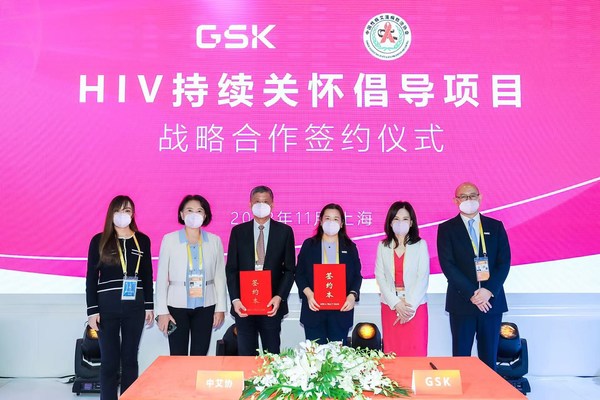
Strategic Cooperation Signing Ceremony for the "HIV Continuous Care Advocacy Project"
"Over the nearly 30 years since its establishment, the China Association for AIDS Prevention has been committed to serving as a bridge between the government and society. Thanks to the efforts of multiple parties, China has formed a pattern of HIV/AIDS prevention and control led by the government, with various departments fulfilling their responsibilities and active participation from all sectors of society. Among them, enterprises have played an important role in HIV/AIDS prevention and control."As the representative of the cooperating party、Hao Yang, President of China STD/AIDS Prevention and Control Association"It was mentioned that, 'The 14th Five-Year Plan period is the critical phase for achieving the goal of ending the HIV/AIDS epidemic. We will work closely with GSK to promote the implementation of the 'HIV Continuous Care Advocacy Program' in China and provide constructive suggestions for the implementation of our national HIV/AIDS prevention and treatment policies. At the same time, we hope to use GSK as a model of public welfare to lead more enterprises to participate in China's HIV/AIDS prevention and control efforts, striving to achieve the goals of 'Healthy China 2030.'"
Vice President,GSKChina General Manager Qi Xin said,"GSK has been deeply involved in the field of HIV prevention and treatment in China for over two decades, continuously providing innovative, differentiated, and affordable high-quality medical products and treatment solutions to people affected by HIV. At the same time, GSK understands that AIDS prevention and treatment is a systematic social effort that requires the participation of government and various sectors of society. GSK is honored to once again partner with the China AIDS Association through the 'big platform' of the CIIE, reaching a strategic cooperation for the 'HIV Continuous Care Advocacy Project' to support China's HIV prevention and control efforts. We look forward to this collaboration offering 'Chinese solutions' to 'Chinese problems,' riding the fast train of the CIIE to benefit more people affected by HIV and build a common health community for humanity."
In recent years, with the implementation of China's "Four Frees and One Care" policy and the widespread availability of antiretroviral therapy (ART), HIV infection is gradually transitioning from a fatal disease to a preventable and controllable chronic infectious disease. With the joint efforts of relevant departments and society as a whole, China's AIDS prevention and treatment work has achieved positive results, continuously improving its capabilities and standards in AIDS control, while maintaining an overall low prevalence of HIV. How to mobilize the strength of all sectors of society to further reduce social discrimination and improve the quality of life for populations affected by HIV has become a new challenge in China's current AIDS prevention efforts.
The "HIV Continuous Care" initiative, launched by GSK and its HIV-focused joint venture ViiV Healthcare, collaborates with Asian partners to deeply analyze the challenges posed by the HIV epidemic in Asia and provide feasible solutions. The initiative involved a steering committee of HIV experts from multiple countries and regions in Asia, including China, in its development.
GSK Signs Memorandum of Understanding with the Chinese Association for AIDS Prevention and Control on the "HIV Continuous Care Advocacy Project"
“HIVProfessor Wei-Ping Cai, Chief Expert of the Infection Disease Center at the Eighth People's Hospital affiliated with Guangzhou Medical University, and member of the Guiding Committee for the "Continuous Care" InitiativeParticipated in this signing event. When mentioning the original intention of initiating this proposal, he stated, "Decades of medical progress and a deeper understanding of HIV have made it possible to end the HIV epidemic. With the joint efforts of various departments, China's AIDS prevention and control work has achieved remarkable results, but there is still a gap from the United Nations 2030 goals. Currently, China's AIDS response still faces many challenges, such as significant regional differences in the epidemic, a noticeable increase in infection rates among the elderly, a persistently high number of late-discovery cases, and increasingly severe complications. Therefore, I also hope that the in-depth findings on HIV prevention and control in China from the 'HIV Continuous Care Advocacy Project' can provide references for China’s AIDS prevention and control efforts, thereby improving the service system and capacity for AIDS prevention and treatment."
“HIVMember of the "Continuous Care" Initiative Steering Committee、Professor Zhifeng Wang from the School of Public Health, Peking UniversityAlso discussed at the event,Improving HIV prevention, enhancing testing, diagnosis and treatment, improving the quality of life for people living with HIV, reducing discrimination, and playing a cross-disciplinary advisory role are the five key aspects of HIV prevention and control identified in this collaboration. This is also an important practice for social organizations participating in China's HIV/AIDS prevention efforts, and it has positive significance for promoting a harmonious society that shares the responsibility of HIV prevention and the right to health.