

ZEISS Expands Digital Pathology Ecosystem in China to Empower Cervical Cancer Screening

Carl Zeiss
Manufacturer of Optical Systems, Industrial Measurement, and Medical Devices
Recently, at the 5th China International Import Expo, the "ZEISS+" strategy was released for the first time. Dr. Zhang Yuxin, Vice President of ZEISS Greater China and General Manager of the Microscopy Division, stated: "The original intention of the 'ZEISS+' strategy is to share cutting-edge technology with China."
With over 170 years of history, Carl Zeiss has a presence in fields such as microscopes, medical equipment, optical glasses, optoelectronic devices, semiconductors, and industrial measuring instruments. Through the "Carl Zeiss+" strategy, Carl Zeiss will share cutting-edge technologies and innovative achievements with local Chinese enterprises, jointly providing solutions better suited to the Chinese market.
In order to truly implement the "Carl Zeiss+" strategy, Carl Zeiss has established three key implementation directions: First, it will use optical technology to serve Chinese partners, scientists, and universities, enhancing domestically-produced microscope imaging technology and supporting developments in China’s medical field, manufacturing, and scientific research innovation. Second, it will closely collaborate with third-party manufacturers through technology transfer and customized production to provide solutions for customers across various industries in China, addressing challenges in equipment integration. Lastly, Carl Zeiss will continue to increase local investment, deeply integrate into the local ecosystem, further consolidate talent, technology, and industry resources in the Yangtze River Delta and Pearl River Delta regions, and contribute to regional integration.
According to Zhang Yuxin, in the field of microscopy, "Carl Zeiss+" encompasses two levels of meaning: In terms of outreach, the focus is on benefiting people's livelihoods and addressing the pain points and challenges in pathology, including the national policy of "two-cancer screening"; at the higher level, it involves transforming China's advanced scientific and technological achievements and rapidly bringing them to market by leveraging Carl Zeiss' channel advantages in China.
Zhang Yuxin stated, based on the aforementioned strategy and marketPain Point——The Severe Shortage of Pathologists,CompanyWhen selecting partners, the focus is on "Faster, More Automated, Higher Throughput, More Intelligent" level, thus choosing partners in two fields: first isThe automatic stage, whose accuracy meets the requirements of pathological software, has now reached a cooperation with Xiamen Haide Star; followed by software, with two companies, Hangzhou Diyingjia and Shenzhen Beiante.
Among them, as an important practice of the "Carl Zeiss+" strategy, Carl Zeiss collaborated with Shenzhen Beiant Medical, a local company in China, to developCarl Zeiss Digital Pathology Imaging System, recently debuted for the first time at the CIIE.
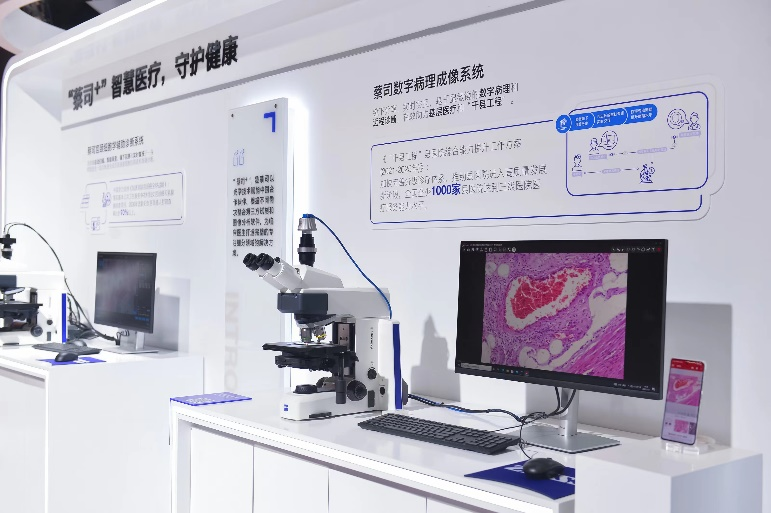
Carl Zeiss Digital Pathology Imaging System
Reportedly, under the framework of the "Carl Zeiss+" strategy, Carl Zeiss has launched a pathology imaging system based on microscopes while incorporating digital imaging technology (developed by Bayant Medical). This system not only meets the daily pathological diagnosis needs of doctors but also enables rapid remote interaction and technical support directly on the microscope through its digital functions. This allows local communities in China to easily access high-quality diagnostic resources. It can also be used for clinical teaching and sharing, quickly enhancing diagnostic capabilities at the grassroots level.
In recent years, with the steady growth of China's economy, the general public's demand for personal health has been increasing. Although the national medical security system is gradually improving, issues such as the uneven distribution of medical resources and the relative scarcity of resources in central and western regions as well as rural areas still persist. In January 2022, China launched the "Thousand Counties Project," focusing on poverty-alleviated areas, the three regions and three prefectures, the former Central Soviet Area, and relocation areas from poverty alleviation efforts. By 2025, at least 1,000 county hospitals across China are expected to reach the service level of tertiary hospitals.
As the most important method of clinical diagnosis, pathology provides the basis for disease diagnosis and prevention. Therefore, how to quickly improve the level of grassroots pathological diagnosis is one of the key factors in enhancing the medical service level of hospitals.。
The main reason for focusing on pathology, according to Zhang Yuxin's explanation, is that "Pathology is like the final appellate court for hospitals or doctors. What causes the disease? How should it be treated? All these are determined by pathology. However, pathology is still in a weak position in China's medical infrastructure. The COVID-19 pandemic has further exposed the shortcomings in this area, which requires long-term cultivation and accumulation. We hope to help narrow this gap."
When discussing the "potential" that cooperation can unleash, Huang Daibin, head of the clinical business unit at Carl Zeiss China's Microscopy Division, pointed out,Microscopes and pathology go hand in hand. The most traditional and core expertise of Carl Zeiss lies in microscopic imaging, which, to a certain extent, has been driving the development of pathology. In clinical diagnosis within hospitals, any sample you can think of—blood, urine, saliva, bone marrow, etc.—has a scenario for microscopic imaging diagnosis. "In hospitals, microscopic imaging represents the most crucial pathological scenario."
As for the exploration of pathology in specific application scenarios, "Carl Zeiss+" has provided applications through practical use——Its first practical achievement in the medical and health field——"Carl Zeiss Cervical Cytology Assisted Diagnosis System"Also made its debut at the CIIE.
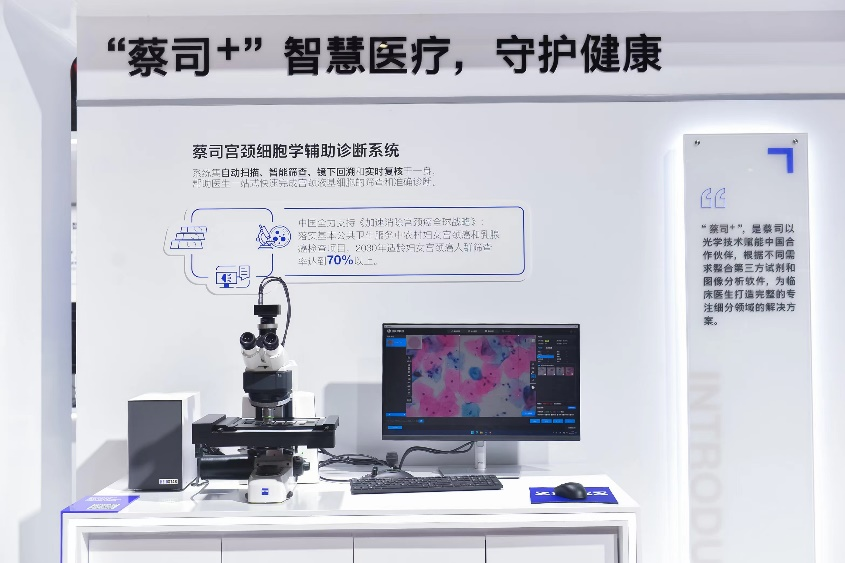
Carl Zeiss Cervical Cytology Assisted Diagnosis System
The diagnostic system was developed by Carl Zeiss and"AI + Pathology" CompanyDiyijia TechnologyJointly developed to enhance China's capabilities in the prevention and treatment of cervical cancer: On one hand, the microscopic technology of Carl Zeiss microscopes can clearly record and highly restore cell images, providing support for pathological diagnosis; the DIAN Diagnostics intelligent module for cervical cytology rapidly analyzes cell images to complete cervical cancer screening and assist in diagnosis.
Currently, cervical cancer is the second most common malignant tumor in women in developing countries. According to the 2020 cancer report from the International Agency for Research on Cancer (IARC), there was one new case of cervical cancer globally every minute in 2020. Regular ThinPrep cytologic test is an effective method for early detection and prevention of cervical cancer.This examination requires pathologists to observe the morphology of tens of thousands of cells under a microscope, heavily relying on the diagnostic experience of pathologists. At the same time, the large volume of screening samples also poses a significant challenge to the number of pathologists in China.。
In January 2022, the National Health Commission of China released the "Cervical Cancer Screening Work Plan," indicating the active use of internet and artificial intelligence technologies to enhance grassroots cervical cancer screening capabilities. This also brought significant benefits and operational guidance to the industry.As for the future implementation of this product,Zhang Yuxin pointed out that different sales models will be provided based on different regions and medical institutions under China's three-tier medical system.
In the future, Carl Zeiss will continue to increase its investment in the Chinese market and serve Chinese partners based on the "Carl Zeiss+" strategy, continuously promoting the implementation of more clinical microscopic imaging diagnostic solutions.