

PT027 (Albuterol/Budesonide) Receives Strong Endorsement from FDA Advisory Committee as a Novel Rescue Treatment for Asthma in Adults

AstraZeneca
Biopharmaceutical Manufacturer
Image Source: Shutterstock
News on November 9, 2022 /BioValleyBIOON/ -- AstraZeneca and its partner Avillion recently announced that the U.S. Food and DrugManagementBureau (FDA) The Pulmonary Allergy Drugs Advisory Committee (PADAC) voted 16 to 1 that:InIn asthma patients aged 18 years and above,Data Supports Favorable Risk Assessment of PT027 (Albuterol/Budesonide) for Asthma TreatmentIn patients aged 12-17, the committee voted 9 to 7 that the data do not support a favorable benefit-risk assessment for PT027 in treating asthma. In pediatric patients aged 4-11, the committee voted 16 to 1 that the data do not support a favorable benefit-risk assessment for PT027 in treating asthma.
In May 2022, the U.S. FDA accepted PT027New Drug Application (NDA): For asthma patients aged 4 years and above, used as needed to treat or prevent bronchospasm and to prevent asthma exacerbation.FDA Sets PDUFA Goal Date for First Half of 2023
PT027 is a potential first-in-class, inhaled (pressurized metered-dose inhaler [pMDI]), fixed-dose combination rescue medication, consisting of albuterol (a short-acting β2 agonist [SABA]) and budesonide (an inhaled corticosteroid [ICS]).Asthma is a chronic, inflammatory, fluctuating respiratory disease that affects up to 339 million people worldwide, including more than 25 million in the United States. Globally, there are over 176 million asthma attacks each year.
According to the announcement released by AstraZeneca,PT027 is the first and only rescue medication recommended for approval in the United States that has been proven to reduce severe asthma exacerbations (flare-ups).PT027 is jointly developed by AstraZeneca and Avillion in the United States under a clinical co-development agreement signed in 2018.
American Academy of Allergy, Asthma andImmunityBradley E. Chipps, former president of the American College of Allergy, Asthma, and Immunology (ACAAI) and medical director of the Sacramento Capitol Allergy and Respiratory Disease Center in the United States, commented: "Millions of asthma patients rely on albuterol rescue inhalers to relieve acute symptoms, but this does not treat the underlying inflammation, putting patients at risk of severe asthma exacerbations regardless of disease severity or control level."If approved, PT027 will change the current emergency treatment methods.”
PT027 NDA is based on the results of the MANDALA, DENALI, and TYREE Phase III clinical trials. The MANDALA trial data shows,In patients with moderate to severe asthma, compared to salbutamol rescue, the use of PT027 as a rescue medication for on-demand relief significantly reduced the risk of severe asthma exacerbations.DENALI trial data shows,In patients with mild to moderate asthma, PT027 significantly improved lung function compared to the individual components salbutamol and budesonide.
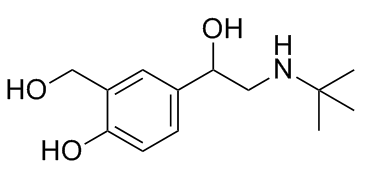
Chemical Structure of Salbutamol (Source: glpbio.com)
In the MANDALA trial, patients with moderate to severe asthma receiving maintenance treatment with ICS (with or without other medications) were randomly assigned to receive PT027 or salbutamol for rescue therapy. The data shows,In adult and adolescent patients, compared with salbutamol rescue, PT027 at a higher budesonide dose intensity (salbutamol/budesonide, 180/160mcg) significantly reduced the risk of severe exacerbations by 27% (p<0.001).
For secondary endpoints, PT027 (albuterol/budesonide, 180/160mcg) showedA 33% reduction in average annualized systemic corticosteroid (SCS) exposure (p=0.002) and a 24% reduction in annualized severe exacerbations (p=0.008).Moreover, compared with salbutamol emergency treatment, PT027 (salbutamol/budesonide, 180/160mcg) after 24 weeks of treatment,Patient Symptom Control andQuality of LifeThe probability of improvement is also higher numerically.。
Data from the MANDALA trial also showed:In adult, adolescent, and pediatric patients aged 4-11 years, when used as a rescue medication on-demand, PT027 at a lower budesonide dose intensity (albuterol/budesonide, 180/80mcg) reduces the risk of severe exacerbations compared to albuterol rescue.StatisticsSignificantly reduced by 17% (p=0.041) in the study.In the trial, adverse events (AEs) were similar across treatment groups and consistent with the known safety profiles of the individual components. The most common adverse events were nasopharyngitis and headache.
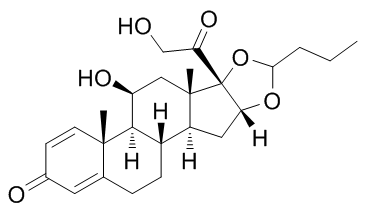
Chemical Structure of Budesonide (Image Source: chemsrc.com)
Asthma is a chronic, inflammatory, fluctuating respiratory disease that affects up to 339 million adults and children worldwide, including more than 25 million people in the United States.Inflammation is a hallmark of asthma and plays a key role in asthma symptoms, exacerbations, and mortality.Patients with asthma will experience recurrent episodes of breathlessness and wheezing, the severity and frequency of which vary over time.Regardless of disease severity, treatment adherence, or level of control, these patients are at risk of serious deterioration.
It is estimated that there are 176 million asthma exacerbations globally each year, including over 10 million in the United States; these pose a physical threat and significant emotional impact on many patients and can potentially be fatal.
Inflammation is at the core of asthma symptoms and exacerbations. Many patients experiencing asthma symptoms use SABA as a rescue medication, but the use of SABA alone does not address inflammation, putting patients at risk of severe exacerbations, which may lead to a decline in quality of life, hospitalizations, and frequent use of oral corticosteroids (OCS).However, when treating asthma exacerbations, just 1-2 short courses of OCS treatment can increase the risk of adverse health conditions, including type 2Diabetes, Depression/Anxiety, Renal Impairment, Cataracts, HeartBlood VesselDiseases, pneumonia, fractures. International recommendations from the Global Initiative for Asthma no longer recommend SABA as the first-line rescue therapy. (Bioon.com)
Source of the original text:PT027 recommended by FDA Advisory Committee as new rescue treatment for asthma