

Mcs Med secures tens of millions in Pre-A round to drive transformation in China's pan-vascular emergency care

MCSMED
Medical Device Developer
Mcs Med, an innovative enterprise in the field of pan-vascular emergency care and life circulatory support, announced the completion of a tens of millions in Pre-A round funding. This round was led by Guochuang Zhiyuan, the capital platform under the National Innovation Center for Advanced Medical Devices, with follow-on investment from Originvest.
The financing aims to accelerate the R&D and clinical progress of Mcs Med's core products, facilitate product registration and certification, and complete production line construction and upgrades. This will further solidify its leading position in the pan-vascular and cardiac life circulatory support field.
Established in April 2023, Mcs Med is committed to building an integrated platform spanning from pre-hospital emergency care to clinical support. Centered on the core strategy of "Intervention + Emergency + Service", Mcs Med has independently developed multiple medical devices with breakthrough performance. Its current product portfolio includes core products such as the PulseVAD® Percutaneous Ventricular Assist Device (pVAD) system, the Mcsreboa® Resuscitative Endovascular Balloon Occlusion of the Aorta (REBOA) catheter, and the Smartpress™ Intelligent Cardiopulmonary Resuscitation (CPR) Compression Device. All core products possess clear clinical positioning and proprietary patented technologies, backed by well-defined plans for regulatory registration/certification and market strategy.

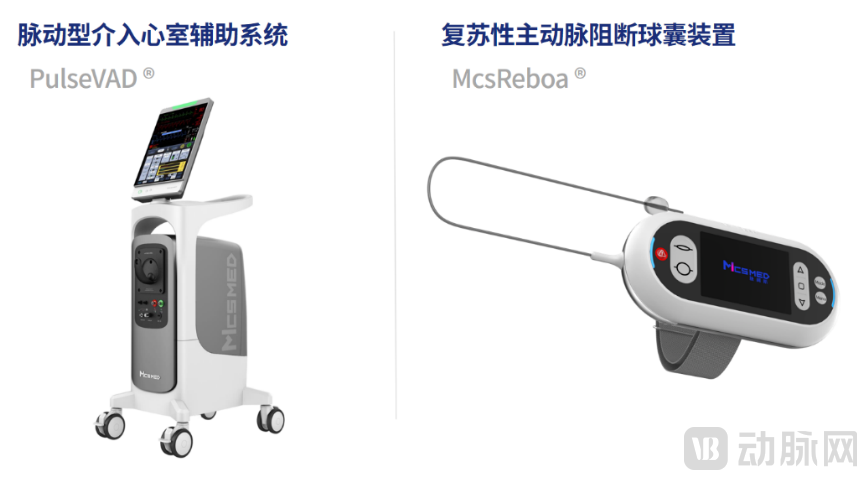
PulseVAD® Pulsatile Percutaneous Ventricular Assist System
In the treatment of cardiogenic shock and high-risk PCI, percutaneous Ventricular Assist Devices (VADs) are emerging as a new focus in global critical care medicine. However, most current mainstream international devices are continuous-flow axial pumps, which are prone to hemolysis, present high puncture difficulty, are costly, and have inherent limitations in valve synchrony, leading to insufficient effective blood flow.
Mcs Med's independently developed PulseVAD® is an ultra-thin catheter-based artificial heart with a catheter diameter of less than 14Fr. It overcomes the critical bottleneck of minimally invasive transfemoral intervention, significantly reducing the risks of vascular injury and limb ischemia. While meeting the safety requirements of transfemoral intervention, the device—through the design of an external pump and key internal valves—can operate in synchronization with the cardiac pulse rhythm, achieving efficient pulsatile flow support and further lowering limb ischemia risk, thus better aligning with the human body's physiological circulatory mechanism. The core breakthrough of PulseVAD® lies in its ability to provide higher Effective Blood Circulation than existing market products, along with pulsatile biomimicry.
Resuscitative Endovascular Balloon Occlusion of the Aorta (REBOA) has regained significant attention in the field of global emergency and trauma medicine in recent years. When immediate surgery is not feasible or when time must be secured for definitive hemorrhage control, REBOA can control bleeding and maintain perfusion to vital central organs by accurately inflating a balloon within the aorta to temporarily block distal blood flow, thereby buying critical "golden time" for subsequent treatment.
The Mcsreboa® Resuscitative Endovascular Balloon Occlusion of the Aorta Catheter, developed by Mcs Med, innovatively integrates ultrasound guidance, automated balloon inflation, and a guidewire-free design. This enables emergency medical personnel to quickly and accurately identify the occlusion site and automatically inflate the balloon to achieve hemostasis, significantly reducing operational complexity and the risk of errors, thereby improving the success rate of emergency interventions.
Against the backdrop of an aging population and the increasing burden of cardiovascular diseases, the domestic substitution of high-end life support medical devices in China has become an inevitable trend. Mcs Med strategically engages with a full-chain, multi-scenario approach, deploying key devices such as percutaneous VADs, REBOA, and intelligent compression systems. This strategy drives comprehensive advancement from equipment technology and system services to future digital capabilities.