

TianGang ImmunoTherapeutics, Co-Founded by a Dual Academician from China and Europe, Files for IPO
TG ImmunoPharma
ImmunoPharma Developer
In recent years, the NK cell therapy track has been very popular, with numerous companies making investments. However, enterprises dedicated to the research and development of NK cell immunotherapy drugs are quite rare. Hefei TG ImmunoPharma Co., Ltd. (hereinafter referred to as "TGI") is one such company, focusing on immune therapies targeting NK cell-related receptors and ligands.
TGI was founded in 2020 by Tian Zhigang, a leading figure in China's NK cell field and a dual academician of the Chinese Academy of Engineering and the European Academy of Sciences.
Why choose to start a business at this point in time? How to target the blue ocean market of NK cell immunotherapy? What are the profound considerations for the development of innovative drugs in our country?With these questions in mind, VCBeat recently spoke with Xiao Weihua, CEO of TGI.
TGI team started product development 33 years ago.
In 1989, this was the year when Academician Tian received his doctoral degree in Medical Immunology from Norman Bethune University of Medical Sciences, and it was also the year when Academician Tian established the first tumor biotherapy research institution in China (Shandong Tumor Biotherapy Research Center), thus beginning Academician Tian's journey of NK cell immunotherapy application and transformation.
At the Shandong Cancer Biotherapy Research Center, Academician Tian led a research team to conduct studies on allogeneic NK cell-based tumor immunotherapy and went to the National Cancer Institute (NCI) in the United States to validate the findings using mouse models.It has been confirmed that allogeneic NK cells in mice can treat tumors, laying a theoretical foundation for the industrialization and scaling up of NK cell therapy.。
At the NCI, Academician Tian met his alumnus Xiao Weihua, who worked in the same building. Professor Xiao, then a researcher at the NCI and later a co-founder of TGI, said: "Both Academician Tian and I come from the school of Professor Yang Guizhen, and we both have a passion for industrial development. Plus, since we lived close to each other in the U.S., we often met and chatted at that time."
Later, Academician Tian and Professor Xiao joined the University of Science and Technology of China (USTC) successively. According to Professor Xiao, at that time, the School of Life Sciences at USTC established a Biomedical Engineering Center, with over 1,000 square meters of clean laboratory space specifically for product development. "I hope to use the knowledge I have accumulated to engage in product development; it is my passion," he said.
But due to the restrictions imposed by policies and systems within the establishment, scientific researchers in universities, research institutes, and other public institutions faced numerous difficulties in transferring research achievements and establishing companies that year. Although they were unable to set up a company, the founding team of TGI...Continuously committed to product development and technology transfer, "maintaining close ties with enterprises and the market."
"Professor Tian and I started product development in the 1980s. When Professor Tian was in Shandong, he completed five or six technology transfers," Professor Xiao stated. Before the establishment of TGI, the founding team had already transferred multiple projects to Fengyuan Pharmaceutical and Ruida Health, "with a total transfer fee of 102 million yuan."
Later, China implemented the "Three Rights Reform" for scientific and technological achievements, granting universities and research institutes the rights to dispose of, benefit from, and use these achievements. The University of Science and Technology of China (USTC) seized the opportunity to be part of the first batch of pilot institutions for this national reform, improving its systems to promote the commercialization of scientific and technological achievements. "In the past, professors had to pay a transfer fee to the university before being granted usage rights; now, USTC allows professors to directly obtain usage rights, and the university only starts charging intellectual property fees when the research yields actual profits," said Professor Xiao with satisfaction.
In addition, the state and universities have also introduced numerous policies to encourage scientific researchers to start businesses. With the pathways for the transfer of state-owned intellectual property and the permission for professors to start businesses both cleared, the founding team of TGI naturally took the opportunity to establish a company and carry out the transformation of scientific research achievements.
Ultimately, in October 2020, Academician Tian, along with Professor Xiao Weihua and Professor Sun Rui from the University of Science and Technology of China (USTC) research team, founded TGI. In 2021, it officially settled in the Smart Industrial Park of Hefei Economic Development Zone, establishing a professional R&D base of nearly 8,000 square meters, including an SPF-level animal laboratory, a GMP-standard recombinant protein preparation laboratory, a BSL-2 biosafety laboratory, and an NK cell detection and analysis platform.
Due to the popularity of PD-1/PD-L1 inhibitors, research on T cells has developed rapidly. In contrast, NK cells, which also possess immune functions, have been neglected and marginalized for a long time, failing to be effectively developed. However, NK cells actually have the advantage of innate immunity. Besides their cytotoxic function, they can secrete various cytokines, chemokines, and growth factors that influence the activity of other immune cells, initiating multiple immune responses to achieve anti-tumor immunity, demonstrating significant development potential.
TGI seized the market window period and entered the field in advance when NK cell immunotherapy drugs in China were still in their infancy. Based on over 30 years of research accumulation in the NK cell field, the company created the ABC-NKer® technology platform. By integrating targeting molecules of NK cell receptors and ligands, the platform enhances their functional activity and drug-like properties, thereby increasing the success rate of candidate drugs.
Speaking about the considerations behind drug design, Professor Xiao introduced: "The overall response rate of PD-1 monoclonal antibodies is only about 20%, mainly because anti-tumor activity is multifaceted, and relying on a single immune checkpoint is difficult to completely solve the problem." Therefore, when designing drugs, TGI considers multiple aspects such as how to activate NK cells, how to block the immunosuppressive state of tumors, and how to target tumors, endowing the drugs with multiple functions.Under such considerations, TGI's technologies and drugs encompass four major series: targeted antibody drugs, immune checkpoint inhibitors, bispecific/multi-functional antibody analogs, and immunomodulators.
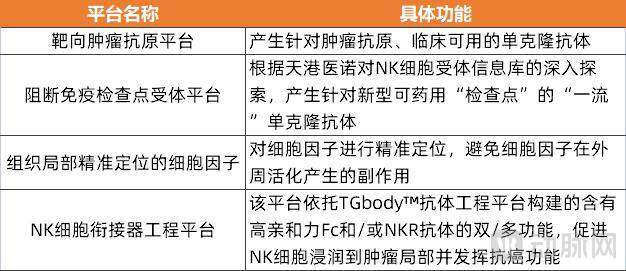
TGI ABC-NKer®The platform consists of four pioneering platforms.
In addition to the technology platform, the development model is also very important. Whether to choose a Biotech focused on drug research and development or a Pharma centered on clinical trials and commercialization? For TGI, this is not a difficult choice.
Although China's pharmaceutical innovation environment has significantly improved in recent years, there are still relatively few truly First-in-class (original innovations), and the capacity for original innovation remains largely insufficient. Professor Xiao noted that China’s market is extremely lacking in innovative drugs.And this is "the advantage of TGI."
Professor Xiao emphasized,The most critical aspect of innovative drug development lies in the target, and "the target is where we have conducted the most research, gained the deepest understanding, and possess the greatest expertise."TGI not only discovered and validated immune checkpoints such as the NK cell inhibitory receptors NKG2A and TIGIT relatively early on internationally, but also almost all projects in the company’s pipeline are original innovative drugs, establishing a workflow from concept validation to the discovery of innovative candidate drugs.
According to the team's own expertise and advantages, combined with market demand, TGI positions itself as a Biotech company that adheres to original innovation, focusing on the development and application of early-stage technologies. It is committed to occupying the innovative source of the pharmaceutical industry chain through technology transfer, licensing, and cooperative development business models.Currently, TGI has established cooperative relationships with companies such as D-Mab and GenScript to jointly advance the R&D of innovative pipelines.
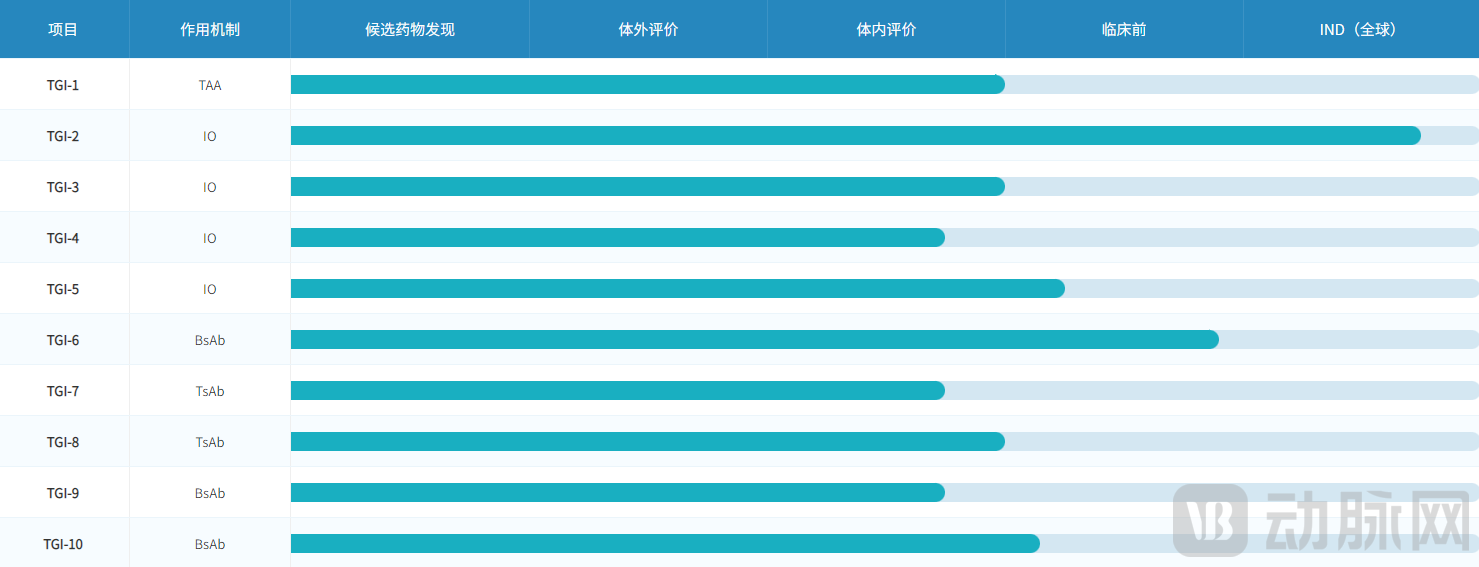
TGI Product Pipeline
TGI-2, the first Class 1 innovative drug with a completely new target independently developed by the company, will be submitted to the FDA for clinical trial application this month. "If everything goes smoothly, it is expected to receive IND approval around January next year," said Professor Xiao. This new drug is also being simultaneously submitted to China's CDE for approval.
TGI Completed a Pre-A Round Financing of Several Hundred Million RMB in April This Year. The Company Plans to Initiate an A Round Financing in the First Half of Next Year, and the Raised Funds Will Be Used for the Development and Clinical Trial Research of Multiple Product Pipelines in Tumor Immunotherapy.