

Lynparza (Olaparib) Plus Zytiga (Abiraterone) Set to Become New First-Line Standard for mCRPC in the US and EU

AstraZeneca
Biopharmaceutical Manufacturer

MSD
Pharmaceutical R&D and Manufacturer

Committee for Medicinal Products for Human Use
Committee for Medicinal Products for Human Use (CHMP)The Committee for Medicinal Products for Human Use (CHMP) is the committee within the European Medicines Agency (EMA) responsible for human medicines. The CHMP replaced the former Committee for Proprietary Medicinal Products (CPMP) in May 2004.The CHMP plays a vital role in the authorization of medicines in the European Union (EU). In the centralized procedure, the CHMP is responsible for: 1) conducting initial assessments of marketing authorization applications across the EU; assessing modifications or extensions to existing marketing authorizations (“variations”); considering recommendations from the Agency’s Pharmacovigilance Risk Assessment Committee regarding the safety of medicines on the market, and, where necessary, advising the European Commission to amend the marketing authorization of a medicinal product, or to suspend or withdraw it from the market.The CHMP also evaluates medicines authorized at the national level that are referred to the EMA, with the aim of maintaining a harmonized position throughout the EU.Furthermore, the CHMP and its working groups promote the development of medicines and pharmaceutical regulation by: providing scientific advice to companies researching and developing new medicines; developing scientific and regulatory guidelines to assist pharmaceutical companies in preparing marketing authorization applications for human medicines; and collaborating with international partners to harmonize regulatory requirements.

Image Source: Shutterstock
November 16, 2022 /BioValleyBIOON/ -- AstraZeneca and Merck & Co., Inc. recently announced that the European MedicinesManagementThe Committee for Medicinal Products for Human Use (CHMP) of the European Medicines Agency (EMA) has issued a positive review opinion, recommending approval.PARP Inhibitor Anticancer Drug Lynparza (Chinese Brand Name: Lipuzhuo, Generic Name: Olaparib): In combination with abiraterone and prednisone or prednisolone, used for the treatment of adult patients with metastatic castration-resistant prostate cancer (mCRPC) who are not clinically suitable for chemotherapy.
Prostate cancer is the most common cancer in European men, with an estimated 473,000 cases and 108,000 deaths in 2020. It is estimated thatApproximately 10-20% of patients with advanced prostate cancer will develop castration-resistant prostate cancer (CRPC) within five years.Among them, at least 84% of men will develop metastases upon being diagnosed with CRPC. Patients with advanced prostate cancer have a particularly poor prognosis, and the 5-year survival rate remains very low.
The European Commission (EC) is expected to make a final review decision within the next 2 months. If approved, this would represent the first combination of an EU PARP inhibitor with a novel hormone drug. Currently, Lynparza's aforementioned indication application is also under review in the United States.FDAThe priority review is expected to be decided by the agency in the fourth quarter of 2022.
The positive review opinion of the CHMP is based on the results of the Phase 3 PROpel trial (NCT03732820). Relevant data were published in June this year in the international top medical journal, The New England Journal of Medicine (NEJM). For details, see:Abiraterone and Olaparib for Metastatic Castration-Resistant Prostate Cancer。
PROpel is a randomized, double-blind, multicenter Phase III trial, conducted in a first-line setting in patients with metastatic castration-resistant prostate cancer (mCRPC) who have not received chemotherapy or novel hormonal agents (NHA), with or without homologous recombination repair (HRR) gene mutations, comparing the current standard-of-care therapy Zytiga (abiraterone acetate) with the combination therapy of Lynparza + Zytiga.The efficacy, safety, and tolerability. Patients in the two treatment groups also received prednisone or prednisolone twice daily.
The main endpoint results showed,Compared with Zytiga, Lynparza+Zytiga as first-line treatment showed an improvement in radiographic progression-free survival (rPFS).StatisticsStatistically and clinically meaningful improvements. Regardless of HRR gene mutation status, patients achieved clinically meaningful treatment benefits.
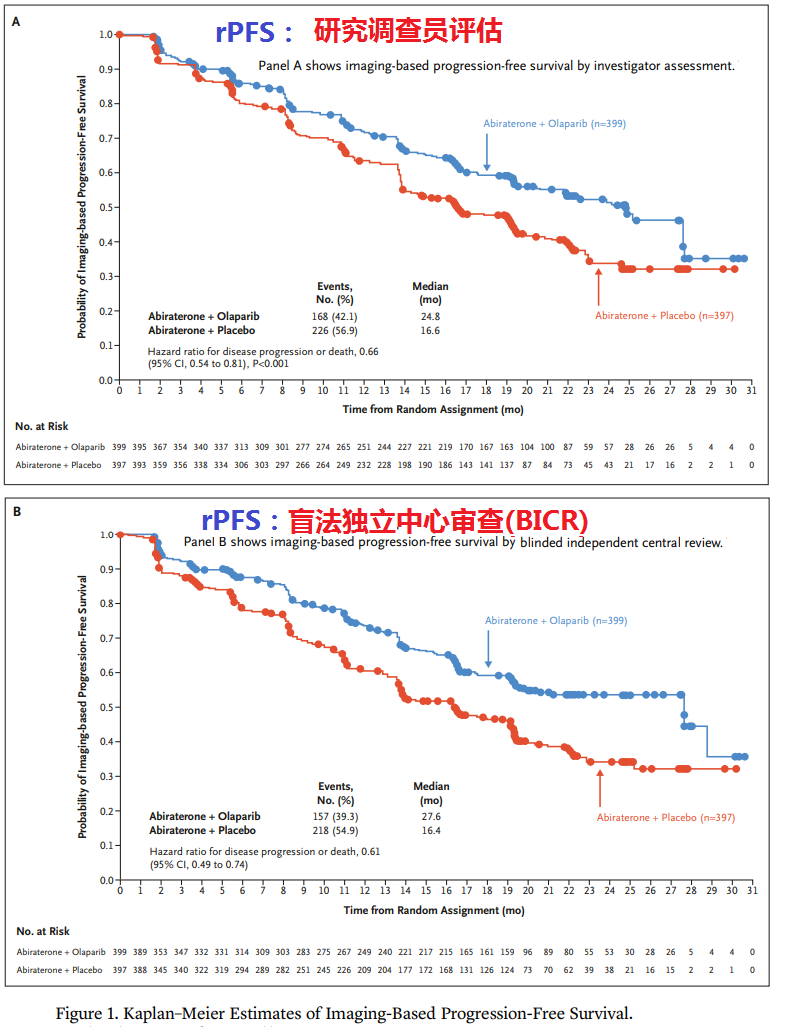
PROpel Trial Results (Click the image to view a larger version, Image source: NEJM)
Specifically, in the pre-specified interim analysis, the primary endpoint showed:In the overall study population, compared with Zytiga, first-line treatment with Lynparza+Zytiga reduced the risk of disease progression or death by 34%.(HR=0.66; 95%CI:0.54-0.81; p<0.0001). The median rPFS in the Lynparza+Zytiga group was 24.8 months, compared to 16.6 months in the Zytiga group. According to the blinded independent central review (BICR) analysis, Lynparza+Zytiga extended the median rPFS by nearly a year compared to Zytiga (27.6 months vs 16.4 months).
The results also showed,Compared with Zytiga, Lynparza+Zytiga showed a favorable trend in improving overall survival (OS)., but at the time of data cutoff (analyzed when 28.6% data maturity was reached), the difference did not reach statistical significance (HR=0.86; 95%CI:0.66-1.12; p=0.29).Data from additional secondary efficacy endpoints, such as time to first subsequent treatment (TFST; HR=0.74; 95% CI: 0.61-0.90), second progression-free survival (PFS2; HR=0.69; 95% CI: 0.51-0.94), exploratory endpoints including objective response rate (ORR; odds ratio OR=1.60; 95% CI: 1.02-2.53), prostate-specific antigen levels, and time to PSA progression (HR=0.55; 95% CI: 0.45-0.68), further support the treatment benefits of the Lynparza + Zytiga regimen compared to Zytiga alone across the entire trial population.
The safety and tolerability of Lynparza in combination with Zytiga are consistent with the results observed in previous clinical trials as well as the known characteristics of each drug. Compared to patients treated with Zytiga alone, the rate of discontinuation of Zytiga among patients receiving the combination of Lynparza and Zytiga did not increase, and health-relatedQuality of LifeNo adverse impact (as assessed by the FACT-P [Functional Assessment of Cancer Therapy-Prostate] questionnaire).

Prostate cancer is the second most common cancer in male patients and caused approximately 375,000 deaths in 2020. In clinical trial settings, the overall survival period for mCRPC patients is about three years, while in real-world settings, this time is even shorter. About half of mCRPC patients may receive only one effective treatment, with subsequent treatments offering diminishing benefits. Approximately 20-30% of mCRPC patients experience HRR gene mutations.
In terms of prostate cancer, Lynparza has been approved in the United States for the treatment of patients with mCRPC who have progressed after prior treatment with enzalutamide or abiraterone and carry HRR gene mutations (BRCA alterations and other HRR gene mutations). In the EU, China, and Japan, Lynparza is approved for patients with mCRPC who have progressed after prior treatment with novel hormonal agents (NHA) and carry BRCA mutations.
The results of the PROpel trial are impressive, as this positive control trial set a high standard of care. In the trial, compared with the standard care therapy Zytiga, the Lynparza+Zytiga regimen showed significant clinical improvement in first-line treatment of mCRPC, regardless of whether the tumor harbors HRR gene mutations. If approved, the Lynparza+Zytiga combination will provide a much-needed new treatment option for first-line patients.
Lynparza is a first-in-class, oral poly ADP-ribose polymerase (PARP) inhibitor that exploits the defects in tumor DNA damage repair (DDR) pathways to preferentially kill cancer cells, offering potential in treating a wide range of tumors with DNA damage repair deficiencies.
Lynparza is the world's first PARP inhibitor to be marketed., which was first approved by the US FDA in December 2014. AstraZeneca and MSD reached a global strategic collaboration in oncology in July 2017 to co-develop and commercialize Lynparza and another MEK inhibitor, selumetinib, for the treatment of various types of tumors. Within the PARP inhibitor category, Lynparza has the most extensive and advanced clinical trial development program. AstraZeneca and MSD are collaborating to investigate the therapeutic potential of Lynparza as a monotherapy and combination therapy for a wide range of tumor types. (Bioon.com)
Source of Original Text:Lynparza in combination with abiraterone recommended for approval in the EU by CHMP as 1st-line treatment for patients with metastatic castration-resistant prostate cancer