

U.S. FDA Grants Priority Review to AbbVie’s CD3xCD20 Bispecific Antibody Epcoritamab for Relapsed/Refractory Large B-Cell Lymphoma

AbbVie
Innovative Drug Developer

Genmab
Differentiated Antibody Therapy Developer

FDA
U.S. Food and Drug Administration
Image Source: Shutterstock
News on November 21, 2022 /BioValleyBIOON/ -- AbbVie recently announced that the U.S. Food and DrugManagementBureau (FDA) Has been acceptedepcoritamab(DuoBody®-CD3xCD20)Biologics License Application (BLA) and proceed with priority review:For the treatment of relapsed/refractory (R/R) large B-cell lymphoma in patients who have received two or more lines of systemic therapyLymphoma(LBCL) adult patients.
In addition, the European Medicines Agency (EMA) has recently accepted the marketing authorization application (MAA) for epcoritamab: for the treatment of R/R diffuse large B-cell lymphoma (DLBCL) in patients who have received two or more lines of systemic therapy.DLBCL, a major subtype of LBCL) Adult patients.
Epcoritamab is a subcutaneously injected CD3xCD20 bispecific antibody, jointly developed by AbbVie and Genmab. Clinical data shows that it has been previously administered in patients who have received at least two lines of anti-lymphoma treatment (includingCAR-TEpcoritamab demonstrated efficacy and durable responses in patients with relapsed/refractory LBCL.
If approved, epcoritamab will become the first subcutaneously injectable bispecific antibody available for the treatment of LBCL.The regulatory application for epcoritamab is based on the preliminary results from the large B-cell lymphoma (LBCL) expansion cohort of the previously published Phase 2 clinical trial, EPCORE NHL-1, for the treatment of relapsed/refractory B-cell non-Hodgkin's lymphoma (B-NHL).
The study cohort included 157 patients with relapsed/refractory LBCL, with a median of 3 prior lines of therapy, an overall response rate (ORR) of 63%, and a complete response rate (CR) of 39%. Baseline characteristics included: 61% of patients were refractory to initial treatment, and 20% had previously received autologousStem CellsTransplant (ASCT), 39% received CAR-T cell therapy (75% were resistant to CAR-T therapy).
In patients who had not previously received CAR-T cell therapy, the ORR was 69% and the CR was 42%; in patients who had previously received CAR-T cell therapy, the ORR was 54% and the CR was 34%. With a median follow-up of 10.7 months, the median duration of response (mDOR) was estimated to be 12 months; in patients achieving CR, the mDOR has not yet been reached, and 89% of patients were still in CR at 9 months.
The safety of epcoritamab is consistent with previous study results. Most treatment-emergent adverse events (TEAEs) occurred within the first 12 weeks of treatment and have been resolved. The most common TEAEs of any grade (incidence ≥15%) included cytokine release syndrome (CRS, 49.7%), fever (23.6%), fatigue (22.9%), neutropenia (21.7%), diarrhea (20.4%), injection site reactions (19.7%), nausea (19.7%), and anemia (17.8%). The most common Grade 3 or 4 TEAEs (≥5%) included neutropenia (14.6%), anemia (10.2%), decreased neutrophil count (6.4%), and thrombocytopenia (5.7%). Grade 3 CRS was observed in 2.5%. No Grade 4/5 CRS was observed.
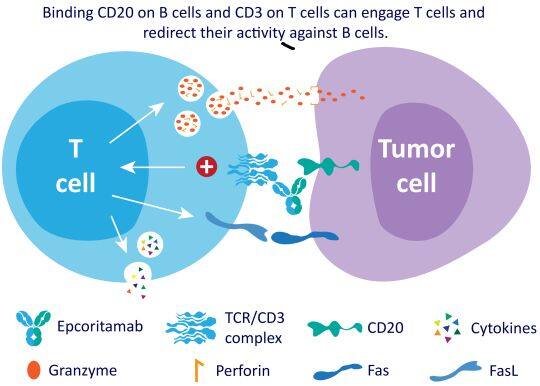
Epcoritamab Mechanism of Action (Image Source: abbviescience.com)
LBCL is a fast-growing type of non-Hodgkin lymphoma (NHL), and the main subtype of LBCL is DLBCL. NHL is a cancer that originates in the lymphatic system and affects B-cell lymphocytes (a type of white blood cell).LBCL is the most common type of NHL, accounting for approximately 30% of all NHL cases.It is estimated that there are approximately 150,000 new cases of LBCL globally each year.
Epcoritamab is an investigational IgG1 bispecific antibody created using Genmab's proprietary DuoBody technology. The DuoBody-CD3 technology is designed to selectively direct cytotoxic T cells to induce a response against the target cell type.ImmunityReaction. Epcoritamab can simultaneously bind to CD3 on T cells and CD20 on B cells, inducing T cell-mediated killing of CD20-positive (CD20+) cells.
CD20 is expressed on B cells and is a clinically validated therapeutic target in many B-cell malignancies.Including diffuse large B-cell lymphoma (DLBCL), follicular lymphoma (FL), mantle cell lymphoma (MCL), and chronic lymphocyticLeukemia(CLL)。
Epcoritamab is part of AbbVie's broad oncology collaboration with Genmab and is being co-developed by both parties. The companies will share commercial responsibilities in the United States and Japan, with AbbVie leading further global commercialization. Currently, both parties are evaluating epcoritamab as a monotherapy and in combination therapies for a range of malignant hematologic tumors. These include: an ongoing Phase 3 open-label randomized clinical trial (NCT04628494) assessing epcoritamab as a monotherapy for patients with relapsed/refractory DLBCL; and another Phase 3 open-label clinical trial (NCT05409066) evaluating epcoritamab as a combination therapy for patients with relapsed/refractory follicular lymphoma. (Bioon.com)
Source of the original text:U.S. FDA Accepts for Priority Review the Biologics License Application for Epcoritamab (DuoBody®-CD3xCD20) for the Treatment of Relapsed/Refractory Large B-Cell Lymphoma