

BioGeometry Achieves International Leadership in Antibody Affinity Prediction, Marks Major Breakthrough in AI-Driven Drug Discovery

BioGeometry
Large Molecule Drug Developer
In September this year, BioGeometry, a Beijing-based AI large molecule pharmaceutical company (hereinafter referred to as "BioGeometry"), announced the completion ofExclusive Tens of Millions of Dollars Financing by Gaorong Capital。
Today, BioGeometry, a company founded in 2021 by Dr. Jian Tang, an associate professor and tenured professor at Mila, the Algorithm Institute of the University of Montreal in Canada, has announced new achievements.
Recently,BioGeometry Collaborates with Wu Yanling's Team from Shanghai Synthetic Immunology Engineering Technology Research Center to Achieve Significant Progress in Antibody Optimization — BioGeometry's Self-developed Antibody Design Platform Exponentially Enhances Antibody Affinity Through Dry-Wet Experimental Closed Loop, verifying its reliability and efficiency,Points to a new direction for the future development of antibody drugs.
Based on Geometric Deep Learning Pre-trained Large Models,
Breakthrough in the Difficult Points of the Original Affinity Maturation Scheme
The continuous growth of the antibody drug market has made the research and development of medicinal antibodies increasingly attractive.
With the development of genetic engineering technology and the emergence of antibody library technology, it has become easy to obtain antibodies by constructing and screening antibody libraries. However, antibodies obtained through library screening have not undergone the in vivo affinity maturation process, often resulting in affinities that are insufficient for therapeutic use. Therefore, in vitro affinity maturation is usually required to meet the demands of clinical applications.
In vitro affinity maturation of antibodies mainly involves simulating the in vivo affinity maturation process by applying various strategies to introduce corresponding mutations to antibody genes, constructing a mutated antibody library, and obtaining high-affinity antibodies through affinity screening. During the in vitro affinity maturation process of genetically engineered antibodies, selecting the mutation region and determining how to introduce mutations are critical issues. Currently, mutation strategies can be divided into three main categories, including random mutagenesis, substitution, and site-directed mutagenesis.
However, there are some problems with the traditional antibody affinity maturation strategies mentioned above. "Traditional affinity maturation methods rely on experimental techniques such as mutation, display, and screening, which often take a long time, possibly more than two months. Long cycles, high costs, and low success rates are the drawbacks of traditional approaches."Dr. Jian Tang, founder and CEO of BioGeometry, mentioned.
It is also aware of the limitations of traditional affinity maturation approaches. As the industry evolves, different methods are being adopted to further enhance the effect of affinity maturation. For example, multiple mutation strategies are combined based on antibody characteristics, and various mutation strategy combinations based on different principles synergistically enhance the affinity maturation of genetically engineered antibodies.
Moreover, with technological breakthroughs, advancements in computer-aided drug design, and the increasing elucidation of antibody structures, it has become possible to achieve more targeted affinity maturation strategies based on the understanding of antibody structures under the guidance of computer-aided design.Its core advantage lies in the ability to economically and efficiently obtain improved mutants in a short time, leveraging different algorithms to understand antibody-antigen structures and interactions.
Some existing structure prediction models are making efforts in this area and have achieved certain results, but there are also some limitations. "Structure prediction models such as AlphaFold2 are not sensitive to mutations, especially in the precise modeling of protein side chain atoms at binding interfaces." In response to the issues with existing structure prediction models,BioGeometry has independently developed a geometric deep learning model at the atomic level, which has been pre-trained on protein complex structure data. This model enables rapid and effective modeling of antigen-antibody interactions and has achieved internationally leading performance in the task of predicting mutant affinity.
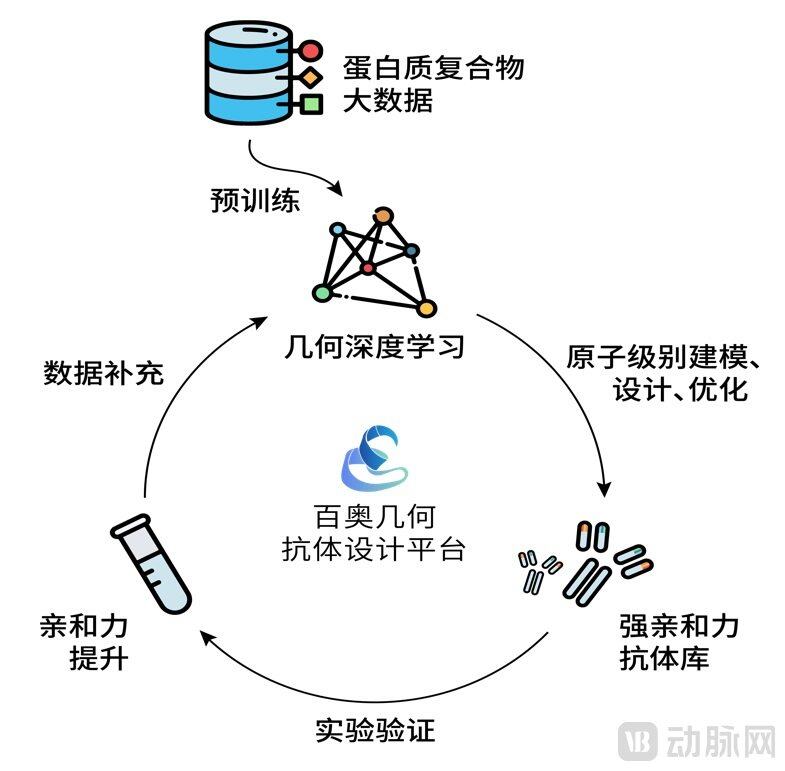
"Pre-trained large models have already made significant achievements in fields such as images, natural language text, and protein sequences, but how to pre-train on the three-dimensional structures of proteins and their complexes remains a challenge and a hot topic. Our work, combining dry and wet lab experiments, demonstrates the outstanding role of pre-trained geometric deep learning models in the field of antibody optimization."Dr. Tang Jian, founder of BioGeometry, pointed out.
Particularly worth mentioning is that the inference speed of geometric deep learning models is hundreds or even thousands of times faster than traditional dynamics methods, easily enabling large-scale virtual screening and multi-target antibody design. This will further save time costs, enhance economic benefits, and increase success rates in the design of potentially medicinal antibodies.
Ultimately, the preparation of high-affinity antibodies will further assist in achieving the desired biological effects at low clinical doses, reduce toxicity caused by dosage, and enhance therapeutic efficacy.
Build a one-stop antibody design platform,
Boosting Optimal Antibody Drug Discovery
In fact,BioGeometry team has previously collaborated with companies such as NVIDIA, Intel, and IBM to release TorchProtein, the first open-source machine learning platform for large molecule drug development.The platform has open-sourced a general framework for deep learning-based macromolecule modeling, the first large pre-trained model based on the three-dimensional geometric structure of proteins, and a standard dataset specifically designed for evaluating the effectiveness of deep learning in protein modeling.
Building on its prior technical foundation, BioGeometry has completed the construction of an AI-powered large-molecule drug design platform. Now, BioGeometry continues to push further into advanced fields.Further built a one-stop antibody design platform based on geometric deep learning pre-trained models, which can simultaneously optimize multiple other drug-like properties such as stability, solubility, viscosity, etc., accelerating the antibody development process.
Dr. Tang Jian stated that traditional drug-like properties are often optimized sequentially, making simultaneous optimization impossible. This may lead to certain issues, such as a decrease in stability when enhancing affinity.Through AI algorithms for prediction, the final outcome can be a pharmaceutically promising antibody with balanced drug-like properties.
In fact, antibody candidates with medicinal potential will also face issues such as immunogenicity. Immunogenicity refers to the ability of biotechnological drugs to induce an immune response in the body against themselves or related proteins, or to trigger immune-related events. The adverse events caused include the formation of anti-drug antibodies and/or neutralizing antibodies. The former often leads to a strong immune response in patients, and may even endanger life; the latter can neutralize the biological activity of the drug, reducing its efficacy.
In order to better address the aforementioned issues, BioGeometry has also taken this into consideration within its one-stop antibody design platform — further enhancing the homology between drug (potential antibody) sequences and human-origin sequences. Immuneogenicity risks are predicted through artificial intelligence, and then potentially immunogenic sites are specifically removed via protein engineering, further reducing the risk of immunogenicity.
Dr. Tang Jian stated that the current affinity optimization is essentially the optimization of antibodies. In the future, the goal is to fully design antibodies through computer-aided methods.With the establishment of a one-stop antibody design platform, BioGeometry has not only completed the construction of an AI-powered large-molecule drug design platform but also gained the ability for in-depth exploration.It will also continue to conduct more cutting-edge explorations on projects where BioGeometry has already gained certain international advantages, such as antibody structure prediction, antibody optimization, antibody sequence design, and enzyme activity prediction. In addition, while further expanding the product pipeline within the company,BioGeometry also has the capability to further proceed with commercialization., which can help pharmaceutical companies adopt a one-stop antibody design platform to achieve antibody optimization, etc.
As BioGeometry collaborates with multiple academic institutions and pharmaceutical companies, it will also accelerate the technological iteration and implementation of its AI-based antibody design platform, aiming to advance drug candidate molecules into the clinical stage as soon as possible.