

Pfizer and Roivant Sciences Launch Vant to Advance TL1A Monoclonal Antibody RVT-3101 for Inflammatory Diseases

Pfizer
Pharmaceutical R&D Developer

Roivant Sciences
Biopharmaceutical Company
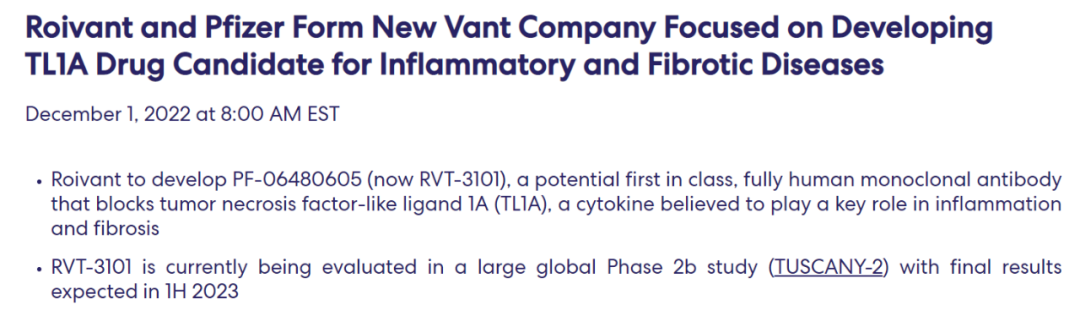
Pfizer and Roivant Sciences Announce the Formation of a New Company Named Vant, Focused on the Development and Commercialization of TL1A Monoclonal Antibody RVT-3101 (Also Known as PF-06480605), Currently inUlcerative ColitisPhase IIb development stage.
According to the agreement, Vant holds the commercial rights of RVT-3101 in the United States and Japan. Pfizer owns 25% of Vant's shares, enjoys its commercial rights outside the United States and Japan, and has representation on the company's board of directors.
In addition, Vant holds the exclusive option to co-develop with Pfizer the next-generation TL1A-targeted antibody, which has recently entered Phase I. Vant has the right to enter into a global development agreement with Pfizer prior to Phase II (expected in 2025), with costs shared equally and commercialization rights shared.
RVT-3101 is a potential first-in-class drug that exerts its therapeutic effects by inhibiting tumor necrosis factor-like ligand 1A (TL1A) to block inflammation and fibrosis pathways.
A Phase II TUSCANY study preliminarily evaluated the efficacy of RVT-3101 in 50 patients, while another global Phase IIb TUSCANY-2 study further assessed the drug in 245 patients with moderate to severe symptoms.Ulcerative ColitisThe performance in adult patients, with final results expected to be read out in H1 2023.
"Our internally developed TL1A antibody has the potential to become the first to offer biomarker selection for patients with inflammatory bowel disease.PrecisionTherapy." We are very excited about the preliminary data from the TUSCANY-2 study and the new developments with Vant," said Mikael Dolsten, Chief Scientific Officer and President of Global Research and Development and Medical at Pfizer.
Inflammatory bowel disease is a chronic inflammatory condition of the gastrointestinal tract, including ulcerative colitis and Crohn's disease. It is estimated that up to 2 million American adults suffer from inflammatory bowel disease, with a high rate of treatment failure. Approximately 50% of patients discontinue a specific therapy within 6-12 months and are less likely to achieve sustained remission.
In the United States alone, such diseases represent an annual commercial market of nearly 15 billion USD, which is continuously growing. The remission rate of existing therapies is very low, and there is an urgent need for effective and safe new treatments to meet the unmet needs of patients.