

AI + Drug Discovery in 2023: Moving Beyond Hype Toward Validation and Execution
LeadMuta
AI Small Molecule Drug Developer
InSilico Medicine
Intelligent Drug Development Platform and New Drug Research and Development Provider

CarbonSilicon AI
Artificial Intelligence Infrastructure and Service Provider
Space Peptides
One-Stop Platform Service Provider for Peptide Drugs
XtalPi
Computation-Driven Innovative Drug R&D Provider
In 2022, for the AI + new drug industry, it was a year of questioning results and also a more pragmatic year.
China's innovative drug industry is gradually becoming more rational. The once disruptive new technology of AI + new drug development, which used to be the "traffic code," can no longer easily excite investors simply because of "AI."
This change began in 2021, but compared to 2021, there were more rational reflections in 2022. Both investors and founders started to contemplate the realities of the AI + new drug industry.
VCBeat has interviewed more than 20 AI-driven drug discovery companies in the past year, hosted two online panels on AI-driven drug discovery, participated in multiple industry exchanges including the 2nd AI-Driven Drug Discovery Conference, and also gained insights into the investment community's perspectives on AI-driven drug discovery.
In August, we released the "2022 AI + Drug Discovery Industry Research Report." Based on interviews and observations at that time, future drug discovery companies will all use AI technology as a foundational technology, and AI will no longer be a marker of advancement. In the online Panel in September, we found that drug design has already undergone a transformation integrating AI with traditional CADD, while AI + drug discovery companies continue to expand the application scenarios of their technologies — from providing technical services for specific stages, to offering end-to-end solutions, to gradually covering the entire drug discovery process.
In November, VCBeat's New Medicine division collaborated with BeiKun Cloud to host an online Panel, aiming to explore the commercialization path of AI + new drug enterprises. The event shared experiences from leading companies in forming collaborations, examined development strategies and survival approaches for small and medium-sized AI + new drug enterprises, and facilitated communication between companies and investors. From the insights shared by investors, we identified numerous industry pain points and challenges — many issues related to AI technology remain unresolved, and currently, the purchasing power of Chinese pharmaceutical companies is relatively weak. In this context, expanding partnerships will also depend on how these AI + new drug enterprises leverage their strengths while mitigating weaknesses.
From the conceptual stage gradually moving towards practical drug development, the focus of industry discussions has shifted from technology and financing to questioning the results: How are the pipeline developments progressing? To what extent can costs be reduced and efficiency improved? How many collaborations have been established? Are large pharmaceutical companies recognizing these efforts?In a series of inquiries,Many AI + new drug companies begin to consider issues at the execution level.
This year, the leading effect in China's AI + new drug field has become prominent, with major collaborations and substantial financing being relatively concentrated. However, for smaller AI + new drug companies, the cooling of the capital market and the decline in sector popularity have put considerable pressure on them, prompting more exploration into survival opportunities and development directions.
The Matthew Effect becomes prominent, and the survival issues of small AI + new drug enterprises draw attention
In 2022, leading companies in China gained more attention and held more resources. They represent the "self-validation" path of AI + new drug development — from the initial construction of technical platforms, target discovery, compound structures, and company financing issues, to current concerns about cost and efficiency, pipeline progress, BD cooperation, and more. Leading enterprises are the visual focus of the industry.
From the perspective of the financing market, a number of early-established AI + new drug enterprises in China have entered D-round financing. In addition to XtalPi, which completed a $400 million D-round financing in 2021, Insilico Medicine also cumulatively completed a $95 million D-round financing in 2022, with its latest valuation at $3 billion.
AgentAI Pharma Completes Two Rounds of Financing, Raising a Total of $1.5 Billion; AI + New Drug Companies Such as VCBeat, XtalPi, Space Peptides, LeadMuta, CarbonSilicon AI, and Others Have Also Completed Series B Financing.
Emerging AI-driven new drug companies are still in the early stages of financing.LeadMuta, founded at the end of 2021, secured an angel round of financing worth tens of millions in 2022, while CarbonSilicon AI, established around the same period, completed a 50 million yuan angel round of financing.
In terms of clinical progressCompared with the situation in 2021, when only a few AI + new drug companies advanced their pipelines to clinical trials, more AI + new drug companies in China obtained clinical assets for AI pipelines in 2022.
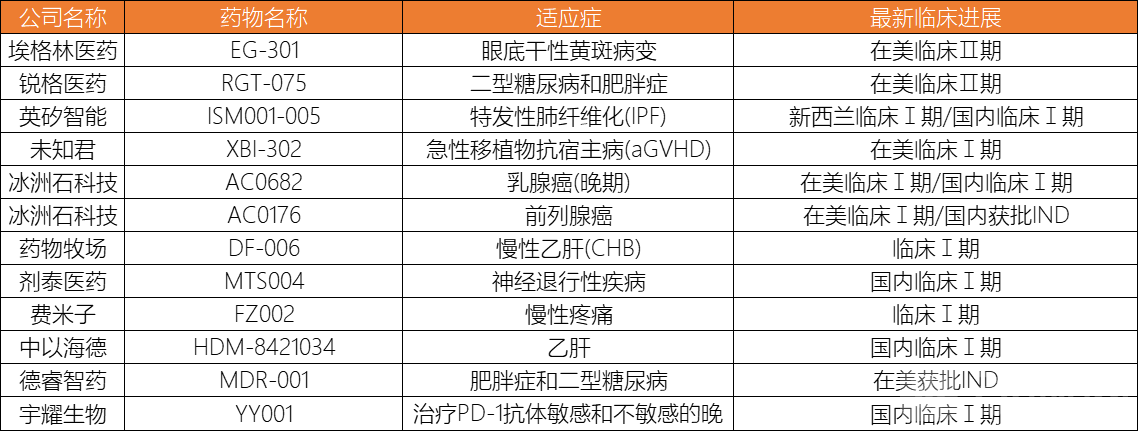
The rapidly developing yet relatively low-profile AI pharmaceutical companies, Egret Pharmaceuticals and RuiGe Pharmaceuticals, both had drugs enter Phase II clinical trials last year. Accutar Biotechnology announced in April and August 2022 that its AC0682 and AC0176 products, which had already entered Phase I clinical trials in the United States, received IND approval from the NMPA. Following the completion of patient dosing for the anti-fibrotic small molecule inhibitor ISM001-055 (for the treatment of idiopathic pulmonary fibrosis) in Phase I clinical trials in New Zealand in February 2022, Insilico Medicine completed dosing for Phase I clinical trials in China in July. The orally disintegrating tablet MTS004, a Category 2.2 improved new drug independently developed by JiTai Pharmaceuticals.Also onIn June 2022, it received IND approval from the CDE. Additionally, rapidly growing industry pioneers such as Zhongyi Haid, Yuyao Biotech, and Derui Zhikang have also made significant progress.
The following isVCBeat Database Statistics 20Latest Clinical Progress of AI + New Drug Enterprises in China in 2022:
Over the past year, China's AI + new drug technology platforms have gradually gained recognition from many well-known pharmaceutical companies. Leading AI + new drug enterprises tend to establish "platform service-oriented" cooperative relationships with multinational or traditional large pharmaceutical companies, while relatively smaller AI + new drug enterprises are more inclined to build "development mutual aid-oriented" partnerships with domestic institutions or companies.
Leading companies such as XtalPi, SinoBio Intelligence, and Accutar Biotechnology have successively gained cooperation opportunities with well-known pharmaceutical manufacturers including Pfizer, Huadong Medicine, and Viva Biopharma, mostly collaborating in the form of platform services. Relatively smaller AI + new drug enterprises mostly focus on co-developing AI technology platforms or researching drugs: CarbonSilicon AI has partnered with Neotrident Technology to jointly build a one-stop AI intelligent drug design platform. Zhi Pharma Technology has reached a project collaboration with a top biology team from Sun Yat-sen University to jointly develop a First-in-Class oral small molecule drug for COVID-19.
Whether it can be called a "leading enterprise" is now determined by the actual progress of pipelines, large-scale cooperation projects, and recognition from international pharmaceutical giants.
Compared with leading companies,Small AI + new drug enterprises are facing more pressure. First, they face survival issues, and secondly, they need to find differentiated commercialization paths.
Reduced demand from downstream enterprises has made the industry very cautious about developing new pipelines and creating new products, with survival being the main challenge. For small AI + new drug companies, setting aside pride and doing whatever it takes to survive is the top priority.
Founded in 2017, Zhikang Technology is a typical case. Currently, Zhikang has reached cooperation with dozens of pharmaceutical companies and research institutions. Through the "software + service" model, it has discovered lead compounds with good activity in multiple projects. Dr. Huang Tao, the founder, has some insights into commercialization — always start with customer needs and avoid the situation of "looking for nails with a hammer."
From the investor's perspective, differentiation is the core issue for small AI + new drug companies. Ma Rui, partner at Fengrui Capital, analyzed that the track has become quite crowded, with leading companies having obvious advantages. New companies need to analyze the problems encountered by the previous generation of AI + new drug enterprises, consider how to differentiate themselves, and identify which unresolved issues still need to be addressed.
Small AI + pharmaceutical companies have to start seeking survival space through differentiation.Space Peptides, a company transitioning from peptide enterprise to AI-driven CDMO services for new drug development, has carved out a unique path—they are one of the few AI + new drug CXO companies in the industry that focuses specifically on peptide drug R&D. Before incorporating AI technology, they had already accumulated years of experience in peptide drug research and development. Partners such as Roche, Lonza, BRACCO, Renfu Pharmaceutical, Xingqi Eye Medicine, and Kangyuan Pharmaceutical highly value this "specialty."
Rationality and Pragmatism: Focus on Specific Execution and Results
In the past year, AI-driven pharmaceutical companies have increasingly focused on pipeline validation and drug efficacy, striving to expand academic and commercial collaborations globally. Under the leadership of pioneering enterprises, close exchanges between industry and academia have been maintained.
AI-driven new drug companies focus on pipeline validation, advancement, and global collaboration expansion.In 2022, XtalPi reached or further expanded academic or commercial collaborations with Singapore's national drug discovery platform Experimental Drug Development Centre (EDDC), Qilu Pharmaceutical, Guide Therapeutics, CT Tianqing, Qingyu Pharmaceutical, United Laboratories, CR Pharmaceutical Research Institute, Janssen Pharmaceuticals, and others to develop drugs including novel ADCs and new anti-tumor small molecule drugs. In September, its self-developed intelligent and automated laboratory made its first public appearance at the 2022 World Artificial Intelligence Conference. Over the past year, XtalPi continued its incubation model and hosted multiple industry exchange events.
In February 2022, Insilico Medicine's drug ISM001-055 for the treatment of Idiopathic Pulmonary Fibrosis (IPF) entered Phase I clinical trials, and in May, the drug was approved to enter Phase I clinical trials in China. Throughout the year, Insilico Medicine discovered a total of 8 preclinical candidate drugs, covering multiple indications such as COVID-19 and breast cancer. Leveraging its end-to-end artificial intelligence-driven drug discovery platform, Insilico Medicine has successively reached collaborations with Fosun Pharma, Centogene, the University of Zurich, EQRx, Yituo Pharmaceuticals, HuaQuan Pharmaceuticals, Haoyuan Pharmaceuticals, the Saudi Arabian Investment Ministry, Sanofi, and the Gates Foundation. In November, Insilico Medicine globally released an update to its Pharma.AI platform, and in December, launched its 6th generation Intelligent Robotic Laboratory.
In 2022,AI-driven new drug companies have moved from discussing "What is it?" and "How is it?" to talking about "What has been done?" and "How to do it?", the focus has shifted from AI to pharmaceuticals, with an emphasis on more pragmatic execution.
At the same time, in VCBeat's online Panel related to AI + new drug this year, the main topics of interaction between guests and audiences also focused on "how to do it": how to commercialize? How to establish cooperation with large pharmaceutical companies? How can small AI + new drug companies survive?
When discussing once again the extent to which AI can transform productivity in pharmaceuticals, the industry seldom uses the term "disrupt" anymore, instead engaging in more rational discussions. During our attendance at the 2nd AI + New Drug Development Conference, we noticed that many corporate representatives' speeches conveyed this signal—"Give technology a little patience," "Lower expectations for artificial intelligence," "AI doesn't need to take full responsibility for drug development; its role has been verified in stages," or "AI is just a tool today, but it may bring changes in the future."。
In general rational discussions, some people hold higher expectations for the application space of AI in the pharmaceutical industry.Some industry insiders believe that the application of AI in disease mechanism research and clinical trials is relatively insufficient, "Molecules only account for 10% of drug development, and most people ignore the use of AI in the overall process," and "Everyone is talking about big data, but what about big knowledge?"
In this regard, VCBeat's new pharmaceuticals sector discovered,Under the conventional AI + molecule research route, some AI + new drug companies have begun to explore the "molecular design" at both ends.For example, BioMap, "At both ends of the drug molecule, we have moved forward to discover new targets, and backward, we have built a high-throughput in vitro immune simulation experimental system. In the future, we hope that with real-world clinical trials, we can use AI and intelligent means to analyze the trial data more accurately, forming a closed loop to guide and update the previous target discovery and disease mechanism models."
Another is Zhe Yuan Technology, an AI + new drug company that follows the technical route of "AI + disease." They adopt a model that reverses the traditional drug R&D process: first identifying the association between genes and diseases at the microscopic level, then searching for drugs that control gene expression and suppress disease onset, aiming to achieve more comprehensive full-process AI application.
AI + New Drug Overall Strategy: Returning to the Essence of Drug Development
In 2022, AI successfully demystified itself in the pharmaceutical industry, and AI-driven new drug companies began to return to the essence of drug development.
At the 2nd AI + Drug Discovery Conference in August, companies and experts reached a consensus on the current situation — AI is just a tool, and the decision-making power lies with humans. Most companies began to pay more attention to pharmaceuticals themselves this year.
Leading enterprises are shifting their focus by restructuring their organization, seeking drug R&D collaborations, and recruiting pharmaceutical chemistry talents.
Insilico Medicine announced on June 17 the appointment of Dr. Ren Feng as Co-CEO. Previously, Dr. Ren Feng served as the Chief Scientific Officer and Global Head of Drug Discovery at Insilico Medicine. Moving forward, Dr. Ren Feng will also oversee clinical development, taking full responsibility for all research and development activities as well as foundational framework establishment. For the company, this structural adjustment indicates that after the AI technology platform has been largely perfected, Insilico Medicine will place greater emphasis on subsequent drug discovery efforts.
XtalPi has established a partnership with Bradley L. Pentelute, a chemistry professor at the Massachusetts Institute of Technology, to jointly advance research in peptide chemistry and molecular biology. At the same time, XtalPi is seeking to collaborate with Singapore's national drug discovery platform to develop novel drug candidates targeting non-small cell lung cancer (NSCLC) for precise lung cancer treatment. These collaborations will accelerate XtalPi’s drug discovery process and allow the company to accumulate experience in medicinal chemistry.
After the relatively complete development of AI technology platforms, preparing a talent reserve for subsequent drug research and development has become an important task for many companies at present. In 2022, companies such as DRUGiNNO and StoneWise were recruiting pharmaceutical chemistry talents, including positions like CADD Engineer, Director of Drug Chemistry R&D, Drug Chemistry Scientist, Senior Pharmaceutical Product Manager, and more.
A similar trend can be observed among newly-entered companies.Reviewing 2018-2021, which was the peak period for AI + new drug startups, in 2021 alone, 24 AI + new drug companies were established. Many entrepreneurs without a pharmaceutical background emerged, such as Viva BioTech founded by investors and BioMap with a technical background. However, due to the overall pharmaceutical industry and the investment and financing environment in China in 2022, there were very few newly established AI + new drug companies last year.
New entrant companies almost always have a medicinal chemistry expert as a core founding member. LeadMuta and CarbonSilicon AI, both established at the end of 2021, are representative examples of this "rational and pragmatic" approach.
Hou Tingjun is one of the two core members of CarbonSilicon AI. He has over 20 years of experience in methodology and application research in drug design. In the 2022 Global Scholar Academic Influence Ranking, he ranked third among leading figures in pharmaceutical sciences in China. As the chief scientist, he focuses on the company’s R&D and strategic layout in the pharmaceutical field, as well as the exploration of cutting-edge directions.
LeadMuta, founded around the same time, has directly proclaimed its approach of “drug chemistry experts leading with AI as an assistant.” Dr. Shi-Yi Yue, the founder and CTO of LeadMuta, previously served as the Chief Scientist at AstraZeneca's Montreal R&D Center and as the Executive Director of Computational Chemistry and Bioinformatics at Pharmaron. His involvement has attracted professional talents with long-term experience in multinational pharmaceutical companies to LeadMuta, forming a team of drug chemistry experts primarily composed of Chinese returnee scientists.
A Return to Rationality: In 2023, AI + New Drug Development Will Enter a Critical Validation Phase, with More Collaborations and Some Stage Achievements Emerging. AI Will Further Become Tool-like in the Pharmaceutical Industry, Promoting Scalability and Efficiency Improvements in Drug R&D. However, Given the Large Volume of Orders Signed in the Past Year and the Time Needed for Clinical Trials to Progress, Industry Insiders Predict That the World’s First AI-Developed Drug Could Be Launched After 2024.
Of course, perhaps one day AI + new drug development will no longer be seen as a uniqueLeadMutaHowever, before that, we still need to give new technologies a little patience.
Welcome to the live broadcast of the AI + New Drug Special Session. Together with entrepreneurs and investors, we will capture the industrial signals of 2022 and look forward to the specific highlights of 2023.
Time: February 14th (Tuesday) 20:00
Live Platform: VCBeat New Medicine Video Channel, Long press the image to scan and make an appointment.
VCBeat 2022 "AI + New Drug Special Topic" Industry Insights and Interview Reports
3An Analysis of the Nearly 200 AI Pharmaceutical Layouts by the World's Top 20 Pharmaceutical Leaders
6Why does this AI pharmaceutical company prioritize medicinal chemistry experts over AI?
11. AI + Gene Editing: This Company Successfully Treats Adult Thalassemia