

Johnson & Johnson Withdraws New Indication Application for Ibrutinib Combination Therapy in First-Line Mantle Cell Lymphoma

Johnson & Johnson
Healthcare Product Manufacturers, Health Service Providers

European Medicines Agency
The European Medicines Agency (EMA) is a decentralized agency of the European Union (EU), located in London. It began operations in 1995. The agency is responsible for the scientific evaluation, supervision, and safety monitoring of medicines developed by pharmaceutical companies for use in the EU. By ensuring that all medicines available on the EU market are safe, effective, and of high quality, the EMA protects public and animal health in the 28 EU Member States and countries of the European Economic Area.
Intelligency Finance APP learned on January 27 that the European Medicines Agency (EMA) announced that Johnson & Johnson (JNJ.US) had withdrawn on December 13, 2022, the new indication marketing application for ibrutinib (Imbruvica) in combination with bendamustine and rituximab for the first-line treatment of patients with mantle cell lymphoma (MCL) who are not eligible for autologous stem cell transplantation (ASCT).
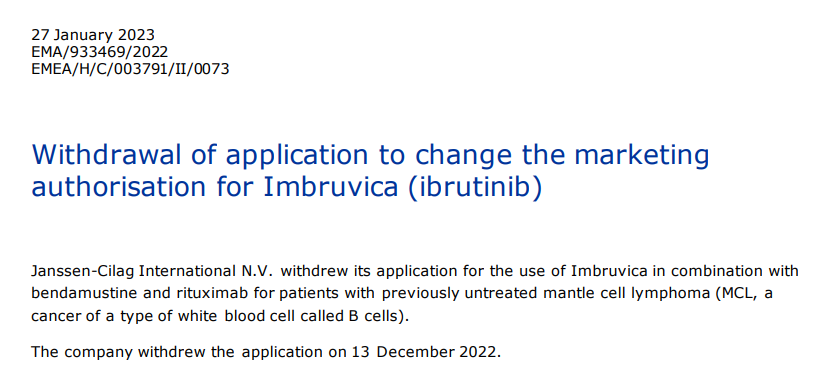
Johnson & Johnson withdrew this marketing application because the Committee for Medicinal Products for Human Use (CHMP) considered that the currently submitted research data were insufficient to support the use of ibrutinib in the proposed indication.
Previously, Johnson & Johnson submitted the results of a randomized, double-blind, placebo-controlled Phase III SHINE study to support this marketing application. The study included a total of 523 previously untreated MCL patients aged ≥65 years. These elderly MCL patients often have poor baseline conditions and are not suitable for ASCT.
The results showed that, at a median follow-up of 84.7 months, the median progression-free survival (PFS) was 80.6 months in the ibrutinib group and 52.9 months in the placebo group (hazard ratio for disease progression or death = 0.75; 95% CI: 0.59-0.96; P=0.01).
In most (but not all) pre-specified subgroups, ibrutinib achieved PFS benefit over placebo. However, the simplified Mantle Cell Lymphoma International Prognostic Index (MIPI) indicated that high-risk patients and those with TP53 mutations did not achieve PFS benefit.
In the ibrutinib group and placebo group, 39.8% and 40.8% of patients died, respectively, with similar overall survival (OS) between the two groups (hazard ratio for death = 1.07). The 7-year overall survival rate was 55.0% in the ibrutinib group and 56.8% in the placebo group.
During the treatment period, 3-4 grade adverse events occurred in 81.5% of patients in the Ibrutinib group and 77.3% of patients in the placebo group. The most common 3-4 grade adverse events were neutropenia (Ibrutinib group: 47.1% vs Placebo group: 48.1%), pneumonia (20.1% vs 14.2%), and lymphocytopenia (16.2% vs 11.9%), etc.
The EMA reviewed the information provided by Johnson & Johnson and identified a series of issues, after which the application was withdrawn. Following Johnson & Johnson's submission of responses to the related issues, the EMA determined that some unresolved issues remained.
The agency believes that the benefits of the combination of ibrutinib, bendamustine, and rituximab are limited and expressed concerns about the potential serious side effects of this combination, including a higher risk of severe infections. The agency also finds it difficult to select patients who are unsuitable for ASCT but still appropriate candidates for this combination therapy.
Johnson & Johnson stated that this withdrawal has no impact on any ongoing clinical trials, and the benefits of Ibrutinib in its approved indications still outweigh the risks.