

BenevolentAI: The Only AI-Driven Drug Discovery Company to Go Public in 2022, Pioneering a 'Precision ChatGPT' for Pharma

BenevolentAI
AI Drug Discovery Developer
In 2022, the European economy fell into recession. According to uktech statistics, compared with 86 technology companies in 2021, only two technology companies had an IPO market value exceeding 1 billion US dollars that year. One of them isUK-based clinical-stage AI drug discovery company —— BenevolentAI。
On April 22, 2022, Benevolent AI Ltd. went public on the Euronext Amsterdam through a SPAC, and the listed entity was changed to Benevolent AI.After the change, the company's issued capital is 1.45126 billion euros, divided into 1.37626 billion euros of ordinary shares and 7.5 million euros of Class B shares.
BenevolentAI was the only AI pharmaceutical company to go public in 2022.Not only that, but in the current climate of a relatively sluggish global economy,This transaction has set the record for the highest amount in a SPAC deal in the history of Europe's pharmaceutical and healthcare sector.
What is BenevolentAI's ironclad guarantee?
According to the 2022 first-half performance data disclosed in September last year, BenevolentAI's revenue in the first half of the year reached £4.8 million, a significant increase compared to £1.7 million in the same period in 2021.Mainly due to the cooperation with AstraZeneca。
In addition to securing financing, BenevolentAI's financial revenue has long benefited from AstraZeneca. The collaboration between the two companies began in 2019, and after the first phase of cooperation expired in 2021, AstraZeneca renewed the partnership until 2025. This ongoing collaboration has continuously brought substantial income to BenevolentAI.
Is BenevolentAI relying on AstraZeneca for survival? In fact, AstraZeneca's trust in it goes far beyond that.
AstraZeneca believes that BenevolentAI has developed to a point where it can be said to have "knowledge graph(Knowledge Graphs)”The Best-Utilized Companies(Information excerpted from www.nature.com).
And how to use the recently popular ChatGPT and knowledge graph for comparative understanding,Wang Suhong, founder and CEO of Baixinghua Technology AI, told VCBeat New Medicine, "ChatGPT focuses more on open-ended conversations. In contrast, the knowledge graph in the pharmaceutical field should be 'a more precise version of ChatGPT'.""Drug research and development requires retrieving more precise information from larger datasets. Therefore, the combination of ChatGPT's extensive data accumulation and the specialized information architecture of knowledge graphs, complementing each other’s strengths, could be the ideal pursuit."
November 2013Michael Brennan, Kenneth Mulvany, and Dr. Ivan Griffin co-founded Stratified Medical Ltd., the predecessor of BenevolentAI. Over three years, the company developed and tested its "knowledge graph" technology and raised $87 million in funding in 2015. In 2016, it launched its first major drug development program (focused on Amyotrophic Lateral Sclerosis, ALS) and was renamed BenevolentAI Ltd. during the same period.
Thereafter, BenevolentAI began to expand significantly.In February 2018, the company established BenevolentCambridge division after acquiring Proximagen, mainly responsible for laboratory-related businesses. In April 2018, the company secured funding from Woodford and Goldman Sachs.$150 Million FinancingIn May of the same year, Baroness Joanna Shields became the CEO of the company.
Joanna Shields Leads BenevolentAI Towards a Broader Platform. In terms of financing, Temasek and Eli Lilly became shareholders of BenevolentAI after funding rounds in 2019 and 2020, respectively; regarding business collaborations,In April 2019, BenevolentAI began its project with AstraZeneca., As of now, BenevolentAI has established five collaborative pipelines with AstraZeneca in chronic kidney disease (CKD) and idiopathic pulmonary fibrosis (IPF). Moving forward, the two companies will continue their collaboration in the areas of systemic lupus erythematosus (SLE) and heart failure (HF).
Ongoing collaboration has made BenevolentAI a crucial component in AstraZeneca's AI-driven drug innovation projects. Leveraging its core "Knowledge Graph" technology, BenevolentAI has established over 30 drug pipelines.
In this case, the collaboration pipeline with AstraZeneca may just be the tip of the iceberg in BenevolentAI's application of knowledge graphs to assist in new drug discovery.
"We are drowning in a sea of data, yet we are thirsty for knowledge." This quote from Nobel laureate Sydney Brenner encapsulates the information paradox in scientific discovery.
The leap from perception to cognition requires the introduction and development of "cognitive technology." Therefore, "knowledge graphs" have become the key technology to break through this situation.
According to the "iResearch: 2022 China Knowledge Graph Industry Research Report", "As one of the underlying technologies of artificial intelligence, "Knowledge Graph" is a semantic network that depicts relationships between entities, carrying semantics, logical meanings, and rules. It describes relationships between things in the form of triplets, namely "Entity × Relation × Attribute.""Knowledge Graph" can structure and visualize knowledge information in a non-linear world, assisting humans in reasoning, prediction, and classification. Its four basic characteristics are: networked knowledge structure, complex network structure, network composed of triples, and data mainly carried by knowledge bases.
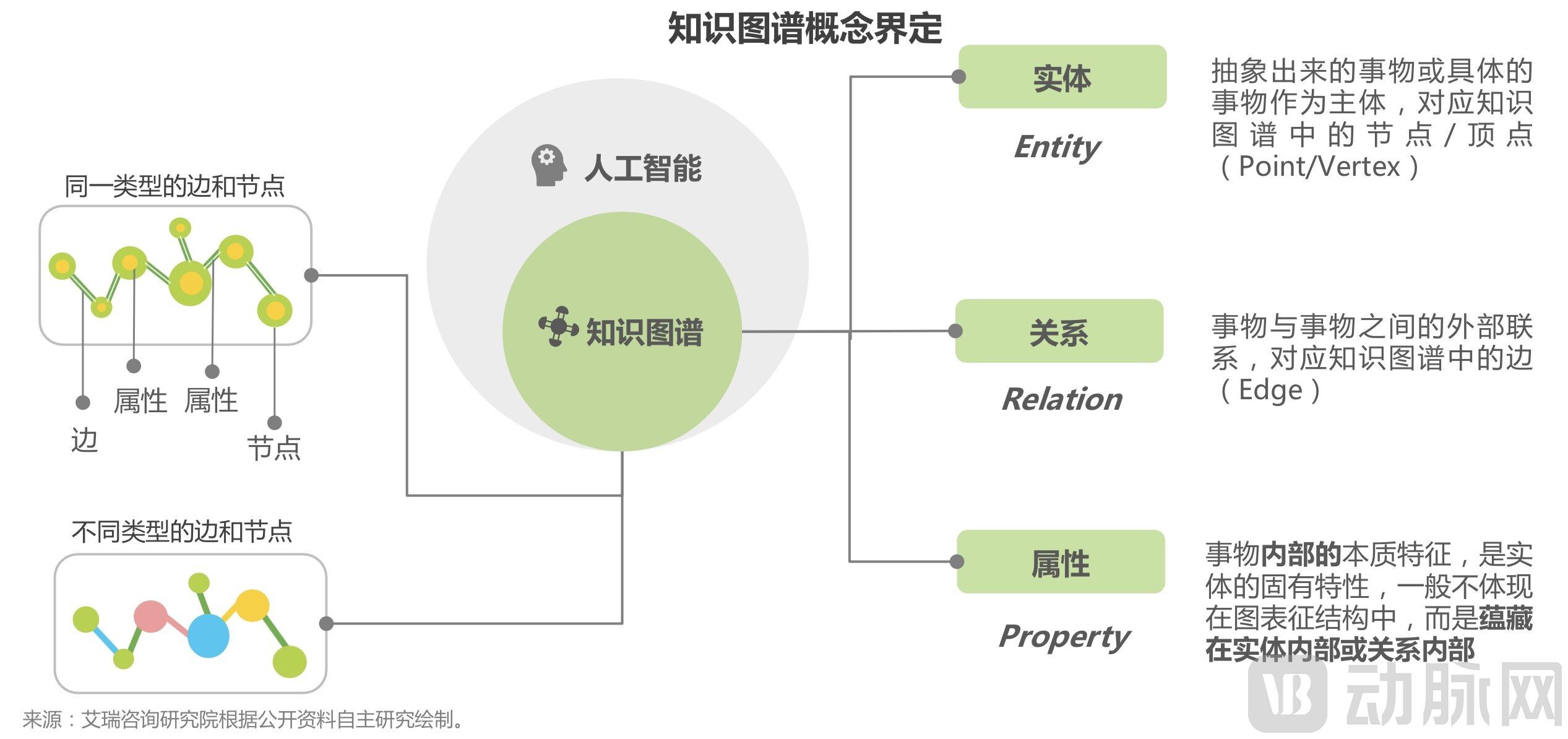
Definition of Knowledge Graph
(Image Source: "iResearch: 2022 China Knowledge Graph Industry Research Report")
BenevolentAI believes that "knowledge graphs" can provide a rich and flexible representation of human biology.
By visualizing the key differences between health and disease, discovering the multidimensional factors involved in diseases, identifying disrupted pathways and mechanisms, and understanding the biological principles of diseases, scientists can make more confident decisions in an era of exponential growth in biomedical data and research. This will accelerate the development of innovative drugs and improve the success rate of research and development.
Based on this, BenevolentAI has placed the core technology of its drug discovery platform on the "Knowledge Graph." This "end-to-end" discovery platform serves as a data engine that integrates relevant open biomedical data from both structured and unstructured sources, including: scientific and patent literature, regulatory documents, raw human data, licensed third-party data, and relevant experimental data from internal laboratories. Meanwhile, the platform is deployed in various third-party environments in the form of a "cloud," inversely enabling the updating and enrichment of the "Knowledge Graph."
"Knowledge graph" can help BenevolentAI focus on mechanism-based drug discovery.Key elements in the fields of genetics, pathology, biological systems, molecular chemistry, genomics, proteomics, and transcriptomics are automatically extracted, curated, and standardized through auditable data structures and fed into proprietary knowledge graphs.BenevolentAI can achieve relevant technical work in four aspects: data foundation, target identification, molecular design, and indication selection.。
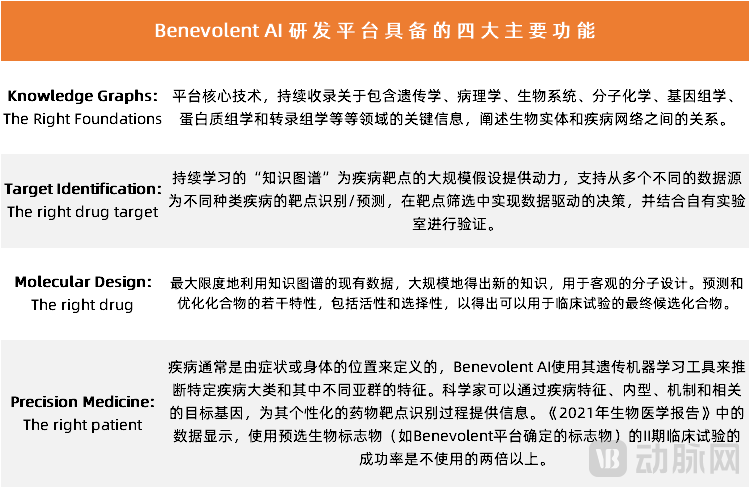
BenevolentAI's Technology Functions Based on "Knowledge Graph" (Source: Company Official Website)
After 10 years of accumulation and沉淀, the insight of its knowledge graph has begun to show results in eliminating traditional biases in disease and treatment, as well as breaking down information silos.
BenevolentAI consistently prioritizes spending on technology research and development, maintaining investment in this area at approximately four times the level of general administrative expenses. Even after going public, the company has continued to increase its expenditure on R&D. According to the mid-year financial report of 2022, BenevolentAI invested £19.3 million in drug discovery and £10.7 million in product and technology standardization in the first half of 2022, representing year-over-year growth of 32.64% and 7.48%, respectively, compared to 2021.
The steadily increasing financial investment has enabled BenevolentAI to expand its drug development pipeline to cover a variety of indications and targets across therapeutic areas such as oncology, immunology, central nervous system disorders, gastrointestinal diseases, and metabolic disorders. Breakthrough progress has already been made in drug pipelines related to atopic dermatitis, ulcerative colitis, glioblastoma multiforme, and amyotrophic lateral sclerosis.
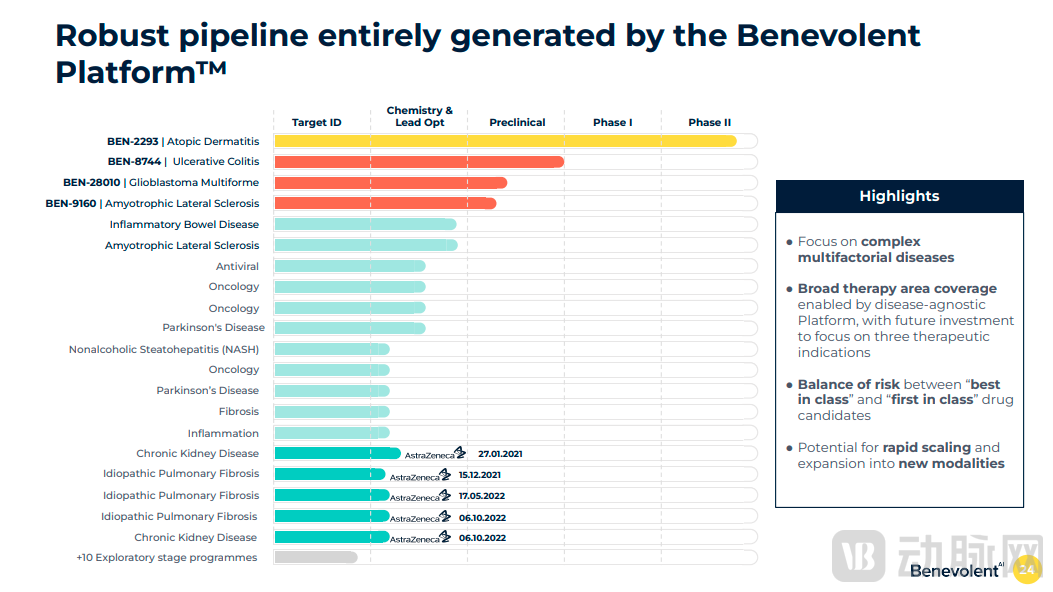
Latest Pipeline Progress of BenevolentAI (Image Source: BenevolentAI)
According to the latest public information from BenevolentAI, the company currently has over 30 drug pipelines under development. Among them, the atopic dermatitis (AD) project BEN2293, which is the most advanced, has entered the relevant research of Phase II clinical trials.
AD is the most common chronic inflammatory skin disease. The treatment needs for itching and inflammation in mild to moderate patients have never been fully met, and existing products, such as steroid creams and other inhibitors, often lead to significant side effects. BenevolentAI used its proprietary knowledge graph to identify Trk receptors as key mediators of itching and inflammation in AD. Inhibition of TrkA can reduce itching, while inhibition of TrkB and TrkC can decrease inflammation, leading to the development of BEN2293, a selective inhibitor targeting three tropomyosin-related kinase receptors. The drug has shown promising results in clinical evaluations regarding efficacy and side effects, with Phase IIa trial data expected to be released earlier this year.
On the other hand,BEN8744 Ulcerative Colitis (UC)It has also approached the endpoint of the preclinical research stage and will initiate clinical trials in 2023. UC is a chronic condition that causes inflammation and ulcers on the inner walls of the colon and rectum, but the exact cause of UC remains unclear. As a result, current treatments can lead to severe side effects, and some patients show limited response to existing drugs. BenevolentAI, based on its proprietary knowledge graph, proposed a solution targeting phosphodiesterase PDE10 as a novel therapeutic target for UC. Although no literature currently indicates a direct link between PDE10 and UC, within two years of PDE10 being validated as a target, the company's team developed an effective peripherally selective inhibitor, BEN8744.
At the same time,BEN9160 Glioblastoma Multiforme, Amyotrophic Lateral SclerosisTwo pipelines have also entered the preclinical research stage. Among the 16 pipelines undergoing compound/lead optimization, five are collaborative pipelines with AstraZeneca, and the company currently has more than ten additional pipelines in the target discovery stage.
It can be seen that BenevolentAI's new drug pipeline targets a wide range of indications, with multiple pipelines accumulated at different stages of development. Therefore, the possibilities brought by its R&D pipelines are greater, and the sustainability of pipeline achievements transformation is also higher. With the accumulation of knowledge graphs and the advancement of pipelines, the possibility of BenevolentAI becoming a large comprehensive pharmaceutical enterprise is also increasing.
BenevolentAI is adept at utilizing its own knowledge graph to explore disease etiology, identify novel targets, and discover the potential for existing drugs to be repurposed for other diseases, achieving "new uses for old drugs."
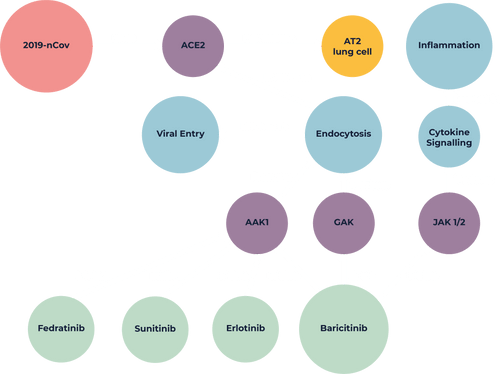
At the beginning of 2020, when the COVID-19 pandemic broke out, BenevolentAI's research team identified OLUMIANT, a drug developed by Eli Lilly for rheumatoid arthritis, as an ideal candidate by using a knowledge graph to search for mechanisms related to viral infection and inflammatory responses. The entire process took only 48 hours.
After verification through clinical research, in November 2020, the WHO and FDA issued emergency authorization for the use of OLUMIANT in hospitalized COVID-19 patients. On May 12, 2022, the FDA converted the emergency authorization into full approval. The anti-inflammatory drug OLUMIANT has thus been repurposed as a drug with off-target antiviral effects.According to data from Eli Lilly's official website, nearly 1 million COVID-19 patients worldwide have received OLUMIANT treatment to date.
Among the currently approved COVID-19 special drugs on the market, Molnupiravir, Paxlovid, Azvudine, etc., like OLUMIANT, are all results of "repurposing old drugs." In response to such large-scale sudden public health incidents, how to quickly discover the relationship between existing drugs and diseases related to the health event, and buy more time for clinical research verification, BenevolentAI's "48-hour case" fully demonstrates the possibility of solving such problems through a knowledge graph.
BenevolentAI has demonstrated the unique advantages of knowledge graphs in target discovery, indication selection, drug repurposing, and more, showing promising results in practical applications. Amid China's rapid development in AI-powered drug discovery technologies in recent years, how has knowledge graph technology progressed within the country?
Currently, the more mature applications in this technical field are general Internet knowledge graphs, such as common search engines, intelligent recommendations, and intelligent Q&A systems. On the other hand, knowledge graphs dedicated to various industries are still in their infancy.In fields such as finance, public security, healthcare, electric power, and military industry, knowledge graphs have already taken initial shape and are being utilized. However, in China's current booming era of AI-driven innovative drug research and development, knowledge graphs in the pharmaceutical research field have yet to become a key player in this intense competition.
At a time when technical feasibility has already yielded positive validation results, what are the main technical difficulties faced in building a knowledge graph in the field of drug research and development? What contributions can constructing such a knowledge graph make to drug R&D? For investors, how much value can this technology add to pharmaceutical R&D companies?
In response to these issues,VCBeat interviewed some enterprises and institutions active in the knowledge graph sector in China: TANSI Intelligence, Baixinghua AI, Derui Zhiyao, and Benchu Capital.
1What are the key technologies required to build a knowledge graph dedicated to drug research and development applications? What might be the key technical difficulties that need to be addressed?
Deng Yafeng, CEO of Carbon Silicon Intelligence:
The difficulties in constructing a knowledge graph come from multiple aspects. Graph modeling mainly involves using AI technologies such as GNN to establish embedding representations for nodes and edges, and employing AI models to predict node attributes and node-to-node relationships. Therefore, constructing a knowledge graph first requires the ability to automatically extract structured information from literature in terms of data parsing, a process that also necessitates the participation of domain experts for annotation. Secondly, merging multiple knowledge graphs is highly challenging, facing issues such as the same entity meaning having different names in different graphs, or entities with different meanings sharing the same name. Additionally, building a knowledge graph in the pharmaceutical field and representation models based on the graph requires comprehensive AI technology, including graph construction techniques, graph embedding representations, reasoning models, and semantic disambiguation techniques used in graph fusion. The noise and missing data problems in the drug development field must also be considered.
CEO of DRUG.AILab, Zhangming Niu:
Novel machine learning technologies, such as neural networks, natural language processing, and reinforcement learning, are key techniques required for the development of knowledge graphs in drug research. In addition to algorithms, rich and high-quality medical and pharmaceutical data serve as the prerequisite and foundation for constructing these knowledge graphs. Following advancements in both algorithms and data, biomedical knowledge graphs will have the potential to offer more cost-reduction and efficiency-improvement support, as well as innovative insights, across various stages of drug development. The main technical challenges that currently need to be addressed include:
(1) How to effectively identify noisy data and high-quality data using algorithms;
(2) Explainability of Knowledge Graph "Prediction";
(3) How to achieve Few-Shot Learning on knowledge graphs in the case of small data;
(4) How to achieve ultra-large-scale drug discovery language models based on big data. It is believed that the future of drug knowledge graphs will have the opportunity to better leverage ChatGPT technology, converting massive amounts of machine language into natural language that researchers can understand more efficiently. At the same time, texts from literature/patents can also be more efficiently recognized and learned by knowledge graph-related technologies, enhancing explainability.
2In the pursuit of reducing costs and increasing efficiency in new drug development, what role can knowledge graphs play in pushing the trend forward?
Deng Yafeng, CEO of Carbon Silicon Intelligence:
The biggest advantage of knowledge graph technology is its ability to leverage various relational data from relevant fields to assist in modeling. For instance, when modeling compound-target relationships, drug-disease and target-disease relationships can be utilized to enhance the modeling process, achieving better results than using only compound-target related data. Therefore, knowledge graph technology can be used independently or integrated with other technologies, offering significant value.
CEO of Derui Zhiyao, Niu Zhangming:
At this stage, knowledge graphs in the biopharmaceutical field generally have two functions:
(1) Data cleaning.
More rapid and efficient integration of information and data cleaning through natural language processing (NLP) and optical character recognition (OCR) technologies, transforming Unstructured Data into Structured Data that machine learning can understand. For example, quickly extracting and integrating data from literature or patents.
(2) Generate creative and inspiring hypotheses (Hypothesis Generation).
The applicable downstream tasks include: drug target discovery, disease mechanism elucidation, drug repurposing, drug-drug interaction, and adverse drug reaction analysis, among other related applications. Previously, DRUGAi has also published relevant research in Briefings in Bioinformatics and Cell sub-journals.
Based on structured data, we aim to systematically uncover the hidden information/patterns (Actionable Insights) behind the data using a knowledge graph, as well as generate new theoretical hypotheses (Hypothesis Generation and Inspiration) through inference. Previously, DRUG.AI has published multiple papers in this area, which is also one of the research directions our company is currently developing. Taking target discovery as an example, a knowledge graph can quickly organize ultra-high-dimensional and complex data, linking different dimensions such as genes, proteins, diseases, compounds, and clinical trials. By employing machine learning methods, it seeks to systematically identify patterns behind the data and generate new theoretical hypotheses (Hypothesis Generation and Inspiration) through AI-based reasoning. This helps researchers understand disease mechanisms, assist in drug target selection, and discover potential new targets.
Wang Suhong, founder and CEO of White Star Flower AI:
Previously, many may have focused more on the role of this technology in the development of first-in-class/best-in-class drugs. However, in the face of the current pandemic, the role of knowledge graphs in "repurposing old drugs" cannot be underestimated. Knowledge graphs can more accurately construct the relationships between drugs, targets, and diseases, rather than merely predicting structures. Through medical knowledge graphs, suitable drugs for the pandemic can be quickly identified. For instance, Pfizer's oral combination drug Paxlovid for COVID-19 includes ritonavir, originally used to treat AIDS; another example is China-produced oral COVID-19 drug Azvudine, which was initially used for AIDS treatment. Thus, it is evident that using knowledge graphs to swiftly identify suitable drugs for pandemics holds significant practical importance in addressing urgent public health emergencies and also brings substantial commercial value.
3For capital, can the support of a knowledge graph help enterprises gain extra points in investment competition?
Vice President of Original Capital, Gao Wenkai:
The data quality and accumulation level of knowledge graphs, along with the platform capabilities of AI algorithms, are key factors in gaining favor from investment institutions. However, the core consideration for capital markets ultimately lies in the progress achieved through a company’s pipeline advancement, as well as the difficulty, innovation, and commercialization process validation of targets and their corresponding indications. BenevolentAI's listing has introduced new perspectives on investment in the AI pharmaceuticals sector for current AI drug discovery startups and investment firms, but it offers more inspiration to domestic startups in terms of "understanding fundamental needs and finding integration points between business and technology." AI pharmaceutical companies capable of building knowledge graphs will undoubtedly possess significant team advantages in medical and pharmaceutical backgrounds, which is one of the differentiated strengths that investment institutions hope to see.
Carbon Silicon Intelligence and Knowledge Graph:
Carbon Silicon Intelligence, established in June 2022, is a provider of intelligent drug discovery technology services. It offers customers a drug design platform product that covers all aspects of new drug discovery and provides AI-based drug design services. In terms of knowledge graphs, Carbon Silicon Intelligence has aggregated and aligned the majority of databases in the field to build a pharmaceutical knowledge graph containing tens of millions of nodes and billions of relationships. Furthermore, they have modeled the graph using knowledge graph embedding techniques such as PairRE. These technologies have been applied in areas like target discovery, drug repurposing, activity prediction, combination therapy, and reverse target identification. Particularly, in drug repurposing based on cold start scenarios, their technology demonstrates an absolute precision improvement of 15% over traditional methods (the related paper has been published in Nature Communications).
Dear Intelligence Pharma and Knowledge Graph:
MindRank is an AI-driven innovative drug discovery company with a one-stop AI-powered drug discovery platform, Molecule Pro. The company focuses on the research and development of new drugs targeting innovative and difficult-to-drug targets, and its self-developed drug pipeline has received FDA IND approval. Its AI pharmaceutical solutions were rated as "one of the 11 most important AI drug R&D breakthrough achievements globally from 2018 to 2020" by Deep Pharma Intelligence. MindRank's biopharmaceutical knowledge graph platform, PharmKGTM, is used for biopharmaceutical data integration and cleaning, assisting in drug target selection, and other related tasks.
White Star Flower AI and Knowledge Graph:
BAIX.AI was founded on September 24, 2020, in Zhongguan Village, Beijing. It is one of the few companies in China that focuses specifically on the field of life sciences as a knowledge graph enterprise. The company primarily targets the pharmaceutical development sector, constructing the broadest range of SCI-labeled methods and precise annotations for pharmaceutical and biological information. Its self-developed BAIX Pharma AI platform has a database of over 1 million entries from real-world/clinical data, a knowledge graph integrating more than 14 million SCI medical literature references, and 12PB of genomic drug data. By extracting key information such as SCI data, hospital data, and clinical databases, it establishes different types of relationships to form connections between nodes. Overall, the BAIX Pharma AI platform can not only retrieve and visually present information from large-scale, complex datasets but also calculate relationships between diseases, targets, and drugs using its proprietary database. This capability supports drug discovery, drug indication expansion, and clinical trials.
About Primordial Capital:
Shanghai Start Financial Consulting Co., Ltd. ("Genesis Capital") was established in March 2016. It is a vibrant boutique investment bank. Genesis Capital has successively entered the education, artificial intelligence, enterprise services, and healthcare industries, providing sell-side consulting services for equity financing to outstanding growth enterprises, as well as investment banking services for domestic and overseas mergers and acquisitions for mature enterprises. Genesis Capital has established an investment banking cooperation network in Europe, North America, and Oceania, with an office in London, UK, enabling it to provide investment banking services to clients, including cross-border transactions.