

Innovation-Driven NewMed Medical Achieves International Leadership in Structural Heart Devices, Files New IPO Prospectus

NewMed
Artificial Heart Valve System Developer
After heart stents and coronary balloons, valve intervention is considered the next big trend in the field of heart disease.
According to the "Report on Cardiovascular Health and Diseases in China 2021," there are approximately 25 million patients with valvular heart disease in China, among which patients with aortic stenosis, mitral regurgitation, and tricuspid regurgitation account for 11.8%, 29.2%, and 25.1% of valvular heart disease cases, respectively. Meanwhile, valvular heart diseases are highly harmful; for instance, the one-year mortality rate for severe mitral regurgitation is as high as 57%.
Based on the large number of patients and the harmfulness of valvular diseases, Frost & Sullivan expects:Emerging Treatment for Aortic Valve Disease: TAVR (Transcatheter Aortic Valve Replacement) - The domestic market in China will exceed 11.36 billion RMB by 2030; Innovative treatment for mitral valve disease: TMV (Transcatheter Mitral Valve Therapy) - The market will be five times larger than the TAVR sector.。
In addition,It is widely believed in the industry that: Valve interventional treatment is the mainstream method for treating valve diseases in the future, with broad prospects.At present, heart valve disease is mainly treated by four methods: medication, traditional open-heart surgery, minimally invasive valve surgery, and interventional procedures. However, medication can only alleviate symptoms and does not address the root cause of the problem; traditional open-heart surgery involves significant trauma and high risks, with high mortality and complication rates in high-risk populations; minimally invasive valve surgery still requires opening the heart and stopping its function, without reducing postoperative complications. Meanwhile,Innovative valve interventional treatments are favored and recognized in clinical settings for their advantages of minimal trauma, less pain, and quick recovery.。
Given the vast market potential and promising future in the field of valve interventions, not only are multinational medical device companies like Edwards, Abbott, and Medtronic accelerating their investments, but approximately 100 innovative enterprises globally are also intensifying their R&D efforts in valve devices. At the same time, this niche sector has attracted significant backing from top-tier investment firms such as Orbimed, Hillhouse, and Sequoia.
In the global valve R&D arms race, multinational medical device companies such as Edwards, Abbott, and Medtronic have made rapid progress and gained significant ground in overseas markets; domestic enterprises, on the other hand, are quickly catching up through innovation, gradually advancing to join the top tier globally.
For example, in the field of transcatheter mitral valve replacement (TMVR), a challenging and trending area in interventional cardiology, the Mi-thos® transcatheter mitral valve developed by NewMed is the first TMVR product in Asia. It was approved by the National Medical Products Administration (NMPA) in 2020 to enter the special review process for innovative medical devices (Green Channel). Currently, there are 3.5-year follow-up results available for patients who have undergone TMVR surgery with Mi-thos®. The follow-up results show that the patient's artificial mitral valve structure and function are all normal, and their cardiac function has significantly improved compared to before the surgery. This patient also holds the record for the longest post-TMVR survival time in Asia.
In addition, NewMed has launched innovative products through technological innovation at the same time as well-known multinational medical device companies. Among them, NewMed's self-developed aortic valve replacement product Prizvalve® and mitral valve repair product Valveclip-M® have both entered the registration clinical research stage, placing them in an industry-leading position.
NewMed is an innovative enterprise focusing on interventional treatment solutions for structural heart disease, with a product pipeline covering all four valves of the human body, including the currently most popular transcatheter mitral valve replacement (TMVR) and repair (TMVr), and transcatheter aortic valve replacement (TAVR). Among these, NewMed already has three products in the "green channel": the Prizvalve® Transcatheter Aortic Valve Replacement System, the Mi-thos® Transcatheter Mitral Valve Replacement System, and the Valveclip-M® Transcatheter Valve Repair System, all of which are in the registration clinical trial stage. Meanwhile, NewMed has proactively laid out the next generation of products.
Prizvalve® is the first domestically produced balloon-expandable TAVR product to enter clinical trials in China. It completed the FIM clinical trial in June 2021 and finished enrolling all patients for the confirmatory clinical trial in June 2022, with an immediate postoperative success rate of 100%. Clinical results show that Prizvalve® can effectively improve the cardiac function of subjects, demonstrating significant clinical importance.
Valveclip-M® is one of the first innovative TMVr products to enter FIM clinical trials in China. It completed the enrollment of all patients in the FIM clinical trial in September 2022. The preliminary results of the trial have shown good safety and effectiveness of the product.
The first TMVR product in Asia, Mi-thos®, is also the first TMVR product in China to enter the FIM clinical trial. Currently, Zhongshan Hospital and Xijing Hospital have successfully completed a total of 10 FIM studies on mitral valve replacement using Mi-thos®, with all cases having finished 30-day postoperative follow-ups. The surgical success rate was 100%, with a 0% mortality rate at 30 days and no major complications during the perioperative period, preliminarily demonstrating the product's good safety and efficacy while essentially confirming the requirements for indication selection and surgical operation standards. In the second phase, the multi-center confirmatory clinical study of Mi-thos® led by Zhongshan Hospital will further demonstrate the safety and efficacy of TMVR surgery.
The valve intervention market is full of fierce competition, but NewMed, the industry leader, is highly confident.
NewMed Chairman Yu Qifeng stated: "Valve intervention is still in the early stages of rapid development. According to Frost & Sullivan, currently, the volume of TAVR surgeries in China is growing at a rate of 50%, but from a penetration perspective, the adoption rate of valve intervention treatments remains severely low. For example, in 2021, only about 0.8% of eligible patients in China received transcatheter aortic valve replacement (TAVR) treatment, while the global penetration rate was only 5%. This indicates substantial room for future growth."
In addition, NewMed also enhances its market competitiveness through differentiated competition, product innovation, and cost reduction.
In terms of differentiated competition, NewMed Medical through the layoutRich Product LineAndDifferent Technical Routes, to significantly enhance market competitiveness.
From the perspective of the product pipeline, NewMed is one of the companies in China with the most comprehensive and innovative portfolio of transcatheter heart valve devices under development. Its products cover mitral valve replacement and repair, aortic valve replacement, tricuspid valve replacement and repair, pulmonary valve replacement, as well as auxiliary devices such as balloon dilation catheters and expandable sheaths.
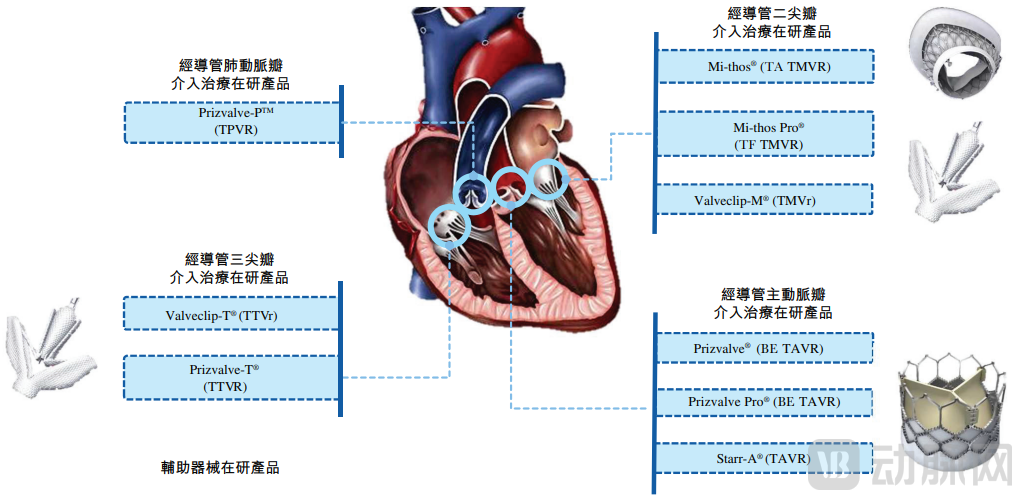
From the technical route perspective, there are currently two approaches in the mitral valve replacement segment: trans-femoral and trans-apical. NewMed's transcatheter mitral valve replacement (TMVR) product, Mi-thos®, utilizes the trans-apical approach. Compared to the trans-femoral approach, the advantages of the trans-apical approach include simpler surgical operation, shorter procedure time and learning curve, and both doctors and patients are spared from X-ray exposure.
It should be noted that NewMed has long mastered the femoral access technology, and its developed transcatheter mitral valve repair (TMVr) product, Valveclip-M®, is delivered via femoral access.
In terms of product innovationNewMedFrom the Perspectives of Doctors and PatientsConsider the optimization and innovation of devices to better meet clinical needs.
Taking the balloon-expandable valve Prizvalve® as an example, the reason for choosing to develop this product is that the NewMed team observed many patients who had previously undergone open-heart surgery to implant artificial valves or annuloplasty rings but faced the need for a second surgery years later due to valve damage. Addressing the significant clinical pain point of secondary valve degeneration, NewMed's Chairman Yu Qifeng led the technical team in conducting extensive technical research and analysis, concluding that balloon-expandable valves could effectively solve such issues.
Due to the high technical barriers in large balloon processing and balloon expansion technology, domestically developed transcatheter aortic valve replacement products in China have predominantly adopted the self-expanding technology route. After repeated trials and validations, dozens of design optimizations and iterations, and extensive animal experiments, NewMed finally overcame the challenges of large balloon processing and balloon expansion technologies. They successfully developed Prizvalve®, the first balloon-expandable transcatheter aortic valve in China, filling the domestic market gap for China-produced balloon-expandable valves.
Compared with the self-expanding technology route, balloon-expandable valves have the advantages of a lower stroke incidence rate, a lower permanent pacemaker implantation rate, and a lower risk of paravalvular leakage, which can bring more benefits to patients.
In addition, NewMed has also innovated in the aspects of valve stent design, sealing skirt design, and delivery system design, making Prizvalve® more compatible with the physiological and pathological anatomical structure of Chinese patients. For example, the delivery system of Prizvalve® has excellent bending adjustment capabilities, allowing for precise positioning and intraoperative bending adjustments through the aortic arch; the size design of the expandable sheath is more suitable for the smaller vascular access dimensions characteristic of Chinese patients.
So far, Prizvalve® has been successfully used in over a hundred cases of new technology applications for valve-in-valve and ring-in-valve treatments, achieving excellent clinical outcomes. Additionally, the Prizvalve® balloon-expandable valve technology has been applied in all four human heart valves, with expectations of broader application in the future.
On December 14, 2022, NewMed's self-developed Prizballoon® Aortic Valve Balloon Dilation Catheter received NMPA approval for marketing. This product is expected to provide clinicians with a more reliable and safer integrated solution that is in sync with international standards when combined with the Prizvalve® valve system in the future.
In terms of cost reductionNewMed is strengthening product innovation, promoting the localization of raw materials, enabling its products to gain a competitive edge in pricing and cost in the market, and benefiting more patients.
Based on the strategic layout in three aspects: differentiated competition, product innovation, and cost reduction, NewMed has not only developed several innovative products urgently needed in clinical settings but also grown into a first-tier enterprise globally. It has been recognized by clinical experts as a model of industry innovation.
NewMed is considered an industry innovation model for two reasons: first, it places high importance on patent layout and protection, with over 340 patent applications, of which more than 150 are invention patents; second, it has three products approved by the NMPA to enter the special review process for innovative medical devices. NewMed is a structural heart disease company with the most products and the broadest categories in the "green channel" within the same industry.
The above achievements were mainly due to the following points, according to Yu Qifeng:
First, the core management team of NewMed has more than 15 years of relevant work experience and is highly strategic; 50% of the employees are R&D technical personnel, and 90% of the technical talents are from key universities in China or overseas prestigious institutions, or have extensive industry experience.
Second, NewMed has built a complete proprietary technology innovation platform covering medical metal materials, medical polymer materials, biological tissue processing, and large balloon technology. These major technology platforms are interdependent and complementary, and can be used in almost all of NewMed's product layouts, helping NewMed accelerate innovation.
Third, NewMed adheres to the combination of medical and engineering, establishing long-term cooperative relationships with top hospitals, PIs, and KOLs in China's structural heart disease field. By deeply understanding clinical needs, they work together with experts in the cardiovascular disease field to optimize and innovate medical devices.
Fourth, NewMed has built an innovative model that combines industry, academia, research, and medicine. It has jointly established multiple "Technological Innovation Joint Laboratories" with renowned universities and research institutions such as Sichuan University, West China Hospital, and Zhejiang University, as well as hospitals. These laboratories focus on conducting cross-disciplinary, cross-field, and cross-professional applied basic research in the field of structural heart disease treatment to tackle key challenges in various areas.
Nowadays, based on its extensive experience in new product research and development and industrialization, NewMed has established the "NewMed Singularity Innovation Center." According to reports, the NewMed Singularity Innovation Center, with the mission of "endless frontiers," adheres to the R&D concept of continuous innovation. It builds a close innovation chain and ecosystem that integrates government, industry, academia, research, medicine, and investment, creating a Chinese version of Biodesign.
It is reported that the Biodesign Innovation Center is a globally leading industrial innovation and entrepreneurship platform focused on advanced healthcare technology innovation. It has not only received support from Stanford University but also gained attention and recognition from top international medical device companies such as Johnson & Johnson and Abbott.
NewMed Singularity Innovation Center,对标Biodesign, actively tracks the cutting-edge innovation trends in the industry in real time, comprehensively promotes the pre-research and incubation of innovative products, and enhances the core competitiveness of NewMed. For instance, in 2022, NewMed successfully incubated Shanghai Huanqing Medical Technology Co., Ltd., which focuses on advancing the research and development and industrialization of internationally advanced cardiovascular circulatory support products and related auxiliary devices. In January 2023, Huanqing Medical won the Field Competition Excellence Award at China’s Disruptive Technology Innovation Competition with its project "Research on Miniature Interventional Artificial Heart Technology and Prototype Development," marking its initial emergence in the field of frontier innovation.
Yu Qifeng stated that in the future, NewMed will deepen its cooperative relationships with Principal Investigators (PIs) and Key Opinion Leaders (KOLs), strengthen academic promotion, and pave the way for the commercialization of its products. At the same time, NewMed will also rely on the platform of NewMed Singularity Innovation Center to nurture new projects in multiple emerging high-end medical device fields, promote the incubation and implementation of innovative achievements, and facilitate the transfer, transformation, and industrialization of technology and outcomes.