

Why Abbott and Boston Scientific Are Pouring Billions into Peripheral Interventions: The Rise of a High-Stakes Medical Device Arena

Abbott
Diagnostic and pharmaceutical product manufacturers
In February 2023, medical device giant Abbott announced an $890 million acquisition of Cardiovascular Systems, Inc. (CSI), a leader in peripheral interventional rotational atherectomy. This deal garnered widespread attention.
This is not the first time that the peripheral intervention field has attracted the attention of industry giants. In 2022, a multinational healthcare company made its first acquisition of a Chinese publicly traded company in five years—Boston Scientific's $523 million acquisition of 18A company Centry Medical also occurred in the peripheral intervention sector.
Cardiovascular Systems and Cercor Pipeline partially overlap. The core product of Cardiovascular Systems is the DIAMONDBACK360® Peripheral Plaque Atherectomy System, which was approved for marketing in 2019. Plaque atherectomy products are also included in Cercor’s pipeline, with an expected market launch in 2023.
Abbott Makes a Significant Move in the Peripheral Intervention Field. In recent years, Abbott has been unstoppable in the medical device field, showing strong performance. In the field of structural heart disease, the interventional mitral valve repair product Mitraclip stands out; in the heart failure field, Hearmate3 defeats Medtronic's artificial heart; in diabetes management, CGM products are making a fortune; in electrophysiology, it is also competing with Johnson & Johnson.
Abbott, with its strong and high-growth momentum, is increasing its investment in the peripheral intervention market, which could potentially alter the current market landscape dominated by Medtronic and Boston Scientific.
Endovascular intervention is divided into three major fields: coronary intervention, neurointervention, and peripheral intervention. Among these three fields, the coronary intervention market was the first to take off.
In the last two decades, giants have fiercely competed in the coronary intervention market. Johnson & Johnson, Boston Scientific, Medtronic, and Abbott have all taken turns at the top of the industry. In order to capture the market, Abbott once provided funding to Boston Scientific to help defeat Johnson & Johnson's acquisition of Guidant.
As part of this transaction, Guidant's vascular and endovascular disease treatment business was integrated into Abbott. Boston Scientific paid $26 billion for the entire Guidant deal. Subsequently, Abbott paid Boston Scientific $4 billion for Guidant’s vascular and endovascular disease treatment business.
After acquiring Guidant and gaining its robust stent technology, Abbott's core stent product, the drug-eluting stent Xience V, entered the market in the later period of the drug-eluting stent era. The approval of the XIENCE stent made it the most frequently implanted drug-eluting stent globally, enabling Abbott to take the lead in market share within the coronary intervention field.
Two decades later, the coronary intervention market growth entered a plateau period. From 2003 to 2016, the number of PCIs performed annually per 100,000 American adults in the United States decreased from 366 cases per 100,000 people to 180 cases.
The热度 of the coronary intervention field is gradually decreasing, and the peripheral intervention market is beginning to become the new battlefield for giants.
With the accumulated advantages in the stent field, Abbott still occupies a place in the peripheral interventional stent market and maintains a certain advantage in the peripheral bare stent market.
But if Abbott relies solely on its stent products, it will be difficult to compete against the current leaders Boston Scientific and Medtronic in the peripheral intervention field.
First, there are limitations to the clinical application of bare stents. Although traditional bare stents and plain balloons are still mainstream products, they have limitations. Due to the high probability of restenosis with plain balloons and complications caused by stents, such as in-stent restenosis (ISR), both types of more traditional minimally invasive interventional treatment devices—bare stents and plain balloons—have certain limitations.
Secondly, the physiological structure of peripheral lower limb arteries imposes extremely high demands on stents. In peripheral vessels, due to the femoral and popliteal arteries being subjected to various complex mechanical forces such as radial compression, axial compression, rotation, and bending, the stent implantation affects not only the implanted vascular segment but also exerts mechanical effects on adjacent vascular segments. Particularly, bending and folding near joint areas make the stent prone to deformation and fracture, impacting vascular patency.
Therefore, for superficial femoral artery interventions above the knee, it is recommended to implant nitinol stents with high fatigue resistance. However, stent implantation is not recommended for the popliteal artery. For infrapopliteal arterial lesions, due to the smaller vessel diameter and longer lesion length, stents are also not suitable for treating infrapopliteal lesions.
Two Major Factors Determine the Limited Ceiling of Stent Products in the Peripheral Intervention Field. Unlike the coronary market, where a single stent can support a market share of millions, the peripheral intervention field emphasizes product combinations. Against this backdrop, Abbott's product line in the peripheral intervention field appears thin.
Medtronic and Boston Scientific have both established complete product lines in the peripheral intervention field.
Medtronic has integrated previously acquired products in the peripheral intervention field to form a combination of PTA balloons, drug-coated balloons, plaque excision systems, and venous closure for varicose veins. Among them, the PTA balloon comes from the Chocolate PTA balloon of QT Vascular acquired in 2018; the drug-coated balloon is from the acquisition of Invatec; and the HawkOne plaque excision system was acquired from Covidien in 2015.
Boston Scientific has laid out three core products: drug-eluting stents, drug-coated balloons, and aspiration. In 2020, Boston Scientific's drug-eluting stent was launched in China, which is its flagship product in the peripheral field. The major move in the drug-coated balloon field was the acquisition of a domestic company, Cercor. Cercor’s peripheral drug-coated balloon was approved in China as early as 2016, leading in market share domestically.
Abbott's Products Aren't Enough, So Acquisitions Fill the Gap. Abbott is also bolstering its peripheral intervention market through acquisitions. Prior to this acquisition of Cardiovascular Systems, in 2021, Abbott acquired Walk Vascular, incorporating its minimally invasive mechanical peripheral thrombectomy system into Abbott’s existing endovascular portfolio. Walk Vascular's JETi Peripheral Thrombectomy System breaks down each thrombus using saline jets at the distal end of a catheter without damaging surrounding blood cells and then removes the fragmented thrombus via a vacuum pump to prevent further blockages. On average, the entire procedure takes just over an hour.
Compared with Medtronic and Boston Scientific, Abbott's peripheral intervention strategy shows a stronger preference for debulking devices. The rotational atherectomy company CSI, recently acquired by Abbott, is a leader in the peripheral rotational atherectomy field.
What Are the Characteristics of CSI That Caught Abbott's Attention?
CSI is a medical device company focused on developing and commercializing innovative solutions for treating vascular and coronary artery diseases. CSI's main product is the plaque debulking system used in the treatment of coronary artery disease and peripheral artery disease. In the peripheral artery market, CSI launched the DIAMONDBACK360® Peripheral Plaque Debuking System, which received FDA approval for market release in 2019.
Rotational atherectomy products belong to peripheral interventional debulking devices. From the strategic layout of giants in the peripheral market, it can be seen that in addition to passive products such as balloons, stents, and guidewires, the giants have also bet on products that can remove plaques, such as rotational atherectomy, rotational cutting, and excision. This type of product belongs to debulking devices in the peripheral interventional market.
Driven by the clinical concept of "intervention without implantation," the idea of debulking has emerged to reduce the occurrence of restenosis after endovascular treatment. Debunking devices can remove plaques from the vascular lumen. Currently, several widely used debulking devices in China mainly include Rotational Atherectomy (RA), Directional Atherectomy (DA), Excimer Laser Ablation (ELA), Percutaneous Mechanical Thrombectomy (PMT), and Orbital Atherectomy (OA). Different debulking devices have different mechanisms and are suitable for different types of lesions.
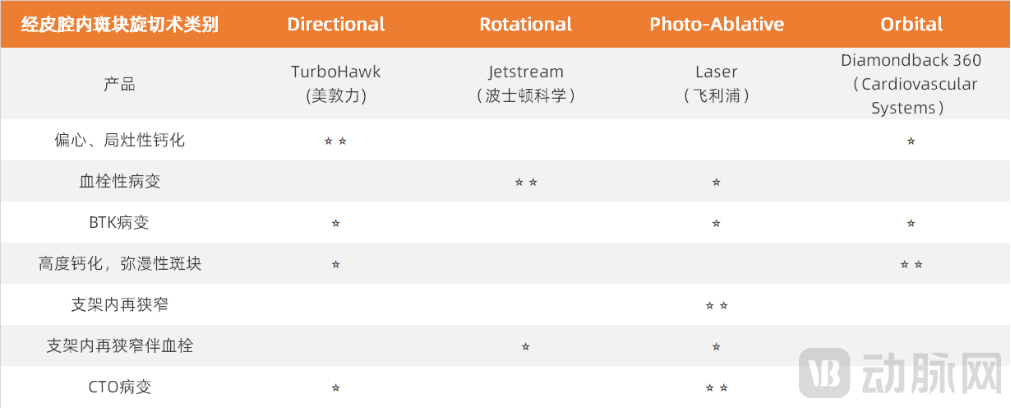
Atherectomy Devices and the Advantages of Each Device (Image Source: Atherectomy for Lower Extremity Intervention: Why, When, and Which Device?)
Abbott Bets on the Plaque Atherectomy Track This Time.
Plaque Rotablation: The "Diamond Drill" Walking in Blood VesselsRotablation refers to the use of a high-speed rotating burr to grind atherosclerotic plaques and calcified tissues in arteries into extremely fine particles. The rotablation process can grind the plaque into small particles, with sizes <5 μm (red blood cells are 6-8 μm). These micro-particles can be degraded by the human phagocyte system, thereby eliminating the plaque that blocks the vascular lumen. It is suitable for severe calcified lesions. Rotablation products can achieve differential cutting; the grinding head can distinguish between plaque and healthy elastic blood vessels. Weaker tissues can shift under the rotating grinder and are less likely to be damaged, while less elastic plaques will be preferentially cut.
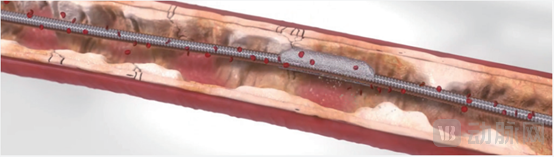
Rotational Atherectomy Product Working Diagram
The significance of rotational atherectomy lies in the pre-treatment of vascular occlusive lesions. In clinical practice, some vessels are completely occluded, making it impossible for even guidewires to pass through. The importance and value of rotational atherectomy products lie in their ability to help physicians achieve a more uniform and larger lumen. During the procedure, small fissures are created within calcified plaques, increasing lesion compliance and responsiveness to PTA, which significantly reduces the incidence of dissection and improves the success rate of the surgery.
Global Peripheral Rotablation Market Shows Strong Growth, CSI Dominates.Globally, Cardiovascular Systems, Inc. (CSI) dominates the peripheral arterial rotational atherectomy market. The peripheral artery market is a key revenue driver for CSI. Despite the impact of the COVID-19 pandemic during the fiscal year 2021, CSI still achieved a 9.5% growth in performance, with revenue reaching $259 million. The peripheral market contributed the majority of this income, with CSI’s peripheral device revenue amounting to $176.9 million, marking a 6.3% increase, while coronary device revenue reached $82 million.
In the field of coronary arteries, the reasons for the low usage of rotational atherectomy products are as follows: Coronary artery plaque rotational atherectomy can only address superficial calcification of the intima but is "helpless" against medial calcification, calcified nodules, or severe calcification, requiring combination with other devices. On the other hand, the device operation is relatively complex, with a long learning curve and a higher incidence of postoperative complications.
Can CSI replicate its overseas market growth in the domestic market?
In terms of market capacity, the peripheral interventional market at home and abroad is still in its early stage of development, with products almost in a blank phase. However, several companies in China have already started to enter this market.
Unlike Abbott, which has chosen the rotational atherectomy route, domestic companies in China are betting on shockwave balloon technology. The shockwave balloon can efficiently and safely fracture calcified plaques without damaging the vascular intima. It is effective in treating calcified nodules, eccentric calcification, and both superficial and deep calcified lesions. It is suitable for the pretreatment of moderate to severe calcified lesions in coronary or peripheral arteries, and doctors find it relatively easier to learn to operate. Companies currently involved in this field include Genesis Medtech, Ceyear Medical, Puchuang Medical, and Zhenyi Medical.
It can be foreseen that, in the future, as products from multiple companies are successively approved, the competition in the peripheral interventional debulking field will be intense.
In the peripheral intervention sector, foreign giants have chosen the path of a product portfolio combining balloons, stents, and debulking. In the Chinese market, are there any companies that can rival these giants?
Several companies in China's peripheral intervention field have adopted the same strategy. Innova Medical, acquired by Boston Scientific, possesses drug-coated balloons, aspiration, and rotational atherectomy products, with relatively advanced product development progress. Changde Medical is committed to efficiently creating a comprehensive solution in the peripheral intervention device field, developing products such as drug-coated balloons, catheters, stents, and thrombectomy devices for peripheral arterial and venous diseases. Some domestic companies have chosen to refine individual products while gradually completing their product lines, such as Tianhong Shengjie, which focuses on peripheral veins, and Dingkang Medical, which specializes in balloon technology.
For Abbott, in recent years, Abbott has achieved success in multiple fields of medical devices, outperforming early entrants in the fields of structural heart disease, artificial heart, and blood glucose management.
Abbott has demonstrated the innovation of its product design and the strength of its commercial advancement in multiple fields. With this acquisition of the Rotablation product, will Abbott once again make a leap forward and reshape the peripheral intervention market in the future? Let's wait and see.