

MoleculeX Secures Over RMB 100 Million Strategic Investment from Kaisyn Biosciences to Advance MoleculeOS, the 'ChatGPT for Protein Design'
MoleculeMind
AI Protein Design Platform Developer

Cathay
R&D and Manufacturing of Bio-based Materials

LCIG
Tech Industry Investment Firm

HongShan
Business Consulting, Enterprise Management Consulting Investment Institutions
36Kr learned that the AI protein design platform "MoleculeMind"Recently completed a strategic financing round exceeding 100 million yuan, led by the synthetic biology listed company"CathayShanghai Cathay Biotech R&D Center Co., Ltd. (688065.SH) led the investment, Lenovo Ventures followed up, and HongShan, the leading investor in the angel round, added further investment. This round of financing will be used for the development of the AI protein optimization and design platform MoleculeOS, exploring the application of platform capabilities in biopharmaceuticals, synthetic biology, and other industries.This is the second round of investment that MoleculeMind has received within one year of its establishment.。
The lead investor of this round, Shanghai Cathay Biotech R&D Center Co., Ltd., is a representative enterprise in China's synthetic biology field. Its bio-based long-chain dicarboxylic acid series products hold approximately 80% of the international market share, with clients including DuPont, EMS, and Novo Nordisk. Additionally, Cathay Biotech’s bio-based sebacic acid, bio-based pentamethylenediamine, and bio-based polyamide products have production capacities reaching tens of thousands of tons, with planned construction to expand capacity to hundreds of thousands of tons.
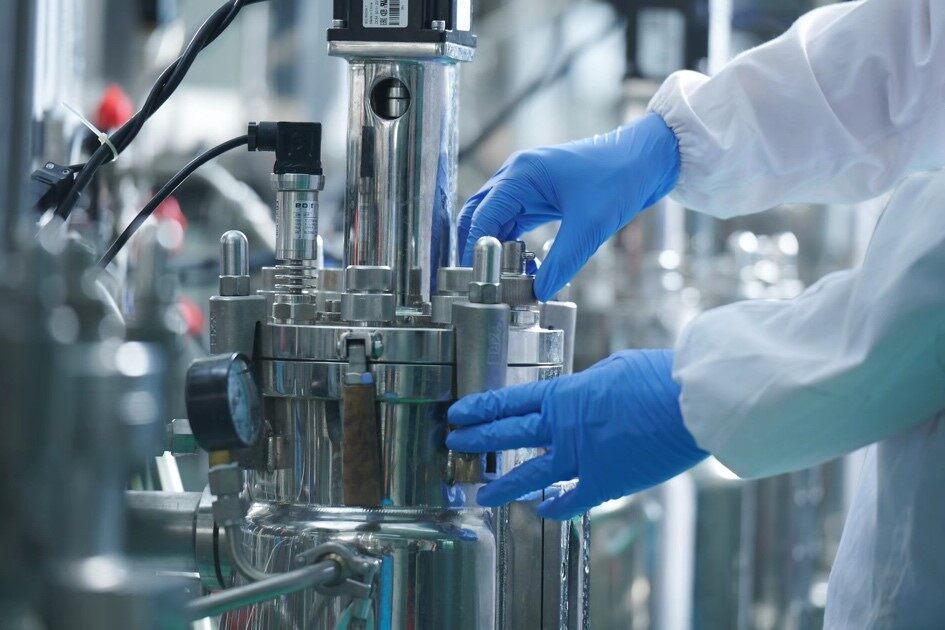
Photo provided by the company
"The industrialization project of Cathay Biotech has proven that synthetic biology technology can create products more competitive than those made through chemical methods," said Liu Xiucái, Chairman of Cathay Biotech. "This collaboration between Cathay and MoleculeMind introduces AI technology into the biomanufacturing R&D system, starting from the scientific origin to enhance the research efficiency of new technologies and products."
MoleculeMind was founded by Professor Jinbo Xu, with research and development centers established in both China and the U.S. The company has assembled a team of computational biology experts, most of whom have overseas prestigious university research backgrounds. Xu currently serves as a professor at the Toyota Technological Institute at Chicago and a visiting professor at Tsinghua University's Institute for AI Industry Research (AIR). He has conducted extensive research in the field of AI protein prediction and design. In 2016, he developed the RaptorX-Contact method, which first demonstrated that deep learning could significantly improve the accuracy of protein structure prediction and later inspired DeepMind.
MoleculeOS, an AI-powered protein optimization and design platform independently developed by MoleculeMind, utilizes data-driven deep learning algorithms to analyze the expressivity, stability, and drug-like properties of proteins. It assists industry experts in identifying suitable proteins or directly designing and generating desired proteins, accelerating the industrial transformation of laboratory outcomes.
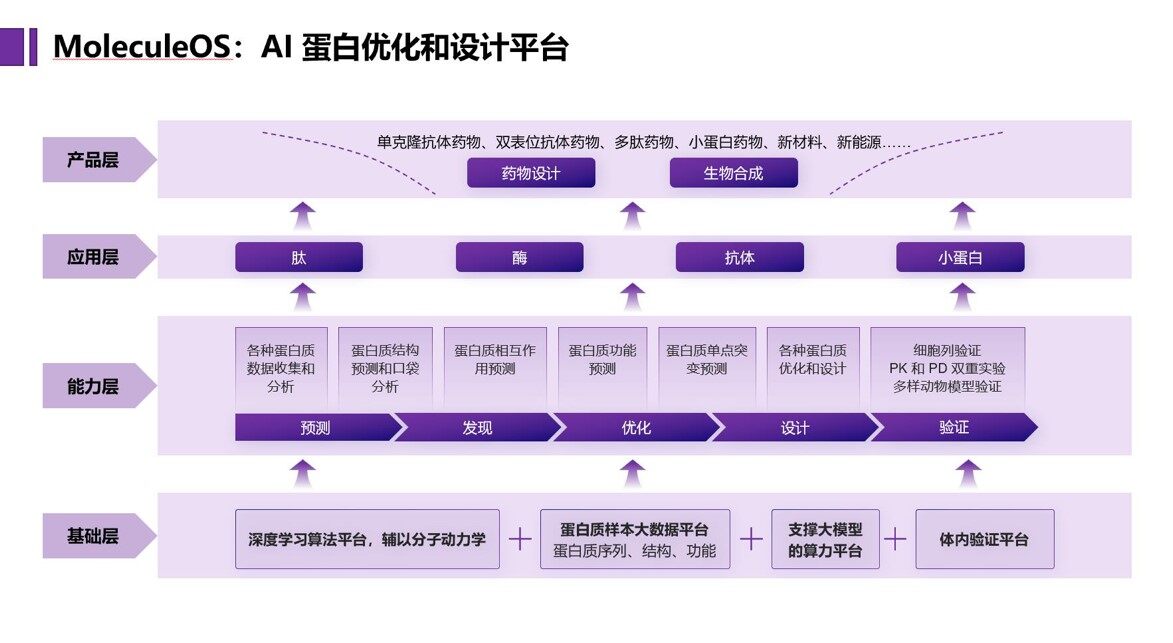
Photo provided by the company
Based on the ability to identify, modify, and design suitable proteins from scratch, this platform will be used for the design and research of peptides, antibodies, enzymes, and small proteins, making the development of large-molecule innovative drugs closer to being programmable and predictable. In addition to biopharmaceutical R&D, the AI-powered large-molecule optimization and design platform is also applied to synthetic biology. For example, it can be used to produce renewable biofuels to address energy and environmental issues, or to create new industrial enzymes with stable functions using AI.
"MoleculeMind possesses AI protein technology, while Shanghai Cathay Biotech R&D Center Co., Ltd. has a complete industrial layout and multiple product lines. The collaboration between the two parties will enable the deep application of AI protein technology in the field of synthetic biology, driving the intelligent upgrading of biomanufacturing to develop new materials with greater market and environmental value," said Xu Jinbo, founder of MoleculeMind.
It is reported that the current algorithms of MoleculeMind can be applied to protein and complex structure prediction, de novo protein design, and protein function prediction, among other areas. For instance, it has made certain breakthroughs in AI-based single-sequence protein structure prediction. After years of research, academia and industry have reached a consensus: deep learning significantly improves protein structure prediction and can accurately predict the general shape of most protein three-dimensional structures. However, a common flaw exists in various AI algorithms in the industry—they heavily rely on MSA (multiple sequence alignment from homologous proteins) and its derived co-evolution information and sequence profiles during prediction. As a result, "AI protein prediction methods that do not use homologous sequences and co-evolution information" have become a focal point of interest in the industry.
Based on the MoleculeOS platform, MoleculeMind has proposed an AI single-sequence protein structure prediction algorithm that directly predicts protein structures from primary sequences without using MSA. Additionally, the model and parameters employed are more lightweight. This algorithm is expected to enhance the exploration efficiency and application boundaries of protein structure prediction.
Currently, the potential of ChatGPT in the AIGC field has been tapped and recognized, and the industry's attention to generative AI has reached a new height. In the life sciences sector, recent years have seen continuous technological breakthroughs in designing and generating proteins from scratch using AI algorithms. These novel proteins are also being applied in the research and development of new drugs such as antibodies and peptides, as well as in the field of synthetic biology. At present, several startup companies are gradually emerging in China, and 36Kr will continue to monitor the developments and progress in this area.
Reference Reading: