

FarSight Vision Launches IPO Filing: Building the 'iOS' of Vision Therapy with VR-Based Digital Therapeutics Platform
It seems that no one can deny the outstanding contribution of optometry projects to the development of the ophthalmology industry in recent years.
Taking Aier Eye Hospital as an example, in the first half of 2022, its optometry service project generated a revenue of 1.763 billion yuan, second only to the 3.438 billion yuan from the refractive surgery project, making it the second-largest source of revenue for Aier Eye Hospital. Moreover, compared to the first half of 2021, it increased by 15.67% year-on-year, with the growth rate also being second only to the refractive surgery project. (Data source: Aier Eye Hospital's 2022 Semi-Annual Report)
To some extent, the revenue structure can reflect a company's strategic layout, and the revenue results are also the best verification of the corporate strategy. In view of Aier Eye Hospital's leading position in China’s ophthalmic medical services industry, its strategic deployment could be regarded as a weathervane for the development of ophthalmic medical services and even the entire ophthalmology industry in China. Therefore, Aier Eye Hospital's semi-annual report for 2022 reveals the significant importance of optometry projects to its revenue. Moreover, optometry projects will become increasingly vital for Aier Eye Hospital.
"We hope that through the exploration and innovation of the optometry clinic model, optometry business will become the company's largest business, with revenue share gradually increasing to over 20%-30%," Wu Shijun, Secretary of the Board of Aier Eye Hospital, revealed to the public in 2013. This means that as early as 2013, this giant of China's ophthalmic medical services had already recognized the importance of optometry business and adjusted its strategy to embrace this significance.
Naturally, many other enterprises in China have also realized the importance of optometry businesses and put it into practice, such as Oupukang Vision, which focuses on eye health and myopia prevention and control technologies and services, eye medical service institutions like Chaoju Eye Hospital and He's Eye Hospital, as well as medical device companies producing reversal lenses and traditional vision training instruments. With the rise of the digital therapeutics concept in recent years, its broad application prospects in the field of optometry have also attracted innovative companies to explore. The protagonist of this article — Shenzhen Foresee Vision Technology Co., Ltd. (hereinafter referred to as Foresee Vision) — is one of them.
The management team of FarVision is highly characterized by the integration of medicine, engineering, research, commerce, and management. It includes senior executives from Fortune 500 companies, professionals with a background in communication technology, and senior experts in medicine and VR technology. Based on over 30 years of preliminary R&D achievements from the Institute of Physiology at the Chinese Academy of Sciences, modern ophthalmology theory and practice, as well as VR technology, they have launched the "FireEye Crystal" intelligent vision device, which can be used for myopia prevention and control as well as amblyopia training.
Moreover, this intelligent vision screening device passed the national standard, "Evaluation Method for the Impact of Virtual Reality Products on Visual Health," formulated by Zhongshan Ophthalmology in 2022. After laboratory testing and human trials, it was verified as a low-risk product for visual health and will obtain Class II medical device certification in April 2023.
The story begins with three men, a drink, and a grand idea.
CEO Yang Peng and Chief Marketing Strategist Chen Wei — one with 18 years of experience at Huawei, having served as President of the R&D Product Line, General Manager of multiple overseas countries, and President of the Latin America Regional Carrier Business; the other as the former head of Huawei's Wireless 4G & 4.5G product launches, and having held positions such as Executive Vice President of Bestconsulting Group and Vice President of Xingchen Technology Group. These two core members of Visionary Insight, equipped with profound experience in the communications industry, firmly believe in the potential of the post-5G era’s terminal devices and ecosystem applications, especially the development of VR technology. Therefore, in the second half of their careers, Yang Peng and Chen Wei are seeking entrepreneurial opportunities in the VR vertical, hoping to leverage their accumulated ICT and digitalization expertise to assist and empower certain traditional industries.
By a twist of fate, the two entrepreneurs met Xiong Xu, the current Chief Product Officer of Foresee Vision, who is a specialist in PANCAKE technology with eight years of product experience in the VR/AR industry and has designed VR solutions for numerous well-known large enterprises. Regrettably, Xiong Xu's child suffers from severe amblyopia and has endured great suffering in the process of seeking medical treatment. Thus, after a banquet, a startup idea emerged from the hearts of these three fathers — given that the imaging principle of VR is similar to that of the human eye and there are successful cases abroad of using VR for eye health recovery, could vision training content be moved to a VR platform? Could patient compliance be improved through engaging content, along with more scientific training methods to enhance the training effect?
Moreover, after the initial market research, the three became even more excited: the market for myopia prevention and control among teenagers and children is vast, with policy encouragement and parental anxiety, yet the industry faces issues such as fragmentation and unequal distribution of medical resources — for instance, according to Frost & Sullivan, in 2019, China had only 0.7 ophthalmic hospitals per million people, and about 3.5 ophthalmologists per million people, far fewer than Japan's 127, America's 72.1, and Europe's 56.
At the same time, in recent years, driven by favorable policies, industries related to myopia prevention and control for children and adolescents, such as the "three key solutions for myopia control" – orthokeratology lenses (OK lenses), atropine, and defocus lenses – have experienced rapid development. However, each of these solutions has certain limitations and adaptability issues. For example, OK lenses are expensive, require professional optometry and regular follow-ups, need to be replaced annually, and can only be provided by medical institutions at or above the secondary level. Defocus lenses, on the other hand, are purely optical solutions without active intervention effects, while atropine carries potential risks of adverse drug reactions and is currently only available as an in-hospital reagent.
"In other words, 'On the one hand, the demand for myopia prevention and control is enormous; on the other hand, this market is still relatively fragmented and, to a certain extent, a mixed bag with varying quality levels,'" said Chen Wei, Chief Marketing Strategist of Foresee Vision. "This means that non-surgical, non-pharmaceutical, safe, healthy, and effective professional vision training solutions can provide doctors and parents with another excellent option."
Facing the fragmented state of the industry, how can we propose more professional solutions to meet the enormous demand? Insight Vision drew inspiration from the logic of internet platforms—on one hand, by collaborating with experts on innovative projects to transform knowledge outcomes, and using feedback from patient diagnostic data to further iterate, ultimately forming a unified medical paradigm; on the other hand, by using quality products and content to further aggregate users. Therefore, Insight Vision actually aspires to be a platform company focused on digital therapeutics for optometry, rather than just another pure medical device enterprise.
But there is no doubt that good products and high-quality content are a key part of Yuanjian Ruishi's business concept, and also an indispensable part of our exploration of Yuanjian Ruishi.
The training paradigm of the first generation of FarVision "Fire Eye Crystal" Intelligent Vision Instrument was derived from the CAS Vision Instrument co-developed by Professor Ji Wanzhong, a senior engineer at the Chinese Academy of Sciences (CAS), and Academician Yang Xiongli based on their research "Measurement and Study of Ocular Steady Accommodation."
The academic principle applied by this optometry instrument is the accommodation theory, which attributes myopia to the decline in the ciliary muscle's accommodative ability caused by visual fatigue, leading to pseudomyopia. This increases the conditions of hyperopic defocus and image lag, which can easily induce axial elongation and develop into axial myopia. Through targeted training of the ciliary muscle’s accommodative power and sensitivity, the stimulation of accommodative lag on axial growth can be reduced, effectively controlling myopia.
In the early documents released by the National Education Commission, as well as the Shanghai and Nanjing Municipal Education Commissions, which mentioned the CAS Satellite TV Device, the phrase "treatment effectiveness rate of 92%" appeared.

However, this CCTV instrument from the Chinese Academy of Sciences is, after all, a product of 1993. How to make it better meet the needs of current and future optometric training has become the primary task of Foresight Vision.
In response, based on the core functions of the CAS TVS (Chinese Academy of Sciences Tele-Vision System), ForeVision proposed the product development concept of "More Scientific, More Portable, and Smarter." "More Scientific" means that while the CAS TVS is merely an optometric training instrument, ForeVision has expanded from an overall solution of "Measure, Protect, Train, and Consult," adding sections such as optometric detection, vision record-keeping, personalized and customized precision medical training plans, training effect tracking, and expert consultation to adapt to the characteristics of myopia prevention and chronic disease management.
Moreover, in terms of training paradigms and content, Forward Vision has inherited and optimized the product advantages of the CAS TV Trainer. Among the enhancements, the addition of engaging training content to improve compliance goes without saying. Two key points deserve special mention: first, the continuation of the "monocular training" feature of the CAS TV Trainer. This is primarily because "in cases of significant anisometropia, if binocular training is used, the brain will automatically suppress the image from the auxiliary eye. Thus, in such cases, so-called binocular training essentially only trains one eye, and the suppression during training may lead to worsening vision in the auxiliary eye," explained Chen Wei.
Secondly, similar to the training paradigm adopted by the CAS Satellite TV, which uses specific rhythm + specific spectrum + optotype brightness, Foresee Intelligent Vision also adopts a training paradigm of specific rhythm + specific spectrum + optotype brightness. However, the difference is that Foresee Intelligent Vision uses VR display technology, which enables the optotype to move back and forth continuously at a specific rhythm between 0.15 meters and infinity, thereby enhancing the ciliary muscle's adjustment ability. Moreover, since high-energy blue light can easily cause damage to retinal epithelial cells, Foresee Intelligent Vision, in collaboration with BOE, has introduced a customized anti-blue light design and obtained the German TÜV Rheinland anti-blue light certification. This design reduces the intensity of high-energy blue light by 77.5% while ensuring no color distortion.
Not only that, the CCTV instrument from the Chinese Academy of Sciences weighs about 1kg and requires a power connection, while the FarVision intelligent CCTV instrument weighs only 0.16kg and can be carried around for use. The product's lightweight portability is due to FarVision's core advantages accumulated in hardware technology.
According to Chen Wei, the lens used in Yuanjian Ruishi's intelligent optometry instrument is a Pancake lens. The processing precision and difficulty of the lens barrel even surpass those of a Nikon DSLR camera, making it the thinnest and lightest home optometry instrument, vision training device, and head-mounted projector in the industry.
As for "smarter," Yuanjian Ruishi hopes to make personalized training programs more refined through the accumulation of more data. It is reported that, to date, Yuanjian Ruishi has accumulated over 5,000 users and provided a total of 1.2 million minutes of visual training services. Based on the training data of more users in the future, it hopes to "make user test data more accurate, training plans more scientific, and training effect evaluations more optimized," with more targeted and personalized approaches in user training patterns, duration, content, frequency, and effectiveness, ultimately forming a precise digital therapy closed loop.
In the vision enhancement boot camp jointly organized by Forward Vision and its partner private ophthalmology institutions, post-camp vision tests showed varying degrees of improvement in both uncorrected and corrected visual acuity among participants. "This is equivalent to our pre-clinical stage. After obtaining Class II medical device certification in April, Forward Vision will officially launch clinical trials," Chen Wei introduced.
But as mentioned earlier, Foresee Optometry truly aims to become a digital therapeutics platform enterprise in the field of optometry.
In response, Forward Vision has specifically done two things: First, it built the "iOS" system for digital therapeutics in the field of optometry. This is a digital and intelligent R&D platform that integrates optics, mechanics, electronics, software, and algorithms, incorporating a client-side APP and VR training terminals, with a complete Saas\PaaS\IaaS system. In addition to accommodative training, the system has currently integrated various comprehensive training methods such as accommodative sensitivity training, Gabor patch training, and fusion training. Leveraging the adjustable VR spectrum and 3D split-view features, Forward Vision has also developed a unique patented stepless zoom design (focusing from 0.15 meters to infinity), which can gradually support solutions for myopia, eye fatigue recovery, amblyopia, presbyopia, and low vision.
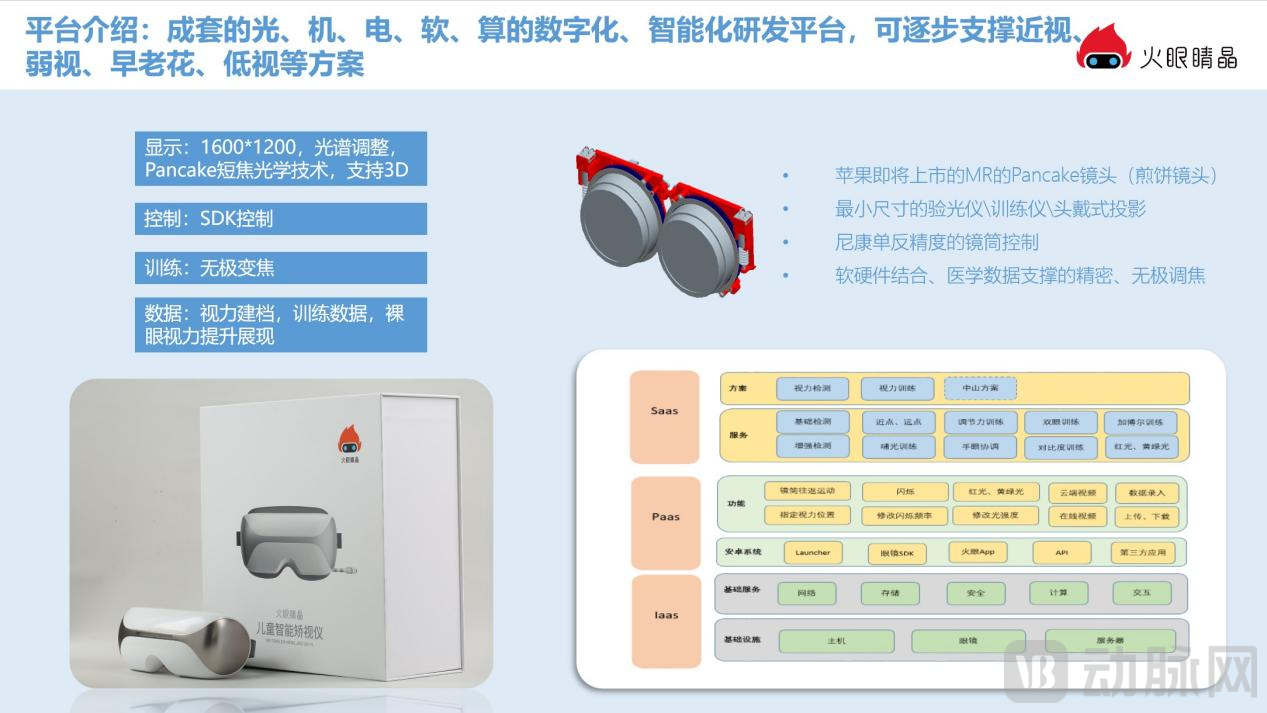
This is also the "standard" mentioned by Chen Wei. According to the platform built by Forward Vision, more theoretical achievements of optometry experts can be continuously transformed into product content for entry, just like the relationship between Apple and numerous apps in the Apple App Store. Based on this model, Forward Vision is able to "free up its hands" to focus on areas it excels in (VR, big data, AI). Meanwhile, the updating and iteration of content within the platform are also guaranteed.
Second, expand the boundaries of cooperation and continuously explore more possibilities for collaboration. For instance, Visionary Insight is not only exploring partnerships with some online education platforms and healthcare ecosystem enterprises but also negotiating with schools regarding the deployment of offline "Eye Care Classrooms."
"And at the end of the interview, Chen Wei also admitted frankly, 'In the future, on the one hand, we will continue to follow our existing approach to cooperate with mainstream hospitals to improve the clinical effect verification of the Foresight RuiShi intelligent ophthalmoscope; on the other hand, we will first open direct-operated intelligent community optometry centers in Shenzhen, Guangzhou, and Shanghai for scenario cultivation, streamline optometry service processes, refine optometry training programs, gradually achieve cloud-based operation management, realize a profitable business model, thereby achieving an ecological closed loop of "product + service" in another sense.'"
"Serving the vision health of Chinese people and bringing professional optometric services home has always been our original intention. We also believe that digital therapeutics in optometry will soon have a bright future," said Chen Wei.