

Bayer Reports 15.1% Revenue Growth in 2022, Forecasts Profit Decline in 2023 Amid Falling Agrochemical Prices and Leadership Transition

Bayer
Pharmaceutical Product R&D Developer
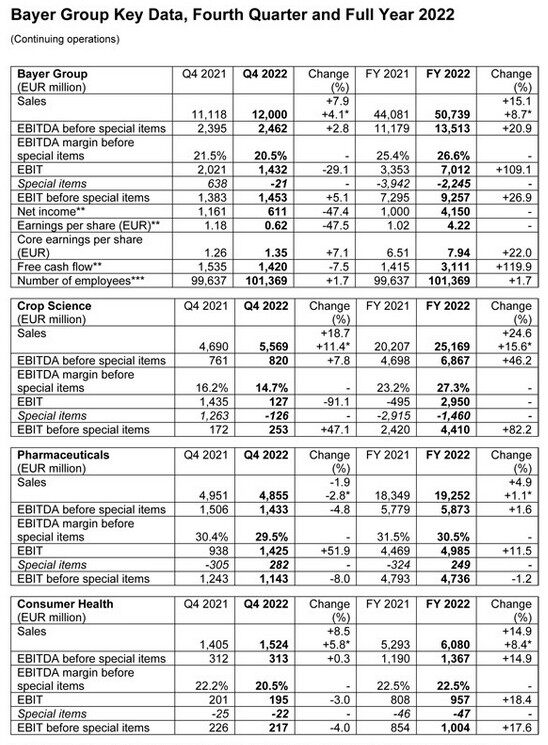
Intelligent Finance APP learned on February 28 that Bayer (BAYRY.US) announced its Q4 and full-year 2022 financial results. The report showed that Bayer's Q4 revenue was 12 billion euros, a year-on-year increase of 7.9%; net profit was 611 million euros, a year-on-year decrease of 47.4%; core earnings per share were 1.35 euros, better than the market expectation of 1.20 euros. In the full year of 2022, revenue was 50.739 billion euros, a year-on-year increase of 15.1%; net profit was 4.15 billion euros, compared to 1 billion euros in the previous year; core earnings per share were 7.94 euros, compared to 6.51 euros in the previous year.
By business division, Bayer's Crop Science division reported Q4 revenue growth of 18.7% year-over-year to €5.569 billion, with full-year revenue increasing by 24.6% year-over-year to €25.169 billion; the Pharmaceuticals division saw Q4 revenue decline by 1.9% year-over-year to €4.855 billion, while full-year revenue grew by 4.9% year-over-year to €19.252 billion; the Consumer Health division achieved Q4 revenue growth of 8.5% year-over-year to €1.524 billion, with full-year revenue rising by 14.9% year-over-year to €6.080 billion.
Moreover, Bayer forecasts its revenue for 2023 to be between 51 billion and 52 billion euros. The core earnings per share are projected at 7.20-7.40 euros, down from 7.94 euros in 2022, also falling short of market expectations. Bayer anticipates that the main reason for the decline in profits in 2023 will be the drop in prices of its agricultural products, including the herbicide Roundup. Due to a decrease in the price of glyphosate (the active ingredient in Roundup) produced by Bayer in Louisiana, the revenue growth of the Crop Science division, which was the biggest growth driver for Bayer in 2022, is expected to slow down.
Bayer's pharmaceuticals division may continue to see revenue growth of around 1% in 2023, as its best-selling blood thinner Xarelto faces new competition. The company hopes to improve the situation with its new cancer drug Nubeqa and kidney drug Kerendia.
Bayer's fastest growth in 2023 may come from its consumer health division, with revenue potentially increasing by about 5% due to a surge in demand for allergy and cold products.
Bayer's Growth Slows as CEO Transition Looms: Werner Baumann, at the helm of Bayer for seven years, is set to step down, with former Roche pharmaceutical head Bill Anderson scheduled to take over as CEO in June. This leadership change has reignited speculation about a potential breakup of the company, which spans agriculture, pharmaceuticals, and consumer health divisions. Werner Baumann remains adamant that Bayer’s current strategy is the right one.
Although Bayer's stock price has risen by about 14% over the past year, it has fallen by approximately 40% since the completion of the acquisition of Monsanto in June 2018. After completing the acquisition, while Bayer became the world’s largest supplier of crop seeds and pesticides, a wave of lawsuits alleging that its Roundup herbicide causes cancer also surged, weighing down Bayer’s stock price.