

Daiichi Sankyo Announces Positive Early Clinical Data for HER3-Directed ADC Patritumab Deruxtecan in EGFR-Mutated NSCLC and HER3-Positive/HER2-Negative Breast Cancer

Daiichi-Sankyo
Pharmaceutical R&D Developer
On March 20, Daiichi Sankyo announced the results of two clinical trials (U31402-A-U102 and U31402-A-J101) for patritumab deruxtecan (HER3-DXd). HER3-DXd is an antibody-drug conjugate (ADC) developed by Daiichi Sankyo that targets human epidermal growth factor receptor 3 (HER3), based on their proprietary DXd ADC technology platform.
▌U31402-A-U102 Study: NSCLC with EGFR Mutation
U31402-A-U102 is a Phase I study with dose escalation and dose expansion, enrolling a total of 264 patients with previously treated, EGFR-mutated, unresectable or metastatic non-small cell lung cancer (NSCLC). In the dose escalation part, the enrolled patients were characterized by progression after treatment with osimertinib or progression after treatment with erlotinib, gefitinib, or afatinib but without the EGFR T790M mutation.
In the dose-expansion portion, the therapeutic dose was 5.6 mg/kg, and enrolled patients were divided into three cohorts: ① locally advanced or metastatic NSCLC with EGFR mutations who progressed after receiving EGFR TKI therapy and platinum-based chemotherapy; ② NSCLC without EGFR-activating mutations who progressed after receiving PD-1/PD-L1 inhibitors and platinum-based chemotherapy; ③ NSCLC harboring EGFR-activating mutations.
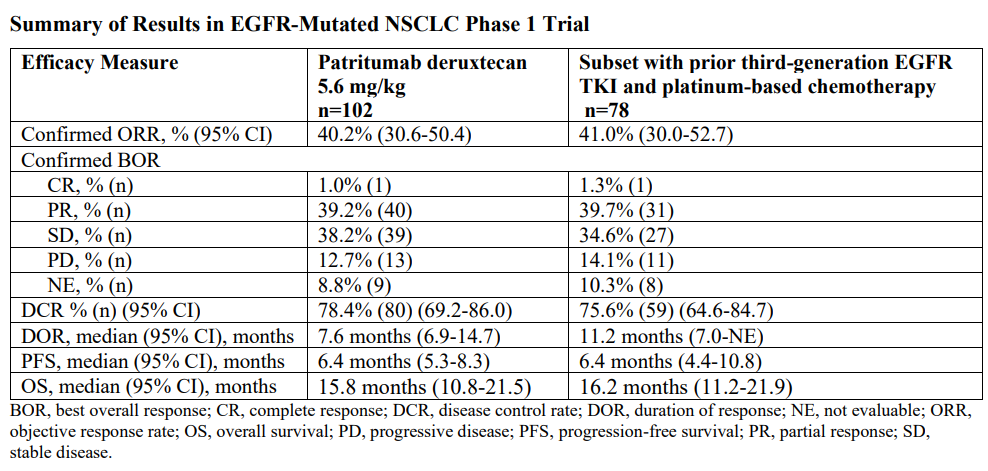
Results showed that at a median follow-up of 23 months (11.8-36.0 months), the confirmed objective response rate (ORR) was 40.2%, the disease control rate (DCR) was 78.4%, the duration of response (DOR) was 7.6 months, progression-free survival (PFS) was 6.4 months, and overall survival (OS) was 15.8 months in patients treated with patritumab deruxtecan (5.6 mg/kg). Consistent efficacy was observed in the subgroup of patients previously treated with third-generation EGFR TKI inhibitors and platinum-based chemotherapy. Additionally, the confirmed ORR was 36.4% in patients with a history of central nervous system (CNS) metastases and 44.7% in those without. In locally advanced/metastatic patients who had received 4 (1-14) prior lines of therapy, the DOR was 5.5 months.
In terms of safety, the incidence of treatment-emergent adverse events (TEAEs) of grade 3 or higher was 56.9%, including decreased platelet count (26%), decreased neutrophil count (21%), fatigue (10%), etc. Interstitial lung disease (ILD) related to treatment occurred in 8 patients (7.8%), although the majority of ILD cases were of low severity.
▌U31402-A-J101 Study: HER3-Positive/HER2-Negative Breast Cancer
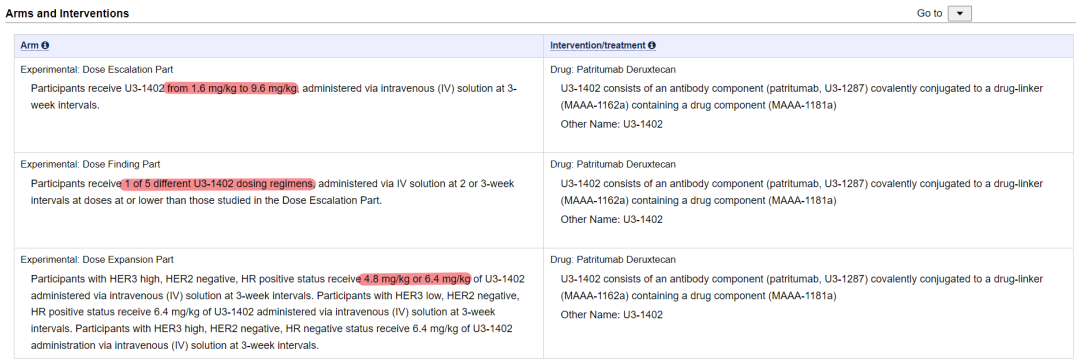
U31402-A-J101 is an open-label, multi-dose Phase I/II clinical trial that enrolled a total of 182 patients with HER2-negative/HER3-positive locally advanced or metastatic breast cancer. The study is divided into three parts: dose escalation, dose exploration, and dose expansion, with treatment doses of 4.8mg/kg or 6.4mg/kg in the dose expansion phase.
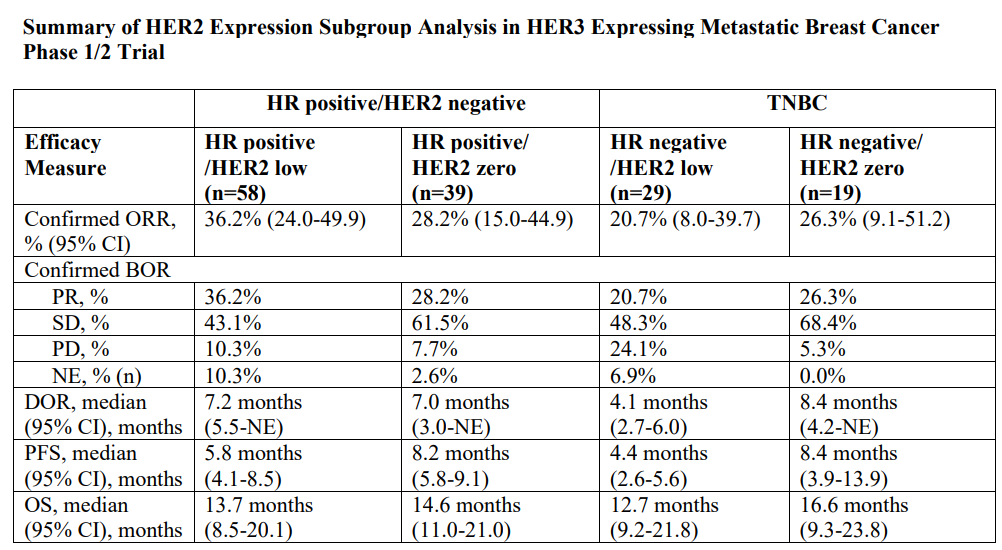
In HR-positive/HER2-negative/HER3-positive breast cancer patients, the confirmed ORR in the HER2-low subgroup was 36.2%, DOR was 7.2 months, PFS was 5.8 months, and OS was 13.7 months; in HER2 (0) patients, patritumab deruxtecan still maintained efficacy.
In HER3-positive triple-negative breast cancer (TNBC) patients, the confirmed ORR in the HER2-low subgroup was 20.7%, with a DOR of 4.1 months, PFS of 4.4 months, and OS of 12.7 months. In HER2 (0) patients, patritumab deruxtecan demonstrated even better efficacy.
HER2 low expression is defined as IHC 1+ or IHC2+/ISH- or HER2 (0).
Lung cancer and breast cancer are the first and fifth leading causes of cancer-related deaths globally, with approximately 1.8 million and 685,000 deaths, respectively, in 2020. HER3 is a member of the EGFR family of receptor tyrosine kinases. About 83% of primary NSCLC tumors express HER3, and 90% of advanced tumors carrying EGFR mutations express HER3 after treatment with EGFR TKIs. HER3 is also highly expressed in 30%-50% of breast tumors. Currently, no HER3-targeted drugs have been approved for marketing.