

Rouling Tech Secures Tens of Millions in Angel+ Funding to Advance Non-Invasive Brain-Computer Interface R&D and Commercialization

FlectoThink
Brain-Computer Interface Field Product Developer
Editor's Note: This article comes from 36Kr, authored by Hai Ruojing. VCBeat is authorized to reprint.
Recently,Brain-computer interface company "FlectoThink" recently completed an angel+ round of financing worth tens of millions of RMB, exclusively invested by Zhejiang Chunxiao Digital Publishing Fund, which is managed by Shanghai Dunhong Asset Management. This round of financing will mainly be used for the technological research and development of non-invasive brain-computer interfaces and business model expansion.
FlectoThink was founded in 2020. Dr. Sun Yu, the founder and CEO, graduated from the Department of Polymer Science at the University of Akron in Ohio, USA, and is the author of the best-selling book on brain-computer interfaces, "The Third Layer Brain"; Chief Scientific Officer Liu Bing is a Research Associate at Duke University and holds a Ph.D. in Neurobiology from the Chinese Academy of Sciences; CTO Wan Li is a postdoctoral researcher in Rehabilitation Medicine at the First Affiliated Hospital of Shenzhen University and holds a Ph.D. in Neurobiology from Fudan University.
"The current team has more than 50 people, mainly focusing on the R&D team, including hardware, software, algorithms, products, and design," introduced Dr. Liu Bing, Chief Scientific Officer of FlectoThink. "Our core team is relatively diverse and interdisciplinary, with most members having overseas experience."
Non-invasive brain-computer interface applied in sleep monitoring and intervention
After more than two years of development, FlectoThink has launched several products at this stage. In consumer scenarios, the single-channel miniaturized EEG monitoring device Airdream is coin-shaped and weighs 4g. In addition to monitoring sleep quality through EEG signals, it is equipped with a home sleep EEG management system, which achieves closed-loop sleep intervention through noise stimulation.
To ensure the quality of EEG signal acquisition during sleep, Airdream has extensively utilized flexible conductive materials. Currently, most EEG recording equipment uses rigid materials, which can easily leave marks on the skin during wear and are prone to friction during movement, affecting signal acquisition quality.
"The signal acquisition quality of flexible materials may be higher, but the relevant design solutions need to strike a balance — evenly laying very small nano-metal particles on the flexible material," Liu Bing explained. If the nano-metal particles are too small, they tend to clump together, affecting electrode quality; increasing the diameter of the nano-metal particles facilitates even distribution but compromises the material's flexibility. "We are now applying a technology that allows nano-metal particles to be evenly laid onto flexible substrates while achieving both good flexibility and conductivity."
In addition to hardware materials, FlectoThink has also explored various methods in algorithms to improve the quality of single-channel EEG signal acquisition. For instance, it alerts users when issues like abnormal wearing occur; obtains "pure" EEG signals through technical means; and separates different signals to assist AI in classification, enhancing the algorithm's accuracy for better real-time sleep staging and neural marker monitoring.
"We also use brain-like algorithms to conduct sleep cycle analysis, feature wave extraction, and attempt time-frequency spectrum analysis methods to collect sleep feature waves in real-time and accurately," introduced Liu Bing. In these aspects, FlectoThink has obtained multiple invention patents. Regarding the accuracy of signal acquisition, it is currently conducting head-to-head trials with PSG (polysomnography, also known as electroencephalogram sleep graph) equipment. "The similarity between our EEG signals and PSG signals reaches over 95%."
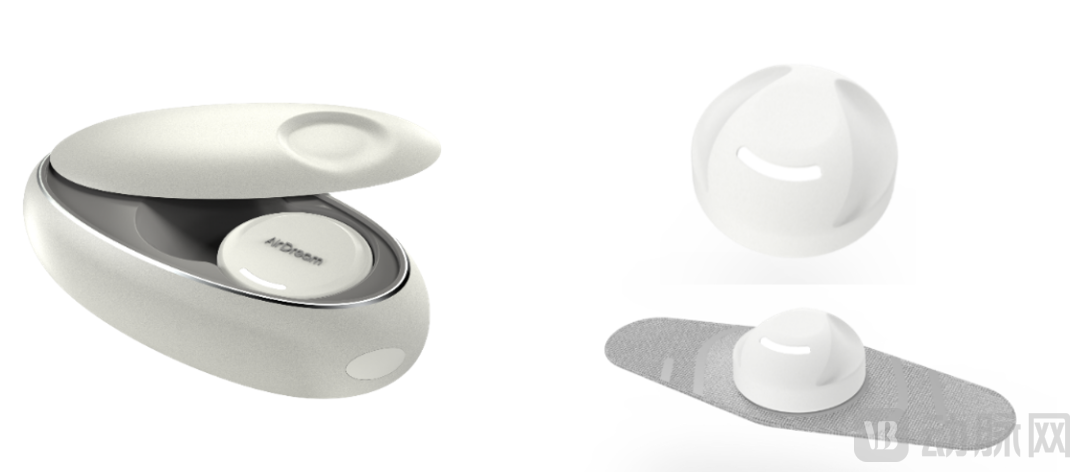
Single-Channel Miniaturized EEG Monitoring Device Airdream
Data is an indispensable element for training AI algorithms. It is reported that FlectoThink currently collects sleep data by collaborating with hospitals, including the Hangzhou Seventh People's Hospital (Zhejiang University Mental Health Center) and Nanjing Brain Hospital, among others. Additionally, it partners with B-end institutions in wellness, meditation, and related fields to help build its database.
Based on EEG signal monitoring, FlectoThink's Airdream has also added a "noise closed-loop intervention" function, which uses a closed-loop system to enhance slow-wave sleep (SWS) and intervenes in the brain's sleep state through periodic sound stimulation.
According to FlectoThink, "This system uses a practical closed-loop sleep regulation method. This EEG-guided closed-loop noise stimulation can enhance slow-wave sleep in the brain and does not pose the inherent risks associated with electrical stimulation or pharmacological approaches."
In addition to its application in consumer scenarios, FlectoThink's miniaturized EEG monitoring device is also expanding its use in medical scenarios. It is reported that it is expected to obtain a Class II medical device registration certificate in the first half of 2023. Its digital therapy software for different indications provides doctors with efficacy evaluation and chronic disease management assistance by detecting specific neural markers in EEG; it is suitable for sleep disorders and various psychiatric and neurological diseases.
Neuromuscular Electromagnetic Interaction Bracelet
According to reports, in terms of neuro-electromyography interaction, the bracelet developed by FlectoThink can currently achieve interaction recognition of 53 static gestures and 20 dynamic gestures, while featuring low latency, high robustness, and high accuracy.
"Many members of our team have a background in neuroscience and are very familiar with neurophysiological systems, so in terms of the sampling rate of electromyography (EMG), FlectoThink's bracelet can cover the frequency band richest in neurological information," Liu Bing introduced. To achieve high robustness, various attempts were made not only in algorithms but also in product design, combining algorithm requirements with hardware specifications.
Through FlectoThink's 8-channel neuro-electromyography wristband, aerial handwriting can be performed. "Constrained by natural language models, the decoding effect can reach normal handwriting speed, with over 98% accuracy for writing English words, numbers, and punctuation marks." It is currently undergoing algorithm iteration and corresponding engineering processing, allowing it to be deployed on mobile devices, PCs, XR glasses, and in-car systems.
"Brain-computer interface is a highly integrated discipline, and brain science is also a very complex comprehensive science, regarded as the next main battlefield for the intersection and integration of life sciences and information technology. We believe that a strong interdisciplinary scientific team background like FlectoThink's can tackle this systematic project." Zheng Hualiang, partner of Dunhong Asset, stated: "We are particularly optimistic about the paradigm-shifting interaction capabilities of brain-computer interfaces in the future metaverse era, and we look forward to FlectoThink bringing us the future technology of human-computer interaction as soon as possible."