

Kangxi Bio's Collagen-Based Cartilage Repair Scaffold Receives NMPA Class III Approval

Konee
Osteoarthritis Medical Device Developer
36Kr learned that,Konee's "Collagen Cartilage Repair Scaffold" Recently Approved for Class III Medical Device Registration by NMPAThe product innovatively adopts a bacterium-removal process during collagen extraction in production, eliminating the immunogenic telopeptide structure, and is capable of mass-producing collagen material with a complete triple-helix structure in a stable manner.
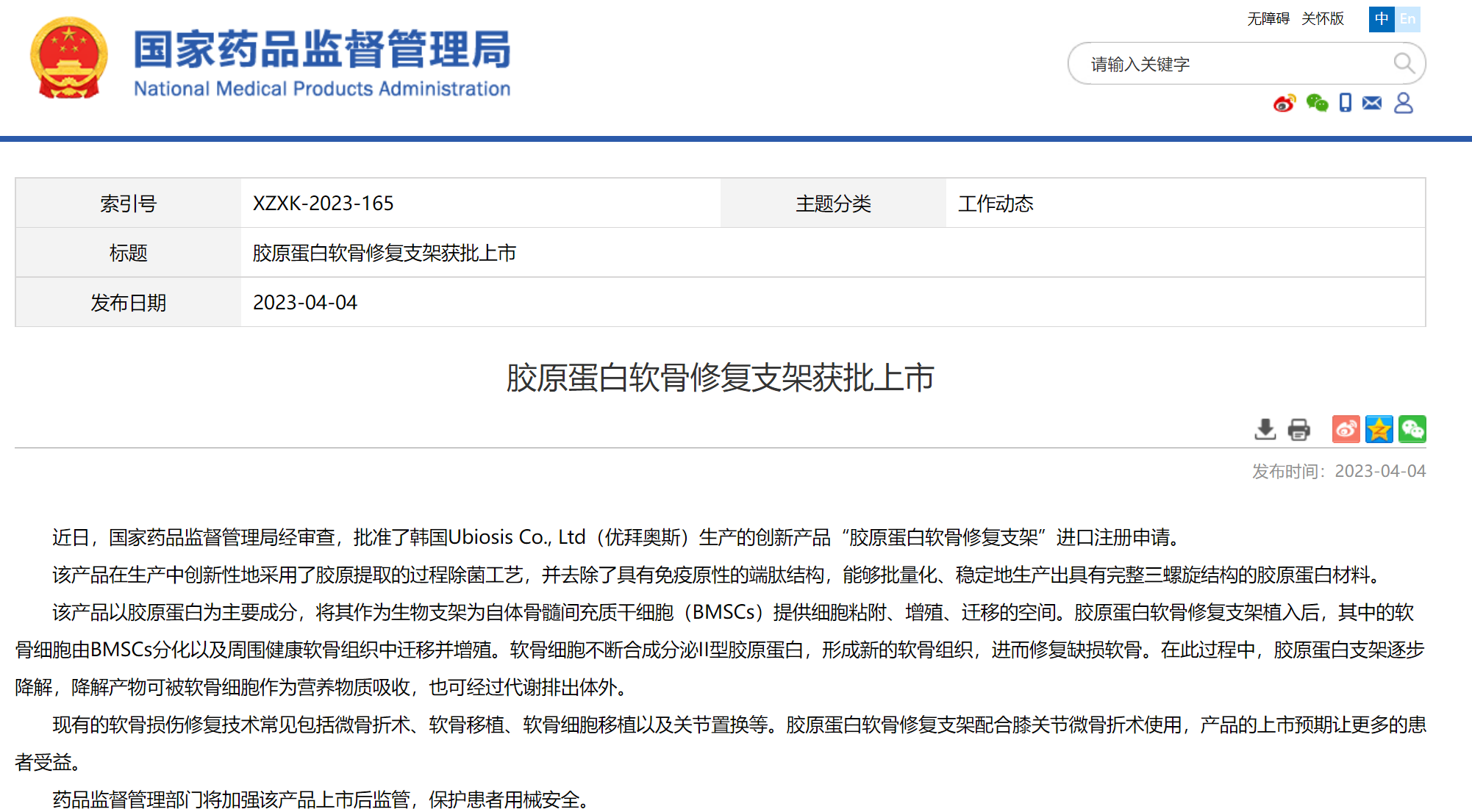
Source: NMPA
It is reported that the inventor of the aforementioned product technology includes Li Jianmo, the founder of Konee. In addition to the collagen cartilage repair scaffold, Konee's PRP (Platelet-Rich Plasma Preparation Kit) has also been approved for a Class III medical device registration certificate by the National Medical Products Administration (NMPA) in China.
KoneeFounded in August 2016, Konee Co., Ltd.'s founder and CEO, Dr. Jianmo Li, graduated from the Department of Medical Engineering at Imperial College London. The company has gradually built a team of approximately 40 people. Members of the core R&D team come from prestigious universities both in China and abroad, such as Humboldt University of Berlin, Imperial College London, and Shanghai Jiao Tong University. Professor Guixing Qiu, the company's chief scientist and an academician of the Chinese Academy of Engineering, pioneered the application of collagen in biological scaffolds and has published numerous high-level papers.
Regenerative Medicine: A Key Focus of Medical Research
The pathways of regenerative medicine are diverse, among whichBiomaterials Combined with Cell TherapyProgressing rapidly. Human body repair requires the three elements of tissue engineering, namely scaffold materials, cells, and growth factors, similar to bricks, cement, and steel bars in civil engineering. The main technology of Konee Co., Ltd. is applied toTissue Engineering Scaffold, Different human tissues require a scaffold for repair, allowing cells to adhere and grow on it, thereby enabling the cells to perform their respective functions. For example, stem cells in cartilage can differentiate into chondrocytes, and the migrated chondrocytes can secrete to form new cartilage.
It is reported that Konee has built a tissue engineering scaffold technology platform, which is appliedImplantable Regenerative Medical CollagenAs a scaffold material, different products have been developed according to the application scenarios of medical devices, required forms, mechanical strength, degradation cycles, and other performance characteristics. These include product forms such as gels, sponges, membranes, and coatings, which can be applied in clinical scenarios like cartilage repair, tendon repair, and endometrial repair.
"The medical collagen material we have developed has excellent bioactivity, low immunogenicity, and high purity, with all indicators far exceeding national standards," said Li Jianmo, founder of Konee, in an interview with 36Kr. The mainstream method of animal-derived collagen decellularization in China struggles to effectively control immunogenicity. Konee achieves the extraction and preservation of the characteristics and triple-helix structure of long-chain collagen molecules by thoroughly removing telopeptides, ensuring higher bioactivity. At the same time, through the core process of 'in-process sterilization,' impure proteins, endotoxins, and other elements are removed to reduce immunogenicity.
According to the introduction, Konee's collagen cartilage regeneration and repair scaffold is designed for third-degree or higher cartilage defects with an affected area of 2-8 square centimeters. Through a single surgery, it is expected to repair damaged joint cartilage.
Due to trauma, excessive exercise, degenerative diseases, and other reasons, cartilage defects may occur. "We often hear that cartilage injuries are irreversible and difficult to repair because after the cartilage is damaged, chondrocytes are also lost, leaving no driving force for continued cartilage secretion. Moreover, the nutrient exchange process required for chondrocyte growth is rather indirect, leading to slow cartilage recovery. To date, there is no device in China capable of regenerating healthy cartilage on the market," explained Li Jianmo.
Konee's Collagen Cartilage Repair Scaffold is an innovative product that can be implanted into the damaged area through arthroscopic surgery, providing a space for the adhesion, proliferation, and migration of autologous bone marrow mesenchymal stem cells (BMSCs). After the collagen cartilage repair scaffold is implanted, chondrocytes differentiate from BMSCs and migrate and proliferate from the surrounding healthy cartilage tissue. Chondrocytes continuously synthesize and secrete type II collagen, forming new cartilage tissue to repair the defective cartilage. During this process, the collagen scaffold gradually degrades, and the degradation products can be absorbed by chondrocytes as nutrients or excreted through metabolism.
Compared with intra-articular stem cell injection and autologous chondrocyte transplantation, the aforementioned surgical approach is "relatively moderate in cost; in terms of recovery time, significant results are typically seen within 3 to 6 months."
In addition to the collagen cartilage repair scaffold, Konee's tendon repair and endometrial repair products will enter the clinical trial stage in 2023. Based on the tissue engineering scaffold technology platform, the company’s short-term focus is primarily on injectable gel-state products, while mid-term development will target products such as oral regeneration membranes and bone repair. In the long term, the company plans to further develop repair products for meniscus, intervertebral disc soft tissues, nerve repair products, and more. Additionally, it was reported that Konee will also engage in raw material cooperation for collagen, working with universities, research institutes, and enterprises to co-develop organoid culture media, medical aesthetic implants, and other related products.
After the product has been approved and certified, the next step is to enter the hospital sales phase. In terms of marketing strategy, Konee will drive sales through academic promotion. At this stage, it has signed a strategic cooperation agreement with the headquarters of CR Medical to accelerate market penetration; at the same time, it will expand its channels through a regional tiered agency model. In terms of policy, many hospitals in China currently...Innovative HealthcareMedical device products have a special approval channel, which is expected to shorten the hospital entry cycle.
In the field of cartilage regeneration and joint surface lesion implants, Agili-C, an implant product developed by the Israeli medical device company Carti Heal, has received FDA approval for marketing to treat cartilage injuries such as trauma and osteoarthritis. In July 2022, Bioventus (stock code: BVS), a divested business line of Smith & Nephew, acquired Carti Heal for $315 million.
Under the trend of population aging, the demand for cartilage repair in China is large and growing rapidly. Konee's collagen cartilage repair scaffold product has considerable market prospects.It is understood that the company is currently undergoing a new round of financing.