

Behind the ¥2B+ Deal: Qilu Pharma licenses AKT Inhibitor LAE002 (afuresertib) from Laekna amid breast cancer demand
Laekna Therapeutics
Innovative Drug Developer

Qilu Pharmaceutical
Specialty Formulations and Active Pharmaceutical Ingredients (API) Developer
Laekna Therapeutics (Stock Code: 2105.HK) and Qilu Pharmaceutical have jointly announced an exclusive licensing agreement, under which Laekna grants Qilu Pharmaceutical the rights in China to its core investigational product, the AKT inhibitor afuresertib (LAE002), a novel drug candidate for breast cancer.
Under the agreement terms, Laekna is eligible to receive non-refundable upfront and clinical development milestone payments of up to RMB 530 million in aggregate upon New Drug Application (NDA) approval of the first indication in China, with total upfront and milestone payments reaching up to RMB 2.045 billion. In addition, Laekna is entitled to receive tiered royalties on future net sales within the licensed territory in China, at percentages ranging from the low teens to the low twenties.
The Future of AKT Inhibitors Looks Bright
Breast cancer currently poses a major threat to women's health globally. According to a study based on GLOBOCAN database, there were 2.3 million new cases of female breast cancer and 670,000 related deaths worldwide in 2022. Among all cancers in women, breast cancer accounted for 25% of incidence and 15.5% of mortality, ranking first in both categories.
The disease burden is projected to worsen significantly. By 2050, global new cases of female breast cancer are expected to increase to 3.2 million, with deaths reaching 1.1 million—representing increases of 38% and 68% respectively from 2022 levels. This underscores the growing urgency for disease prevention and the development of novel treatment approaches. Among breast cancer subtypes, HR+/HER2- (hormone receptor-positive/HER2-negative) patients represent a large population with urgent unmet needs. Although initial benefit can be achieved with first-/second-line endocrine therapy combined with CDK4/6 inhibitors and/or chemotherapy, most patients eventually develop drug resistance leading to treatment failure. Novel therapeutic options targeting resistance mechanisms are critically needed, and AKT inhibitors effectively address this gap.
AKT kinase serves as a core regulatory node in the PI3K/AKT/mTOR signaling pathway, with its three isoforms (AKT1, AKT2, AKT3) playing crucial roles in tumor proliferation, metabolism, and resistance development. Inhibitors targeting this pathway can precisely block survival signals in drug-resistant tumor cells, offering a new therapeutic direction for HR+/HER2- breast cancer patients. Currently, only two AKT inhibitors have advanced to late-stage clinical development globally, with Laekna's LAE002 (afuresertib) being one of them.
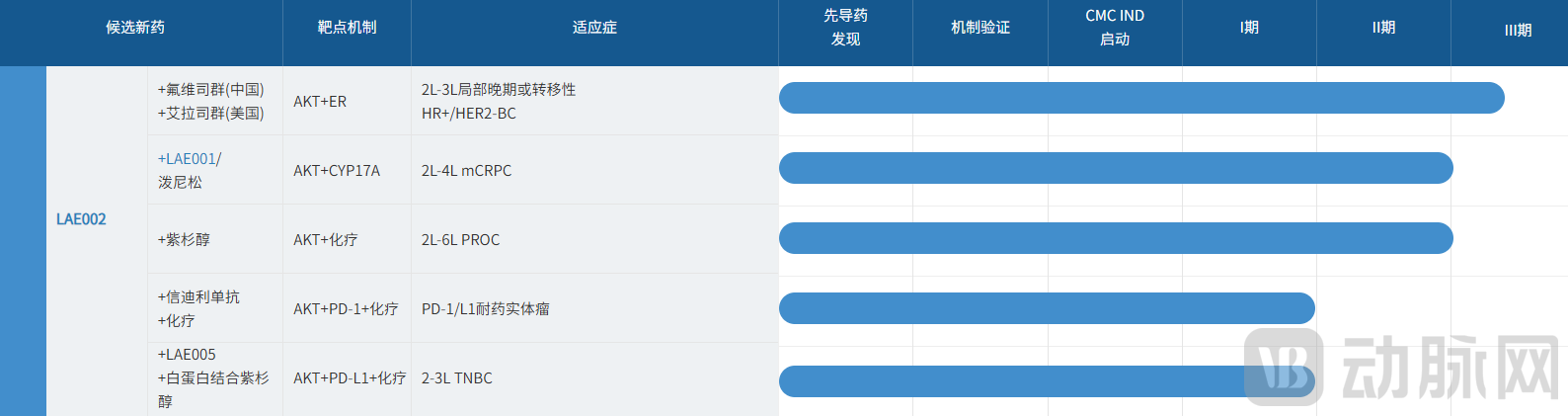
LAE002 (afuresertib) demonstrates balanced, potent inhibition against all three AKT isoforms, enabling more comprehensive blockade of tumor cell signaling while showing superior safety profile. As of global Phase Ib data in August 2024: among a cohort of 18 breast cancer patients harboring PIK3CA/AKT1/PTEN mutations, LAE002 achieved median progression-free survival (PFS) of 7.3 months. Compared to competitor capivasertib, LAE002 shows comparable efficacy (ORR 33.3% vs. 28.8%; mPFS 7.3m vs. 7.3m) with clear safety advantages (fewer Grade 3/overall TEAEs, versus a 13% discontinuation rate in capivasertib). The Phase III clinical trial (AFFIRM-205) for HR+/HER2- breast cancer is progressing as planned, targeting completion of patient enrollment in Q4 2025 and New Drug Application (NDA) submission to China's Center for Drug Evaluation (CDE) in 2026.
Beyond breast cancer, LAE002 is also being explored in clinical trials for other indications including metastatic castration-resistant prostate cancer and PD-1/PD-L1 resistant solid tumors, further expanding its potential applications.
From the perspective of global breast cancer targeted therapy market trends, a 2025 research report by Wiseguy Reports indicates that the global market size for HER2-related breast cancer targeted drugs reached USD 14.37 billion in 2024. It is projected to grow at a compound annual growth rate (CAGR) of 5.11% from 2025 to 2032, with the market size expected to exceed US$21.4 billion by 2032. The second-line and later treatment market is demonstrating significantly higher growth than the overall market, driven by the expanding drug-resistant patient population. As the drug-resistant patient population continues to grow and AKT inhibitors expand into multiple cancer indications, the market size is expected to further increase. The world's first approved AKT inhibitor—AstraZeneca's capivasertib—achieved global sales of US$430 million in 2024. However, its sales in China have not yet been fully realized due to its approval only being obtained in April 2025. This confirms the unmet demand for AKT inhibitors in the Chinese market, unlocking substantial commercial opportunity for LAE002.
Complementary Capabilities in Innovation R&D and Commercial Implementation
The collaboration between Laekna Therapeutics and Qilu Pharmaceutical embodies the synergy between innovative drug discovery at the clinical stage and the end-to-end capabilities of a vertically integrated industry leader.
Founded in 2016, Laekna Therapeutics is a science-driven, clinical-stage biotechnology company committed to bringing novel therapies to patients worldwide with metabolic diseases, cancer, and liver fibrosis. The name "Laekna" derives from Old Norse, meaning "to heal."
In June 2023, Laekna was listed on the Main Board of The Stock Exchange of Hong Kong Limited. By the end of 2024, the company had initiated seven clinical trials for its core assets, including LAE102 and LAE002 (afuresertib), building a pipeline of 19 investigational programs focused on two core areas: oncology and metabolic diseases.
In oncology, Laekna's lead asset LAE002 (afuresertib) is one of only two AKT inhibitors globally in late-stage clinical development. Laekna has also built a diversified oncology portfolio, including clinical-stage and preclinical candidates such as LAE001.
In metabolic diseases, Laekna's internally discovered LAE102, an ActRIIA monoclonal antibody, promotes muscle regeneration and reduces fat mass by blocking the Activin-ActRII pathway. It has obtained IND approvals in both China and the U.S. for the obesity indication. In November 2024, Laekna entered into a clinical collaboration agreement with Eli Lilly and Company to accelerate global development. Additionally, LAE103 (an ActRIIB-selective antibody) and LAE123 (an ActRIIA/IIB dual antagonistic monoclonal antibody) further explore the therapeutic potential of ActRII targets, covering muscle-related disorders and other indications.
Qilu Pharmaceutical, as a leading vertically integrated pharmaceutical company in China, has established a comprehensive ecosystem spanning R&D, manufacturing, and commercialization, ranking among the top three Chinese pharmaceutical companies in 2024.
With 12 subsidiaries globally, 11 Chinese manufacturing sites, and over 36,000 employees, Qilu exports its products to over 100 countries and regions. Qilu has launched over 300 products, including more than 55 first-to-market drugs in China.
Qilu's pipeline includes a diversified portfolio of over 200 generic products, more than 20 biosimilars, and over 80 innovative drugs. While maintaining strong large-scale manufacturing capabilities, the company continues to reinforce its market position through increased investment in innovative drug development. Its core strengths lie in its deeply penetrating commercial network, highly efficient supply chain, and proven market access capabilities, with products already widely covering healthcare institutions across China—providing a solid foundation for rapid commercialization of innovative drugs.
This partnership represents an ideal combination: Laekna contributes high-quality pipeline assets and technology platforms typical of an innovative biotech, while Qilu provides top-tier manufacturing and commercial capabilities, together creating strong assurance for future product success.
A Rational Choice under Industry Trends
This collaboration is the result of a triple resonance of industry phases, policy guidance, and corporate strategic needs.
From an industry perspective, AKT inhibitors, as key targets in the PI3K/AKT/mTOR pathway, have long been regarded as a promising direction in cancer treatment. AstraZeneca's capivasertib remains the only approved drug in this class, while most candidate molecules from other companies are still in Phase I/II clinical stages, yet to establish a mature commercial landscape. Despite high R&D barriers, this pathway's compelling biological rationale in breast cancer, prostate cancer, and other areas continues to make it a focus for both multinational pharmaceutical companies and Chinese biopharmas. For innovative drug developers, choosing partnership as an entry strategy into this emerging field represents a rational approach to balance risk while securing forward-looking positioning.
On the policy front, regulatory optimization and industrial guidance have created an enabling environment for such collaborations. China's National Medical Products Administration (NMPA) and Center for Drug Evaluation (CDE) have consistently advanced review and approval reforms, introducing mechanisms such as priority review and conditional approval. In July 2024, they released the "Pilot Work Plan for Optimizing Clinical Trial Review and Approval of Innovative Drugs," establishing a 30-working-day review channel for clinical trial applications, while subsequent policy announcements explicitly supported international multi-center clinical trials and encouraged cross-institutional collaboration in innovative drug development. These policy signals—accelerated review plus collaboration incentives—provide a practical pathway for companies to share R&D resources and mitigate individual project risks through licensing and partnerships.
From a broader perspective, China's innovative drug sector is transitioning from scale expansion to quality-driven collaboration. Against the backdrop of rising R&D costs and stabilizing capital markets, optimizing resource allocation through regional licensing and co-development has become an industry consensus. The partnership between Laekna Therapeutics and Qilu Pharmaceutical represents not only a long-term commitment to an emerging target but also reflects the increasingly sophisticated collaboration logic of Chinese pharmaceutical companies navigating complex industry cycles—anchoring promising fields through rational judgment, reducing innovation risks through synergistic complementarity, and ultimately achieving a balance between innovative value and commercial implementation.