

Neurointerventional Firm Achieves 12.2x Revenue Surge Amid Exponential Growth, Only to Face 'Volume-Based Procurement' Headwinds

Wallaby Medical
Developer and Producer of Therapeutic Products in the Neurointervention Field

HeartCare
Neurointerventional Medical Device Developer

Zylox-Tonbridge
Innovative R&D, Production, and Sales of Medical Devices in the Vascular Intervention Field
Peijia Medical
Developer of Cardiac and Cerebrovascular Interventional Medical Devices
When the pandemic hit and the international situation changed dramatically, forcing most industries to pause, neurointervention staged an incredible comeback and created a commercial miracle.
In 2020, the field of neurointervention suddenly gained popularity overnight, becoming the "hot favorite" in the capital market. Among them, at least 24 neurointervention companies completed financing, with 60 investment institutions placing their bets.
However, just in the past year, the neurointervention field has entered a capital winter period. In the second half of 2021, only about four companies completed financing, and various investment institutions also shifted their focus to other fields.
If this is the end, then what has been witnessed in the field of neurointervention is no miracle. In the unnoticed corner, neurointervention companies have begun to push forward with commercialization and are...Achieving exponential growth in just three years, such as HeartCare's revenue increasing 12.2 times and Zylox-Tonbridge's neurointervention business revenue growing 11.65 times...
From the commercial exploration in 2020 to the rapid development in 2022, leading companies in the neurointervention field have fulfilled their promise of performance growth, achieving a doubling of revenue. Meanwhile, the growth logic in the neurointervention sector remains intact, and it is expected to maintain high-speed growth moving forward.
From 0.15 billion to 1.83 billion, an increase of 12.2 times; from 0.2 billion to 2.33 billion, an increase of 11.65 times; from 0.39 billion to 1.44 billion, an increase of 3.69 times… The leading enterprises in China's neurointerventional industry all achieved revenue multiplication between 2020 and 2022. HeartCare, Zylox-Tonbridge, Peijia Medical, and Minimally Invasive Brain Science have all entered the billion-yuan revenue club.
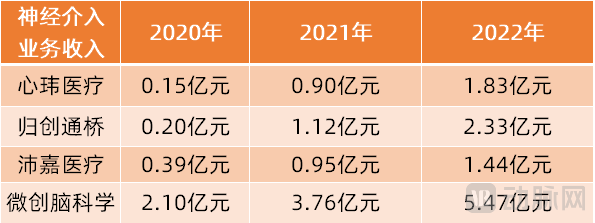
The reason for the doubling growth is due to national support for the development of the neurointervention industry, the approval of a large number of domestically produced neurointervention products, the rapid increase in the volume of neurointervention surgeries, and the explosive growth of the neurointervention market.。
Specifically, first, the state has issued policies such as the "Comprehensive Plan for Strengthening Stroke Prevention and Treatment to Reduce One Million New Disabilities," improving stroke prevention and treatment efforts and promoting the widespread adoption of neurointerventional technologies like thrombolysis and thrombectomy. With the joint efforts of the government, experts, guidelines, and enterprises, an increasing number of doctors are recognizing and utilizing neurointerventional surgeries. For patients, thanks to advancements and applications in screening and diagnostic technologies, more patients are being diagnosed promptly and receiving treatment.
Second, China continues to increase the construction of stroke centers, enhancing the diagnosis and treatment capabilities for stroke. According to statistics from the National Health Commission of China, as of the end of November 2022, 602 tertiary hospitals have established stroke centers, along with 1,125 secondary hospitals. Meanwhile, 208 cities across 28 provinces have released stroke emergency maps, with 2,770 medical institutions becoming part of the stroke emergency network. As the number of stroke centers continues to grow, an increasing number of hospitals are able to perform neurointerventional surgeries, allowing many patients who were previously constrained by time-sensitive treatment windows to finally receive timely care.
Third, the supply of domestically produced neurointerventional medical devices has increased, and the volume of neurointerventional surgeries is showing a rapid growth trend. According to incomplete statistics from VCBeat, in 2021, more than 25 neurointerventional products were approved in China, and in 2022, over 120 products were approved. Currently, the number of domestically produced neurointerventional products has far exceeded imports, and the types of domestically produced neurointerventional products are diverse, including thrombectomy stents, aspiration catheters, coils, intermediate catheters, distal access catheters, intracranial balloon dilation catheters, etc., which can sufficiently meet the diverse needs of different patients.
Driven by policy support, the promotion of neurointerventional surgeries, the increase in domestically produced neurointerventional product supply, and enhanced market education, the volume of neurointerventional surgeries in China is experiencing rapid growth, leading to a surge in the size of the neurointerventional market.
However, despite the significant growth in the neurointerventional market, it is still in its early stages of development, with relatively low market penetration, especially in the vast grassroots areas represented by lower-tier cities and counties. Meanwhile,Not all companies have benefited from the industry's explosive growth; only a few have achieved exponential growth, while most remain stagnant or experience slow growth.。
In 2022, HeartCare achieved a revenue of 183 million yuan, representing a year-on-year increase of 103.2%. The neurovascular intervention business income of Zylox-Tonbridge reached 233 million yuan, marking a year-on-year growth of 107.9%. Peijia Medical'sNeurointerventional business achieved revenue of 144 million yuan, a year-on-year increase of 51.7%;Minimally Invasive Brain Science achieved revenue of 547 million yuan, representing a 43.0% increase over the previous year.
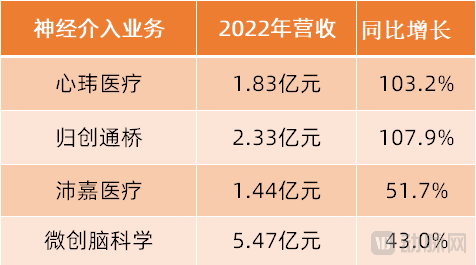
In the same market environment, different development paths bring different market growth rates to enterprises, and different market measures also lead to different revenue changes.
In addition to conventional measures such as strengthening marketing, increasing market promotion, and covering more hospitals, each company has also attempted differentiated initiatives.
Peijia Medical Promotes Groundbreaking Innovative Products with Clinical Advantages Based on Innovative ProceduresSpecifically, Peijia Medical promotes balloon angioplasty (BASIS) protected by a distal thrombectomy stent, while also promoting its thrombectomy stent; it also promotes a new ICAS vascular interventional surgery, along with its delivery-type balloon dilation catheter.
According to the introduction, the BASIS technique is a combination of thrombectomy stents, balloons, and intermediate catheters. It can utilize the thrombectomy stent's capture basket as protection to reduce the risk of thrombus escape caused by balloon expansion, and avoid the risks of intimal injury, plaque rupture, and vascular spasm associated with traditional surgery when passing the thrombectomy stent through narrow lesions.
In terms of ICAS, vascular interventional surgeries for treating intracranial atherosclerotic stenosis (ICAS) traditionally involve twelve steps, including multiple exchanges of guidewires, catheters, and balloons. These exchanges often lead to complications such as guidewire-induced vessel perforation. The innovative balloon dilation catheter integrates the functions of both balloon catheters and microcatheters. With this advanced product, doctors performing ICAS surgeries can eliminate the need for repeated exchanges, thereby reducing complications associated with exchanging guidewires and catheters. This innovation also lowers procedural difficulty, minimizes operational risks, and enhances surgical safety.
Minimally Invasive Brain Science Builds Systematic Training System, Strengthens Grassroots Hospital Market, and Increases Market Share by Nearly Double. For the grassroots market, Minimally Invasive Brain Science promotes neurointerventional knowledge to doctors and patients in lower-tier cities and county-level hospitals through the "Divine Eagle Flying Swallow" program. It provides grassroots doctors with clinical training, postoperative consultation, and routine guidance, helping patients receive standardized stroke diagnosis and treatment services locally. In 2022, the Divine Eagle Flying Swallow team of Minimally Invasive Brain Science continuously expanded its network, reaching over 250 newly developed grassroots hospitals, cumulatively covering approximately 600 hospitals across more than 200 lower-tier cities and counties in China.
At the same time, Minimally Invasive Brain Science (Suzhou) Co., Ltd. promotes the下沉of high-quality medical resources and enhances the ability of grassroots medical staff to detect stroke early and take intervention measures as soon as possible through the "Bainao Shentong" Neurointerventional Young Physician Training Special Fund, benefiting more local cerebrovascular disease patients. By the end of 2022, "Bainao Shentong" had signed and launched six clinical education bases, funded 10 young doctors for further study, and provided technical training for about 60 surgeons.
Based on various initiatives in products, market, commercialization, supply chain, etc., the annual report of Minimally Invasive Brain Science shows that its market share is about 8%, nearly doubled compared to 2020.
HeartCare enhances hospital penetration through efficient sales channels and a stable supply chain.In 2022, HeartCare's products were sold to more than 1,000 hospitals. Its revenue increased by 103.2%, mainly due to the continuous growth in sales of its ischemic stroke thrombectomy devices and intracranial artery stenosis treatment devices. Additionally, the launch of new hemorrhagic stroke treatment, prevention, and access devices in 2022 contributed to the revenue.
As of now, HeartCare has three production bases: one in the Lingang Special Area of Shanghai, another in Zhangjiang, Shanghai, and the third in the Jiangbei New Area of Nanjing, ensuring an adequate supply of products.
Zylox-Tonbridge Builds a Series of Clinical Treatment Solutions Based on Its Product PortfolioFor example, for ischemic stroke, Zylox-Tonbridge actively promotes the BADDASS thrombectomy technique and has launched the Jiaolong intracranial thrombectomy stent, intracranial support catheter, and balloon guiding catheter as a complete three-piece solution.
Zylox-Tonbridge believes that: The combined application of the BADDASS method with the Jiaolong intracranial thrombectomy stent, intracranial support catheter, and balloon guiding catheter as a three-piece solution can achieve a higher first-pass recanalization rate of intracranial vessels, shorten recanalization time, and reduce the distal escape rate during thrombus retrieval. This effectively improves surgical success rates, reduces operation time, and lowers the incidence of postoperative complications.
Based on different commercialization capabilities and market initiatives, the revenue growth rates of various companies also vary. However, with the industry's rapid expansion, the aforementioned companies, as leaders in the neurointervention field, have still achieved significant growth. Meanwhile, strategically, these companies have either already begun or are preparing to launch their globalization strategies, accelerating the overseas expansion of medical devices.
From the development history of various enterprises, Minimally Invasive Brain Science is one of the earliest leaders in neurointervention to implement an overseas strategy for medical devices, and it has also achieved substantial results by leveraging advantages in products, channels, and early-mover benefits.
In 2022, Minimally Invasive Brain Science established four overseas subsidiaries in the United States, the United Kingdom, the Netherlands, and Brazil, and set up regional sales headquarters in Europe, the Middle East and Africa (collectively referred to as the "EMEA" region), North America, Latin America, and the Asia-Pacific region, each led by experienced team leaders with a deep understanding of the local markets.Build Global Sales ChannelsAt the same time, Minimally Invasive Brain Science also collaborates with the leading international company Rapid Medical,Leverage Rapid Medical's sales network in the United StatesTo promote its overseas business.
As of the end of 2022, Minimally Invasive Brain Science's products have been commercialized in seven overseas countries, including South Korea, the United States, Brazil, Poland, Spain, Portugal, and Chile, covering nearly half of the top ten countries in the world by volume of neurointerventional surgeries.
In South Korea, the NUMEN coils from Minimally Invasive Brain Science have been included in the national health insurance reimbursement list, leading to a significant increase in sales; in the United States, Minimally Invasive Brain Science has partnered with overseas company Rapid Medical to quickly promote products like the NUMEN coils through their existing sales channels; in Brazil, the intracranial stents from Minimally Invasive Brain Science have completed their first batch of sales.
In terms of overseas market promotion, Minimally Invasive Brain Science conducted 18 surgical training and academic exchange activities in 2022, covering innovative products such as coils, intracranial stents, and support catheters. Meanwhile, Minimally Invasive Brain Science also participated in international conferences such as the "2022 Interventional Neuroradiology and Neurosurgery Seminar (LINNC) Paris Annual Meeting," "European Society of Minimally Invasive Neurointerventional Therapy (ESMINT)," and the "UK BRAIN International Conference" to enhance its global brand influence.
Under the strategic initiatives for overseas expansion of medical devices and multi-faceted market promotion, Minimally Invasive Brain Science (Suzhou) Co., Ltd. achieved a breakthrough in its international business in 2022, with overseas revenue reaching 21.9 million yuan.An increase of 3492% over the previous year。
Similar to Minimally Invasive Brain Science,Zylox-Tonbridge has also launched its medical device overseas strategy, with its income from overseas regions growing by 125.2% year-on-year in 2022.。
In the second half of 2022, Zylox-Tonbridge appointed a new Vice President of Sales and Marketing for the Europe, Middle East, and Africa region. With over two decades of sales and marketing experience in the vascular medical device industry, they will oversee marketing efforts in the respective regions. In the third quarter of 2022, Zylox-Tonbridge established a marketing team in Europe to better serve local customers.
Zylox-Tonbridge's annual report shows: It will continue to invest in the international market by establishing sales and marketing teams in overseas markets to accelerate the development of its overseas business. Zylox-Tonbridge will continue to deepen its presence in the European market, with expectations that its intracranial aneurysm coil and flow diverter will receive CE certification in 2024. Additionally, Zylox-Tonbridge plans to establish a European warehousing and logistics center to improve logistics and distribution efficiency in the local market.
Except for Minimally Invasive Brain Science and Zylox-Tonbridge,Peijia Medical and HeartCare are also looking to expand into overseas markets.Among them, Peijia Medical has established a research and development platform in California and an innovation incubation platform in Boston to enhance its international innovation capabilities and global recognition, laying the foundation for subsequent technology and product expansion overseas. HeartCare is currently evaluating the opportunity to market its Captor thrombectomy device abroad and may apply for registration in the United States and Europe based on the evaluation results.
In fact, not only listed companies but also other leading domestic neurointerventional companies are expanding their overseas presence. For example,Wallaby MedicalIn April 2022, the company acquired German phenox GmbH and its subsidiary femtos GmbH (collectively referred to as "phenox") for a total consideration of approximately 500 million euros (including milestone payments). This is reported to be one of the largest cross-border M&A transactions in the global medical device industry in recent years.
Wallaby Medical sells its products to more than 30 countries and regions, including the United States, China, the European Union, the United Kingdom, Chile, etc., and has established sales scale in major developed markets such as the United States and Europe; phenox's products are sold in over 45 countries worldwide. This acquisition will enable both parties to achieve complementarity in product lines, market channels, and other aspects, creating greater synergy after the merger.
As the competition in China's neurointervention market becomes increasingly fierce, it is expected that more domestically produced enterprises will accelerate their expansion overseas to seek opportunities.
In China's neurointervention market, not only are there dozens of companies in fierce competition, but also centralized procurement holds the power over market and pricing.
Previously, coil springs have been included in bulk procurement projects in Hebei, Jiangsu, Fujian, and the 21-province alliance. In Hebei, the average selected price of coil springs dropped from 12,000 yuan to around 6,400 yuan, with an average reduction of 46.82% and a maximum reduction of 66%. In Jiangsu, the average reduction for neuro-specific coil springs was 54%, with a maximum reduction of 69%, bringing mainstream products from 10,000 yuan down to about 3,500 yuan.
For centralized procurement, Zylox-Tonbridge has chosen to actively participate in and embrace the centralized procurement policy. In 2022, the intracranial aneurysm coil system independently developed by Zylox-Tonbridge was awarded bids in several provincial-level centralized procurements. According to Zylox-Tonbridge, its coil system was categorized into Group A (the group with a higher procurement volume) during the Anhui provincial-level centralized procurement and ranked first in the competitive group with a relatively competitive price. Zylox-Tonbridge believes that securing the top rank will provide the company with opportunities to enter every hospital covered by each provincial-level centralized procurement.
Minimally Invasive Brain Science Actively Participates in Centralized Procurement to Rapidly Increase Market Share. In the coil procurement projects carried out across China's provinces, Minimally Invasive Brain Science’s NUMEN coils successfully won the bid. Leveraging this opportunity, the time for hospital entry of its products was significantly shortened, and market expansion made breakthrough progress.
In 2022, the NUMEN coil by Minimally Invasive Brain Science,Clinical usage volume in China has grown more than doubled compared to the previous year.According to Frost & Sullivan statistics, based on the 2022 surgical volume, the market share of its coil products has rapidly increased to over 5% since their launch and promotion in 2021.
HeartCare also stated: We must actively participate in the centralized procurement, make good use of the centralized procurement opportunities, increase the market share of our products, continuously enhance brand influence, and effectively manage costs and improve efficiency.
Previously, the market generally believed that innovative medical devices would be temporarily exempt from centralized procurement.For example, in July 2022, Beijing piloted the "Notice on Printing and Distributing the Management Measures for CHS-DRG Payment Exclusions for New Drugs and New Technologies" for the first time. New drugs, new devices, and new technologies that meet the criteria can apply for CHS-DRG "exemption."
In September 2022, regarding the issue of centralized bulk procurement and medical insurance payment for innovative products, the National Healthcare Security Administration clearly pointed out: Innovative medical devices can be exempted from centralized procurement, meaning that a certain market space will be set aside outside of the centralized procurement to provide room for the development of innovative products.
However, the Office of the Medical Consumables Procurement Alliance of Public Medical Institutions in Henan Province issued a notice on March 13, 2023, incorporating multiple quality categories of neurointerventional and peripheral interventional products.Centralized Procurement. In neurointerventional products,Including innovative products such as dense mesh stents。
Currently, only six flow diverter stents have been approved for marketing in China. Among them, Tubridge by MicroPort NeuroTech was the first flow diverter product to enter the green channel, while Lattice Flow Diverter Stent by ECO Medical was approved to enter the National Innovative Medical Device Rapid Review Channel in May 2020 and received approval as an innovative medical device for marketing in October 2022.
On March 22, the Medical Consumables Procurement Alliance of Public Medical Institutions in Henan Province announced the tentative selection results for peripheral interventional and neurointerventional medical consumables. Among them, 16 categories of products, including thrombectomy stents and aspiration catheters, have been tentatively selected in varying quantities. Products such as flow diverter stents for extracranial use, first-line access standard guiding catheters, first-line access distal guiding catheters, intracranial aneurysm-assisting laser-cut open-loop stents, intracranial aneurysm-assisting laser-cut closed-loop stents, and liquid embolic systems are included.Six categories had no products selected.. The flow-diverting stent outside the tumor showed as "invalid bid".
Insiders believe that the cancellation of the tender for flow diverter stents outside the tumor was due to participating manufacturers' disagreement with price reductions or the price cuts not meeting expectations.
On April 10, the First Affiliated Hospital of Zhengzhou University released the "Announcement on the Tentative Selection Results of the Second Batch of Medical Consumables Alliance Procurement for Public Medical Institutions in Henan Province." This round of centralized procurement covers six categories of neurointerventional products that were not selected on March 22. A total of 69 products participated, with 51 products being selected.
Regarding the market-focused dense mesh stent, Covidien (Medtronic), Stryker, and Aico Medical were not selected, while the flow-diverting dense mesh stents from Taijie Weiye, Weixian Medical (MicroVention), and MicroPort NeuroTech (Suzhou) Co., Ltd. were awarded the bid.
Some industry insiders believe that the recent centralized procurement of medical consumables by the Henan Province Public Medical Institutions Medical Consumables Procurement Alliance has broken the tradition of exempting innovative medical devices from centralized procurement, and may serve as a preliminary pilot for future centralized procurement of innovative medical devices.
Some also believe that: The single-province procurement may not be broadly representative, and attention should still be paid to national-level or broader provincial alliance procurement policies.
At least, for now, innovative medical device manufacturers are not enthusiastic about the centralized procurement and price reduction of innovative medical devices, leading to cases of unsuccessful bids. This is because after these devices are approved, they still need to undergo distribution and hospital entry processes. If price cuts occur before widespread sales begin, it will place significant revenue pressure on the companies.
Zylox-Tonbridge stated:Factors such as volume-based procurement are reshaping the neurointervention industry, and market landscape changes are expected to be seen within the next three to five years.Therefore, the company will leverage its internal technology platform to develop products with significant market potential and shorter R&D cycles. Meanwhile, the company will utilize its robust commercialization capabilities to accelerate growth through mergers and acquisitions as well as licensing.
Peijia Medical stated: "We will continue to strengthen our pipeline, enhance internal R&D capabilities, and at the same time, seek solid collaborations and strategic partnerships globally."
HeartCare stated: We will continue to advance the research and development of emerging businesses. Clinical trials have been initiated for products such as cryoablation devices and catheters, intravascular robotic systems, venous closure devices and catheters, as well as several innovative pipelines. The company plans to develop a full range of innovative medical devices and solutions for the cardiac interventional device market, forming a second business unit with a competitive commercial product portfolio outside of neurointervention.
Minimally Invasive Brain Science (Suzhou) Co., Ltd. stated: The localization rate of raw materials for the company's products has reached over 90%. In terms of manufacturing, the company will continuously improve production yield and efficiency while reducing overall product costs. Additionally, the company will enhance operational efficiency, promote affordable neurointervention solutions, improve stroke diagnosis and treatment capabilities in grassroots hospitals, benefiting more patients; and expand its global strategy, enrich its product portfolio and sales network, establishing an international innovation platform.
Although the centralized procurement and competition among dozens of companies have made the neurointerventional market increasingly intense, the clinical demand for neurointerventional technology still exists. A large number of patients still require neurointerventional treatment, and the penetration rate of neurointerventional surgeries remains at a relatively low level. Chinese-produced neurointerventional devices still have significant room for substitution. Therefore, the long-term development logic of the neurointerventional industry remains intact, and its future growth is expected to accelerate. As for which company will break through and rise above the competition, VCBeat will continue to monitor closely and wait with anticipation.