

Oculis Holding AG Advances Lead Candidate OCS-01 into Phase 3 Registration, Pursues License-in Strategy in Ophthalmology

Oculis
Clinical-stage biopharmaceutical company
The label of "burning money" is firmly branded on Biotech. Even with a successful IPO, Biotech cannot escape the curse of "non-profitability." The lengthy drug research and development process, often spanning decades, along with R&D costs amounting to hundreds of millions, constantly tests the market's patience and confidence in innovation.
Countless eyes are on the "unprofitable" Biotech companies going public—some have fallen from grace, while others are waiting for spring. Oculis Holding AG (hereinafter referred to as Oculis), which has been in continuous losses for three years and is still in the research and development stage, belongs to the latter.
Oculis is a global biopharmaceutical company founded in Iceland in 2003 by Professor of Ophthalmology Einar Stefánsson and Professor of Pharmaceutical Sciences Thorsteinn Loftsson. Headquartered in Switzerland, Oculis has operations in the United States, Europe, and China, with a mission to save sight and improve eye care. Oculis is developing three drug candidates targeting conditions including diabetic macular edema, dry eye disease, acute optic neuritis, and other neuro-ophthalmic disorders.
On March 3, 2023, Oculis completed its SPAC merger with European Biotech Acquisition Corp and was listed on the NASDAQ stock exchange in the United States under the ticker symbol "OCS." The company had previously raised over 90 million US dollars in known venture capital funding.
Oculis Prepares for a Commercial Long-Haul Battle Amid Unprofitable IPO Venture
From the revenue and expenditure data, Oculis hardly has anything to do with "making money."
In the financial report for the fiscal year 2022, Oculis disclosed that its total annual revenues for the fiscal years 2022 and 2021 were CHF 900,000 and CHF 1,000,000, respectively, all of which were derived from reimbursable expenses provided by the Icelandic government for research and development activities.
Correspondingly, Oculis' annual R&D expenditures for the fiscal years 2022 and 2021 were CHF 22.2 million and CHF 9.6 million, respectively. Notably, Oculis’ R&D spending in fiscal year 2022 increased by CHF 12.7 million, representing a 132% rise. The R&D expenses were primarily allocated to Phase 3 clinical trials related to the candidate drug OCS-01, proof-of-concept studies associated with the candidate drug OCS-05, as well as research and development activities for other pipeline candidates.
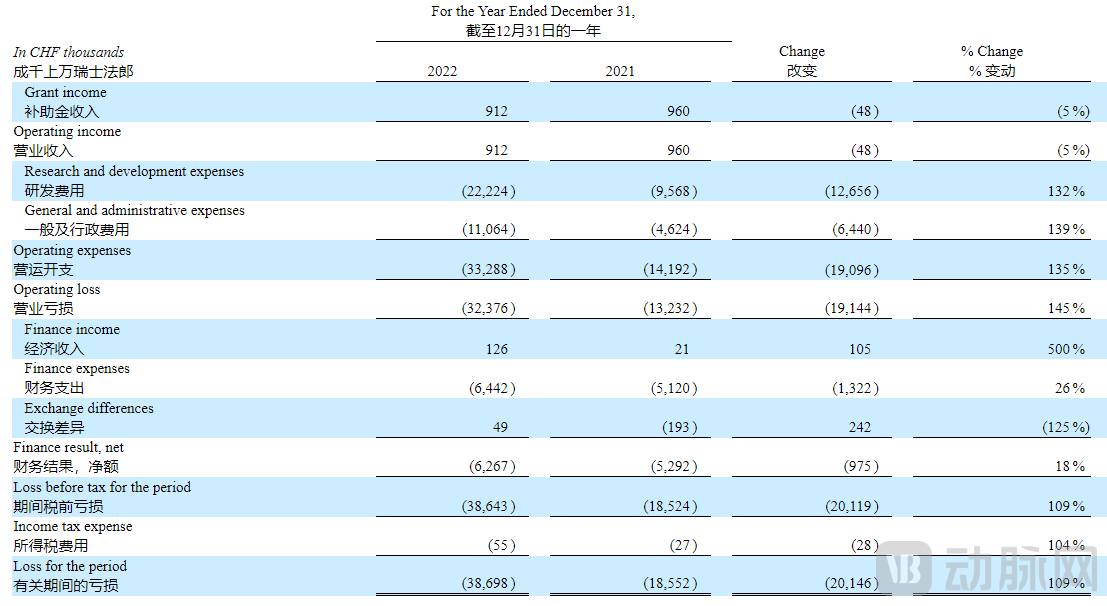
Data from the 2022 Fiscal Year Report
Image Source: Oculis Holding AG Official Website
Oculis stated almost bluntly in its financial report that the company has suffered significant operating losses, has not yet commercialized any products, and does not expect to generate revenue from product sales within a few years. Oculis' total loss for the 2022 fiscal year was 38.6 million Swiss francs. As of December 31, 2022, Oculis had accumulated losses of 111 million Swiss francs.
Facing a continued state of losses,Oculis emphasized in its financial report that its cash reserves are sufficient to cover the company’s operational and capital expenditures for the next year. As of December 31, 2022, Oculis had cash and cash equivalents amounting to CHF 19.8 million and CHF 46.3 million, respectively, with total cash reserves reaching CHF 66.1 million (approximately RMB 516 million).
Cash flow can withstand for a period of time,Before achieving commercialization, Oculis utilized a differentiated pipeline layout and the License-in model to reduce R&D costs, enhance investor confidence, and thereby extend its growth cycle.
Oculis currently has 10 pipelines in its layout. The main candidate drugs include OCS-01, OCS-02, and OCS-05, each of which can target multiple ophthalmic diseases.
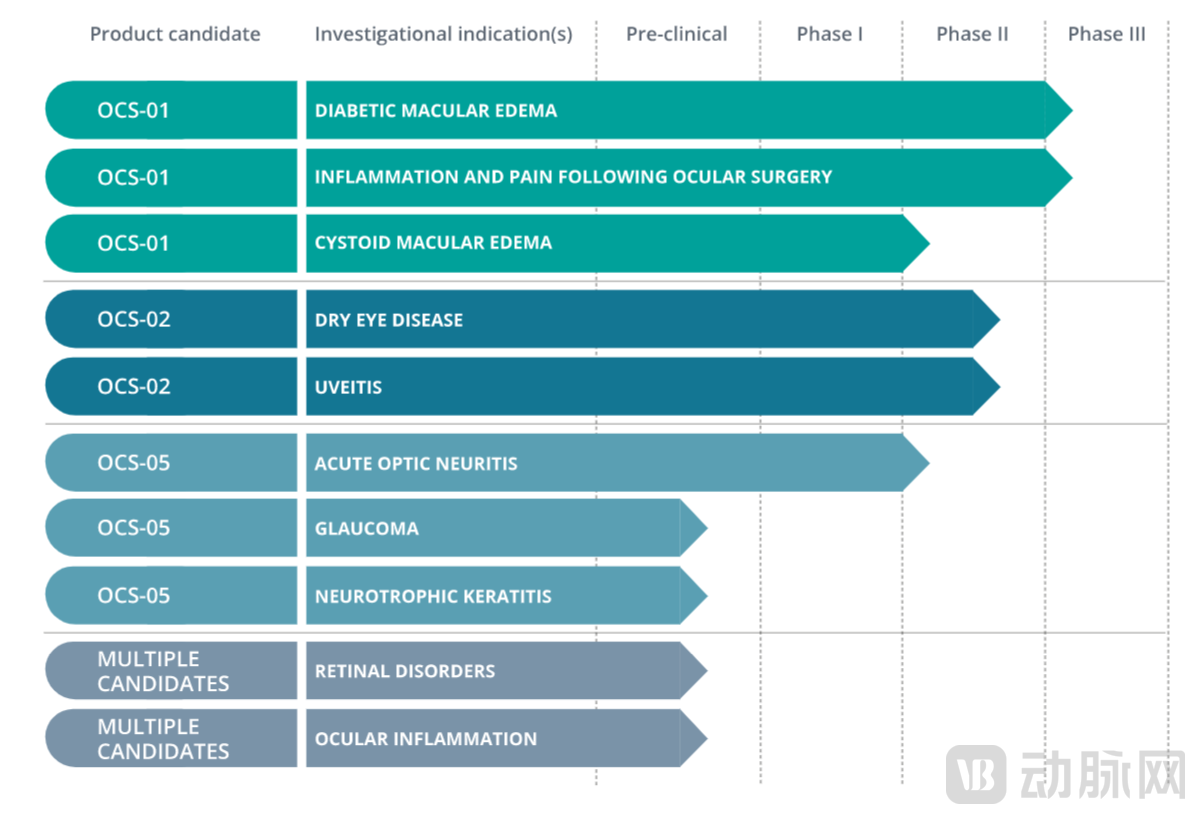
OCS-01: Demonstrated its effect in improving retinal edema in 144 patients
OCS-01 is a high-concentration, preservative-free topical OPTIREACH formulation.It uses Oculis' proprietary Optireach technology, which enables the drug formulation to remain on the eye's surface for a longer duration, enhancing the bioavailability of the medication in relevant ocular tissues.OCS-01 will serve as a potential topical treatment for diabetic macular edema (DME).
Diabetic Macular Edema (DME) is caused by the accumulation of fluid in the macular area of the retina. DME is the most common cause of vision loss in patients with diabetic retinopathy. Approximately half of the patients with diabetic retinopathy will develop DME.
According to a Decision Resources Group report, the number of DME patients in the United States is estimated at 1.75 million. By 2022, it is projected that 875,000 diagnosed DME patients in the U.S. will receive drug treatment, while the remaining 879,000 diagnosed patients will remain untreated.Oculis believes that these 879,000 patients represent a key market for OCS-01.
In addition to treating DME, OCS-01 also has potential applications in treating cystoid macular edema, as well as inflammation and pain following cataract surgery.
Currently, Oculis has completed the Phase 2 clinical trial of OCS-01 for DME.The effect of local drugs on retinal edema was first confirmed in 144 patients.OCS-01 has also successfully completed another Phase 2 clinical trial for the treatment of inflammation and pain following cataract surgery. In March 2023, Oculis completed the enrollment for the Phase 3 OCS-01 OPTIMIZE trial, marking another step forward in the regulatory approval process for OCS-01.
OCS-02: Promising for Uveitis and Dry Eye Treatment
Oculis has designed another candidate drug, OCS-02, using proprietary single-chain antibody fragment technology. This technology allows Oculis to develop a small, pharmacologically active, humanized single-chain variable fragment antibody (scFv). The lower molecular weight of this fragment enables the drug to achieve higher formulation concentrations, thereby enhancing penetration into ocular tissues and making it suitable for topical ocular treatment of surface or anterior chamber eye diseases.
Oculis expects that the mechanism of action and local administration route of OCS-02 can benefit patients with non-infectious anterior uveitis and dry eye disease.
In two Phase 2 clinical trials conducted among patients with dry eye disease and one Phase 2 clinical trial for acute anterior uveitis, researchers demonstratedOCS-02 Local Ocular Administration Associated with Improvement in Overall Ocular Discomfort Scores in Dry Eye Patients vs. Placebo and Achievement of Pre-specified Response Rates in Non-infectious Anterior Uveitis Patients.And OCS-02 was well tolerated in all three studies. Oculis is preparing to initiate two Phase 2b trials of OCS-02.
OCS-05: Has the potential to solve optic nerve injury problems
OCS-05 is a novel peptidomimetic small molecule with a unique MoA mechanism that activates neurotrophic signaling pathways, protecting and preventing optic nerve and retinal damage.
Oculis initially developed OCS-05 as a potential treatment for Acute Optic Neuritis (AON). AON is a rare disease with significant unmet medical needs, and currently, there are no FDA or CE-approved treatments available for AON. OCS-05 has been granted Orphan Drug Designation by both the FDA and CE.
Preclinical studies of OCS-05 have shown that it has neuroprotective effects and promotes remyelination activity.The Phase 1 clinical trial of OCS-05 conducted by Oculis showed that OCS-05 was well tolerated and had good pharmacokinetic correlation with preclinical animal studies.
Because the mechanism of action of OCS-05 can protect nerve axons when the optic nerve is affected, it also has potential therapeutic effects on glaucoma and other neurodegenerative eye diseases, including acute optic neuritis and geographic atrophy.
In addition to the clinical development programs for these three clinical candidate drugs, Oculis has also established several early preclinical development plans. For example, the LEOPARD study investigating the safety and efficacy of OCS-01 in uveitis and postoperative macular edema; evaluating the potential of OCS-03 as a treatment for corneal neovascularization; and developing the topical ophthalmic formulation project OCS-04, which is initially intended for the prevention of corneal transplant rejection.
Biotech companies typically focus on R&D in the early stages and collaborate with large pharmaceutical enterprises through licensing when projects progress to the cooperation stage, in order to alleviate the pressure of later-stage R&D and promote future commercialization.
Unlike the Lisence-out model we are familiar with, Oculis has chosen a License-in collaboration path, which accelerates R&D time while reducing its R&D risks.
License-in refers to a pharmaceutical company obtaining one or more products still in preclinical or clinical development from another company for further development. The pharmaceutical company focuses on product development and launch rather than the preclinical research related to drug discovery.
Dennis P. Schafer, Chief Operating Officer of Somatocor Pharmaceuticals, pointed out that most investors would rather spend $3 million to $4 million to bring a candidate drug to the inflection point of the clinical research stage in 1-2 years, than spend $15 million for the candidate drug to reach the clinical research stage more than 4 years later.Compared to initiating R&D around new technologies, licensing is a cheaper and faster approach.
In December 2018, Oculis reached an agreement with Novartis to obtain the usage license for the compound LME636, which Novartis did not want. At this time, Novartis was planning to divest its Alcon ophthalmology division and focus more on the development of innovative therapeutic drugs.
This drug has undergone early testing in three clinical trials, which have shown that LME636 is promising in treating anterior segment inflammatory diseases, including dry eye disease.The licensing of LME636 (now renamed OCS-02) expands Oculis' portfolio of novel topical treatments for ophthalmic diseases. This agreement is part of Oculis' strategy, as stated by Riad Sherif, CEO of Oculis, in the company’s press release.
In January 2022, Oculis entered into another collaboration with Acure Therapeutics, granting Oculis the exclusive global rights to develop and commercialize ACT-01. ACT-01 is a potential disease-modifying therapy aimed at protecting and preventing damage to the optic nerve and retina. ACT-01 has been renamed OCS-05.
According to the terms of the agreement, Acure Therapeutics will receive an upfront payment, potential milestone payments upon achieving certain development and commercial milestones, as well as tiered royalties on sales.
Through this type of License-in model, Oculis is able to acquire new products at a moderate upfront cost and conduct initial human testing on target indications, quickly advancing to the clinical research stage. This approach achieves an attractive R&D status at a relatively low cost, which helps attract further investor participation.
Before its listing, Oculis was estimated to have a market value of approximately US$220 million. At the time of writing, its market value has exceeded US$280 million (approximately RMB 1.9 billion). Oculis has a clear strategy and defined goals; whether it will be profitable can only be determined by time.