

Siemens Healthineers Shifts Strategy in Endovascular Robotics, Sparking Industry-Wide Debate

abrobo
Developer of Vascular Interventional Surgical Robots

RaysightMed
Medical Imaging Product Developer
AOPENG INTELLIGENCE
Developer and Manufacturer of Endovascular Interventional Surgical Robots

WeMed
Interventional Medical Device Provider
May 10, SiemensVCBeat Releases Q2 2023 Earnings Report and Announces Decision to Halt Vascular Intervention Robotic Surgery Business in Cardiology.
A Single Stone Raises A Thousand Ripples. Upon seeing this news, some quickly published the headline "Siemens to Exit Vascular Intervention Robotics"; others expressed the opinion that "It was already known that vascular intervention robotics addressed a false need"; and some took the opportunity to spread and amplify pessimistic sentiments.
However, as a "newbie" industry insider who has been tracking vascular interventional robots for two years, the author does not believe that vascular interventional robots are a "false track." Sure enough, after reviewing the financial reports, it was found that Siemens Healthineers' decision is to withdraw vascular interventional surgical robots from the field of cardiology and focus on neurointerventional surgery. Currently, Siemens Healthineers has begun developing a new generation of robotic platforms with the aim of providing effective treatment for patients in the critical early stages of stroke.
Nowadays, many media outlets often claim to encourage original innovation and support domestically produced innovations. However, when an overseas company or product encounters setbacks and bottlenecks, they start collectively predicting the decline of the related industry. It seems as if overseas companies have already represented the ceiling of a certain technology or product, and domestic companies and technologies can only be imitators and followers forever.
In fact, China's indigenous original innovation has now entered a deeper stage. Technologies such as PFA ablation systems, single-use endoscopes, interventional artificial hearts, polymeric heart valves, and vascular interventional robots have reached internationally leading levels, and some have even started to lead the development of global niche industries. As we possess technologies that lead globally, we should also have the confidence and solid foundation to guide the world.
Back to the topic, Siemens CFO Jochen Schmitz said: "We have turned the vascular interventional surgery robot into a research and development project, just like all other R&D projects.This is a very, very attractive field.。”
Siemens Healthineers China also responded swiftly on May 11. Siemens Healthineers has always believed that robotic technology for interventional procedures will play a significant role in the future of vascular treatment. In the future, Siemens Healthineers will focus on the application of vascular interventional robots in the field of neurointervention.
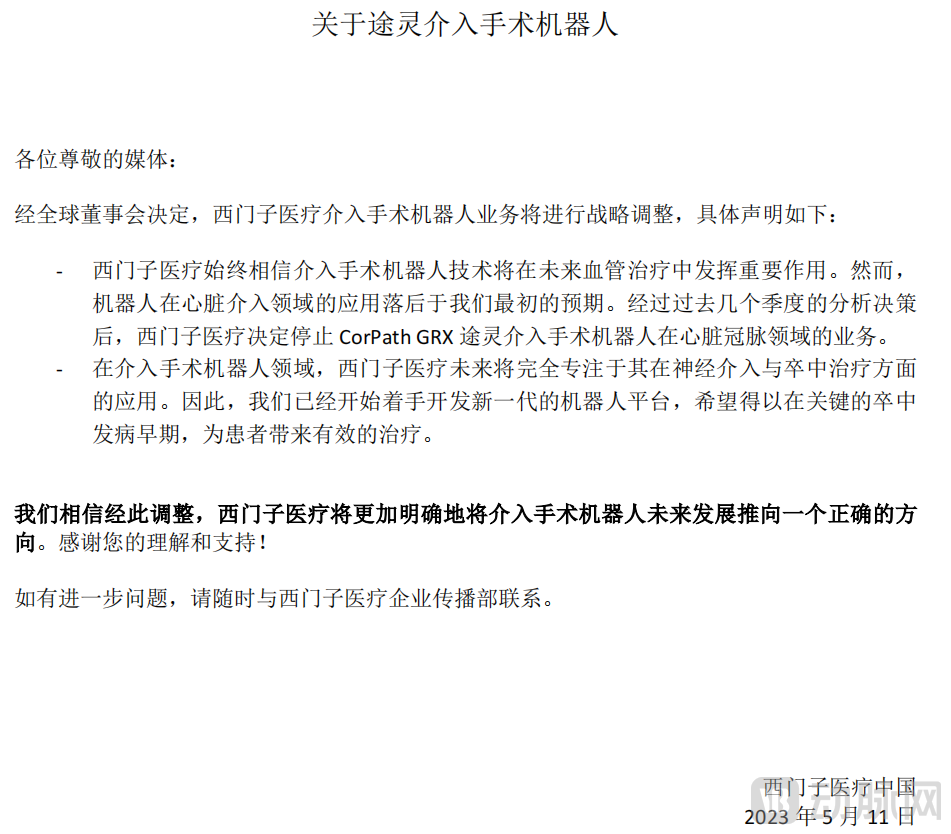
Insiders from Siemens Healthineers China disclosed: "We will align with the product line planning from our headquarters, focusing more on market cultivation in the neurology sector and suspending the supply of existing models in the cardiac field. At the same time, as China has been implementing localized innovative applications, we will collaborate with the headquarters to participate in product lifecycle management, creating new product platforms that better meet the clinical needs of the broader Chinese market."
In 2019, Siemens Healthineers acquired Corindus Vascular Robotics, a vascular interventional robotics company, for a total price of $1.1 billion. The main application of its vascular intervention robot was PCI (percutaneous coronary intervention). This withdrawal from the cardiology field and shift to the neurointerventional field resulted in a loss of approximately $359 million (intangible assets) for Siemens Healthineers.
From this perspective, Siemens Healthineers remains optimistic and plans to continue its investment in vascular interventional robotics. However, the overall valuation of its vascular interventional robotics project will experience a certain degree of reduction.
The main points of this article:
1. The underlying reason for Siemens Healthineers halting its robotic-assisted vascular intervention business in cardiology is product competitiveness.
2. Vascular interventional surgical robots are not a pseudo-demand and have significant clinical value.
3. Chinese enterprises take the lead, starting to guide the global vascular interventional surgical robotics industry.
In the official press release, Siemens Healthineers announced the cessation of its vascular interventional robotics business in the cardiology field, citing that its Corindus vascular robotic system "did not meet expectations."
Following the spread of this news, Ren Wenyong, co-founder of Shenzhen Aibo Medical Robot Co., Ltd., commented: "This event is a devastating blow for domestic companies that merely replicate the Corindus vascular interventional surgical robot and focus solely on PCI procedures. However, for those domestic startups that truly understand the Chinese market, are familiar with clinical scenarios, and are dedicated to developing quality products, it presents an opportunity to rise."
From Siemens Healthineers' perspective, shifting the focus of vascular interventional surgical robots to neurointervention may be due to its underperformance in cardiac intervention. Therefore, it hopes to turn its attention to the neurointervention track, where higher precision in surgical operations is required and the value of precision in vascular interventional surgical robots can be more prominently showcased.
Regarding Siemens Healthineers' decision, a group of China-produced vascular interventional robot companies almost unanimously believe: this is due to the insufficient product strength of Corindus vascular interventional robots, which led to weak market expansion. As a result, it has been converted into a research and development project to rework the product.
Liu Yikun, General Manager of Shanghai Aopeng Medical Technology Co., Ltd., stated: Vascular interventional surgery has only about 30 years of history, and vascular interventional robots have approximately 17 years of history. In these two markets, both still in their early stages,The world's first approved vascular interventional robot has not met clinical needs.。
WeMed founder Yang He also expressed approval of this viewpoint, Corindus vascular interventional surgical robotNo Force Feedback System, unable to detect the resistance generated by guidewires and catheters entering the human body, posing certain safety risks. In the past, when surgeries were performed manually, operators could perceive feedback from consumables such as guidewires and catheters, and in case of risks, the procedure could be urgently stopped, providing a certain level of safety protection.
At the same time, vascular interventional surgery has a high technical threshold and relies on the experience of doctors. If force feedback is lost, the "tactile sense" developed through long-term practice disappears, and the operator needs to adapt again, resulting in high learning and usage costs.
Yang He also stated: "The Corindus vascular interventional surgical robot is too picky about consumables,Only specified model of consumables can be used.This increases the usage cost for both hospitals and patients.Reduced the ease of use of its products。”
Ren Wenyong, co-founder of Shenzhen Aibo Medical Robot Co., Ltd., added: "Corindus vascular interventional surgical robotLimited control over guidewires and catheters, which can only address a specific part of the entire PCI procedure., such as stent placement, while unable to deliver the catheter,Unable to assist in all aspects of the surgery, and there is no possibility for the product to expand into a full-process surgical assistance system in terms of architecture."
In summary, the lack of force feedback technology limits the safety of the Corindus vascular interventional surgical robot. Its selectiveness regarding consumables restricts its ease of use and versatility, while its挑剔 regarding surgical procedures constrains the user experience. These factors combined lead to limitations in the hospital and clinical promotion of the Corindus vascular interventional surgical robot.
Therefore, multiple domestic vascular interventional surgical robot companies believe that Siemens Healthineers' viewpoint is: "The track is excellent, but the product needs to be remade."
After Siemens Healthineers announced the cessation of its robotic-assisted vascular intervention business in the cardiology field, some expressed that they had long seen it as addressing a pseudo-demand.
In response, VCBeat interviewed multiple domestic vascular interventional surgical robotics companies to address the skepticism. We believe that, although existing vascular interventional surgical robots may not fully meet clinical needs, innovative enterprises both in China and abroad are continuously advancing their technology, iterating on products, and developing and optimizing products based on clinical scenarios. It is expected that over time, a disruptive vascular interventional surgical robot will eventually emerge.
From the patient's perspective, vascular interventional surgical robots offer higher precision than human hands. Through the use of vascular interventional surgical robots, doctors can achieve more accurate operations, improving clinical outcomes and safety while reducing complications such as perforations or dissections. Additionally, with millimeter-level precision, patients can avoid the overuse of cardiac stents, thereby reducing the risk of subsequent related complications.
In addition, vascular interventional surgical robots make remote surgery a reality. This is of great value for patients with time-sensitive conditions such as stroke who are located in areas with scarce medical resources.
Liu Fangde, founder of Cloud White Life, stated: "There are approximately 13 million stroke patients in China, most of whom are concentrated in grassroots markets. Acute stroke has an extremely high time window limitation for treatment—patients need to receive timely treatment within a short period; otherwise, they face life-threatening risks. However, in grassroots hospitals, there is a lack of medical resources and the medical capabilities need improvement. Through vascular interventional surgical robots, experts can remotely perform surgeries on patients located in grassroots hospitals." This may also be one of the reasons Siemens Healthineers has focused its attention on the neurointervention field.
From a doctor's perspective, vascular interventional surgery is challenging to perform, requires high precision, involves a long training period, and offers a short career prime. Before the surgery, doctors must determine the access route for the intervention, complete the corresponding angiography, confirm the location, nature, and severity of the lesion, and construct a 3D model of the blood vessels by combining 2D vascular images with their anatomical knowledge. Ultimately, they rely on their experience and tactile feedback to carry out the operation. Therefore, the training period for vascular interventional doctors is relatively long, and their career prime lasts only about 10 years.
WeMed founder Yang He also stated: "The therapeutic effect of vascular interventional surgery is significantly influenced by the operator's experience, and the non-standardization of such surgeries, along with the uncertainty of the operator’s techniques, poses certain risks to the procedure."
If vascular interventional surgical robots are used, doctors can perform surgeries while sitting outside the catheterization room without wearing lead clothing, extending their professional lifespan. Meanwhile, based on the automation, intelligence, and standardization features of vascular interventional surgical robots, the learning difficulty of vascular interventional surgery is significantly reduced, the training period for doctors is notably shortened, and the surgical skills of junior doctors can be greatly improved.
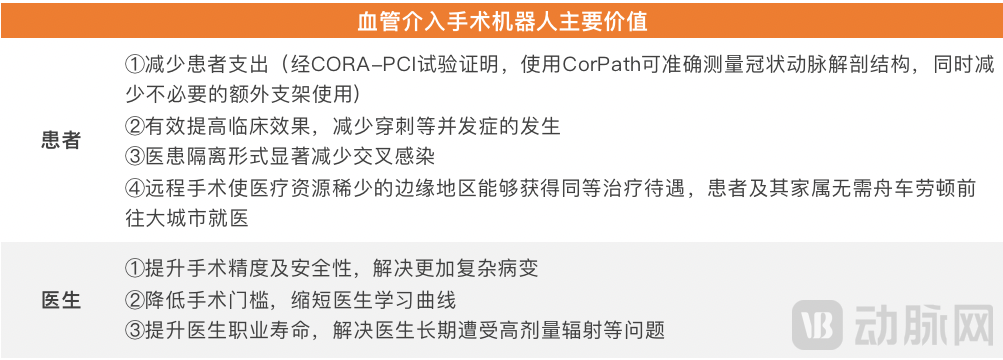
Overall, vascular interventional surgical robots can help patients improve surgical safety, reduce complications, achieve better clinical outcomes, and enable them to receive timely treatment at grassroots hospitals; they can also assist doctors in reducing radiation exposure, shortening the learning curve, enhancing surgical skills, improving the ability to handle complex lesions, extending their professional lifespan, and increasing the supply of social medical resources.
In 2012, Corindus' CorPath 200 received FDA approval for marketing, becoming the world's first approved vascular interventional surgical robot. However, as previously mentioned, it has certain limitations.
Standing on the shoulders of giants, a group of innovative enterprises in China have made targeted optimizations to address the limitations of Corindus vascular interventional surgical robots and have introduced innovations in areas such as intelligentization.
WeMed's self-developed ETcath vascular interventional surgical robot incorporates intelligent tactile sensing for guidewires, enhancing surgical safety. It also features multi-type catheter control, allowing ETcath to be compatible with mainstream consumables on the market, improving the ease of use of vascular interventional surgical robots. Additionally, the ETcath vascular interventional robot boasts a biomimetic propulsion design that fully simulates the precise push and twist actions of the human hand, offering higher propulsion accuracy. Its unique sterile disinfection box and magnetic quick-release design enable 3-second assembly and disassembly.
It is worth mentioning that the full simulation of the precise pushing and twisting operations of the human hand, along with intelligent tactile perception, allows experienced vascular interventional doctors to rely on their previous experience to perform vascular interventional surgeries faster and better, reducing the learning curve for using vascular interventional surgical robots. Additionally, during surgery, the ETcath vascular interventional robot can perform guidewire manipulation, balloon delivery, stent deployment, and IVUS catheter advancement, enhancing the applicability of vascular interventional surgical robots.
As of now, the ETcath vascular interventional surgical robot launched by WeMed has been approved to enter the special review process for innovative medical devices at the national level.
Allvas Vascular Surgery Robot Launched by Shanghai Aopeng Medical Technology Co., Ltd. Adopts a Teleoperation Approach in Its Design to Prevent Hand Tremors, Enhance Operational Stability, and Achieve Precise Execution of Complex Procedures. Aopeng Medical has also Developed a Unique Mechanical Structure That Enables the Robot to Handle, Rotate, and Deliver Vascular Interventional Devices Such as Guidewires, Catheters, and Stents with Greater Efficiency and Accuracy. This Further Reduces Errors Caused by Manual Operations Like Hand Shaking, Jumping, or Displacement, Improving Surgical Precision.
Allvas Vascular Interventional Surgical Robot can also efficiently complete complex surgical operations throughout the entire process, such as guidewire and catheter insertion and stent deployment, further enhancing surgical fluidity and reducing operation time. Meanwhile, the Allvas Vascular Interventional Surgical Robot adopts a bionic structure with dual robotic arms and four robotic hands, providing the surgical robot with higher degrees of freedom and richer functionality. Its robotic hands are specially designed to manipulate various types and diameters of guidewires, catheters, and stents, and can mimic a doctor's surgical movements, achieving actions like gripping, pushing, twisting, and combinations of various motions.
Based on multiple innovations, the Allvas vascular interventional surgical robot can fully cover the entire surgical process, allowing doctors to complete the surgery entirely outside the catheterization room.
Shenzhen Aibo Medical Robot Co., Ltd. designed a vascular interventional surgery robot based on the modular concept, suitable for various procedures such as neurointervention, coronary intervention, and peripheral intervention. During surgery, the robot has achieved control over two catheters, two micro-guidewires, one balloon, and a stent, gaining recognition from clinical experts in China. The robot also incorporates the concept of natural interaction, preserving the doctor’s original operating habits for vascular intervention and shortening the learning curve.
According to the introduction,Shenzhen Aibo Medical Robot Co., Ltd.'s products have full independent intellectual property rights, covering more comprehensive processes of vascular interventional operations and significantly reducing radiation exposure. At the same time, this surgical robot product is compatible with various standardized guidewires and catheters on the market, adapting to multiple surgical procedures.
In early March 2023, Shenzhen Aibo Medical Robot Co., Ltd. initiated the registrational clinical trial for its vascular interventional surgical robot, during which Professor Jianmin Liu from Shanghai Changhai Hospital successfully completed two robot-assisted cerebral angiography procedures.
RaysightMed's Vascular Interventional Surgical Robot Uses a Master-Slave Design, with the Slave End Mimicking the Precise Mechanical Structure of a Human Hand, Allowing the Robot to be as Flexible as a Human Hand While Maintaining Precision and Anti-Tremor Capabilities. The Disposable Surgical Box Independently Developed by RaysightMed is Highly Sealed, Preventing Blood from Entering the Main Instrument. The Entry Port of this Disposable Surgical Box Also Supports Various Sizes of Consumables, Enabling Simultaneous Coordination of Three Instruments: Guidewire, Balloon Stent Catheter, and Guiding Catheter, Meeting the Needs of Multiple Surgical Procedures.
In April 2022, RaysightMed's vascular interventional surgical robot successfully completed clinical registration animal experiments, verifying the product's safety, effectiveness, and precision. During the procedure, the robot completed the entire PCI process: coronary angiography, guidewire manipulation, balloon dilation, stent placement, etc.
In addition to enhancing the capabilities of the human hand, RaysightMed has also applied intelligent imaging software such as RuiXin-FFR (Raysight-FFR), the Raysight Coronary Intelligent Post-Processing Platform, and 3D navigation to vascular interventional surgical robots, helping doctors improve their "eye" abilities; by integrating intelligent algorithms like surgical planning, angiographic FFR, simulated stent placement solutions, and plaque risk assessment systems into vascular interventional surgical robots, they assist doctors in enhancing their "brain" abilities.
RaysightMed CEO Zheng Lingxiao once stated: "RaysightMed hopes to build a complete integrated ecosystem of hardware and software for cardiovascular and cerebrovascular diagnosis and treatment through advanced algorithms and hardware support. It aims to provide better 3D image reconstruction, surgical planning, real-time navigation, and surgical operation platforms—surpassing the limits of human brain, eyes, and hands."
Currently, the RaysightMed cardiovascular interventional surgical robot has completed multiple animal experiments and successfully performed stent surgeries on three sites—coronary, renal aorta, and peripheral—using the same device without changing the transmission apparatus in May 2022.
Overall, China-produced vascular interventional surgical robots have innovated in technologies or functions such as covering the entire surgical process, supporting multiple surgical procedures, force feedback, real-time intelligent imaging support during surgery, surgical planning, and navigation. Although the performance of various vascular interventional surgical robot products in China still needs to be clinically validated in the future, these innovations are already sufficient to lead the development direction of the global vascular interventional surgical robot industry.