

Roche Reports First-in-Human Data for Next-Generation 4-1BB Agonist RO7122290 in Advanced Solid Tumors
Roche
Oncology Drug Research, Development, and Manufacturing
InImmunityCancer immunotherapy, represented by checkpoint inhibitors, has transformed the landscape of cancer treatment. Among these, antibodies blocking PD-1 or PD-L1 have been approved for the treatment of over 25 different types of cancer. However, not all cancer patients benefit equally from these therapies. Overall, more than 80% of cancer patients either do not respond to immune checkpoint inhibitors or eventually develop resistance to them.
4-1BB (CD137) is a co-stimulatory receptor expressed on various immune system cells, particularly on activated CD8+ T and NK cells. Co-stimulation through 4-1BB with its ligand 4-1BBL (CD137L) or an agonistic monoclonal antibody enhances the proliferation, memory formation, longevity, and cytotoxic effects of these immune effector cells, thereby boosting anti-Tumor Immunology。
To enhance the response to immune checkpoint inhibitors, Roche has developed a new generation of 4-1BB agonist—RO7122290, a fusion protein composed of a trimer of 4-1BB ligand (4-1BBL) and an anti-fibroblast activation protein (FAP) Fab. FAP is expressed on cancer-associated fibroblasts (CAFs) in the stroma of more than 90% of human epithelial malignancies. In preclinical models, FAP-targeted 4-1BB agonists have demonstrated greater efficacy compared to first-generation 4-1BB agonist antibodies. This bispecific antibody-like fusion protein can selectively deliver co-stimulatory signals to immune effector cells within tumors, activating T-cell activity more effectively while reducing toxic side effects.
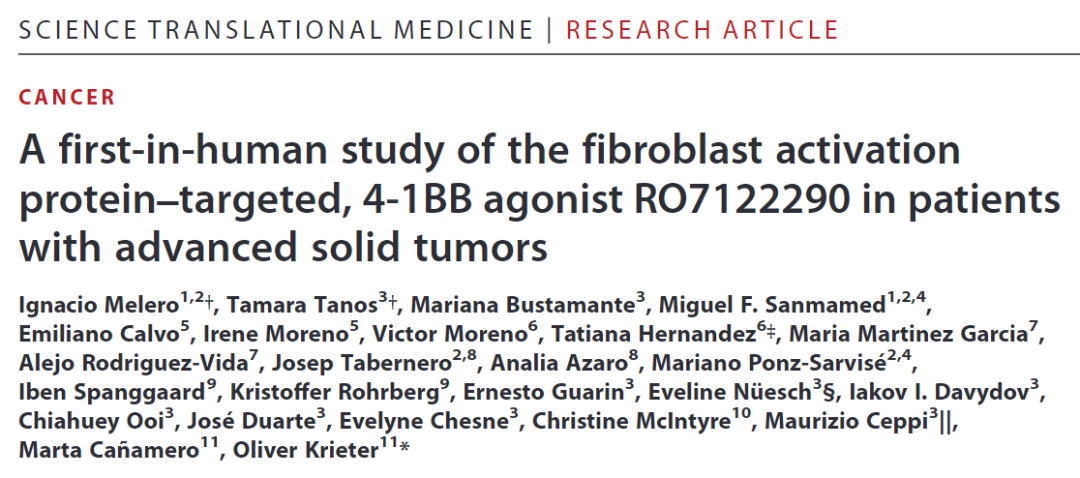
Recently, researchers from Roche published a research paper titled "A First-in-Human Study of the Fibroblast Activation Protein–Targeted, 4-1BB Agonist RO7122290 in Patients with Advanced Solid Tumors" in the journal Science Translational Medicine.
This is the first-in-human clinical study of RO7122290, a 4-1BB agonist targeting fibroblast activation protein (FAP), which explored its safety, mechanism of action, and therapeutic activity in patients with advanced solid tumors. The results showed that treatment led to increased proliferation and activation of T cells in peripheral blood, enhanced infiltration of CD8+ cells within tumors, and complete or partial responses were observed in 11 patients. These findings support further clinical evaluation of RO7122290 in combination with immune checkpoint inhibitors.
In the absence of a functional anti-tumor immune response, RO7122290 may require a combination partner to activate T cells or NK cells. It is known that the combination of RO7122290 and atezolizumab (an anti-PD-L1 monoclonal antibody) targets two distinct elements in the process of generating an anti-tumor T-cell immune response: activating tumor-reactive T cells and providing 4-1BB co-stimulatory signals, further enhancing T-cell function in a synergistic manner. The combination of a 4-1BB agonistic antibody with an anti-PD-1 monoclonal antibody or an anti-PD-L1 monoclonal antibody can elicit a stronger anti-tumor response and has shown preliminary clinical efficacy.
In this first-in-human dose-escalation clinical study, the research team evaluated the safety, tolerability, pharmacokinetics, immunogenicity, pharmacodynamics, and preliminary anti-tumor activity of RO7122290 monotherapy (65 patients) and RO7122290 + atezolizumab combination therapy (50 patients) in patients with advanced or metastatic solid tumors.
In the monotherapy group and combination therapy group, treatment-induced pharmacodynamic changes included an increase in proliferating and activated T cells in peripheral blood. Both treatment regimens observed increased infiltration of intratumoral CD8+ T cells and Ki67+CD8+ T cells, accompanied by the upregulation of T-cell activation genes and gene signatures, with 11 patients achieving complete or partial responses.
These results support further evaluation of RO7122290 in combination with atezolizumab or other cancer immunotherapies for the treatment of solid tumors.