

MicroPort CRM Files for Hong Kong IPO as Yunfeng, Hillhouse Back the 7th MicroPort Spin-off in High-Barrier Cardiac Rhythm Management Sector

MicroPort
High-end Medical Device R&D and Manufacturer
On May 19, 2023, MicroPort Medical spin-off subsidiary MicroPort Cardiac Rhythm submitted its prospectus to the Hong Kong Stock Exchange. This marks the sixth subsidiary that MicroPort Medical has spun off, following the successful listings of parent company MicroPort Medical and subsidiaries including MicroPort Endovascular, MicroPort CardioFlow, MicroPort Robotics, MicroPort Neuromodulation, and MicroPort Electrophysiology.
The MicroPort Cardiac Rhythm Management (CRM), which is part of the cardiac rhythm management device sector known as the most technologically advanced field in cardiovascular care, is involved in this spin-off listing.
In this high-barrier track, even the domestic leader MicroPort Medical entered by acquiring LivaNova's cardiac rhythm management business for $190 million in cash in 2018.
MicroPort Cardiac Rhythm Management's revenue reached $205 million in 2022, with a net loss of $107 million. Before its IPO, MicroPort Cardiac Rhythm Management quietly completed three rounds of financing, attracting investments from several institutions such as Yunfeng Capital, Hillhouse Capital, L Squared, CBC Group, and ICBC International. The Series C round raised $150 million, led jointly by Hillhouse and MicroPort, with other participants including Country Garden Ventures, CICC Capital, and E Fund Management.
From the post-listing stock price performance of MicroPort's subsidiaries, only two subsidiaries, Heartpulse Medical and MicroPort EP, have not seen their stock prices fall below the issue price. Heartpulse Medical has a market value of 12.3 billion yuan, while MicroPort EP has a market value of 10.7 billion yuan. Heartpulse Medical reported revenue of 897 million yuan in 2022, with a net profit attributable to shareholders of 357 million yuan. MicroPort EP reported revenue of 260 million yuan in 2022, with a net profit attributable to shareholders of 2.9718 million yuan.
The cardiac rhythm management (CRM) sector is a crucial segment for medical device giants such as Abbott, Medtronic, and Boston Scientific. In 2022, Abbott generated $2.119 billion in revenue from its CRM business. What is MicroPort Cardiac Rhythm Management's position in the CRM market? Can it replicate the success of these industry leaders? How will it develop in the future? VCBeat (WeChat ID: vcbeat) has provided an analysis.
Cardiac Rhythm Management (CRM) refers to the diagnosis, treatment, and management of arrhythmias and heart failure. The main devices include pacemakers, defibrillators (ICDs), and cardiac resynchronization therapy (CRT) devices. Arrhythmias may lead to heart failure and further result in cardiac arrest. Among various CRM devices, cardiac pacemakers represent the largest sub-market globally (in terms of the number and value of device implants), followed by ICDs (implantable cardioverter-defibrillators), CRT-Ds, and CRT-Ps.
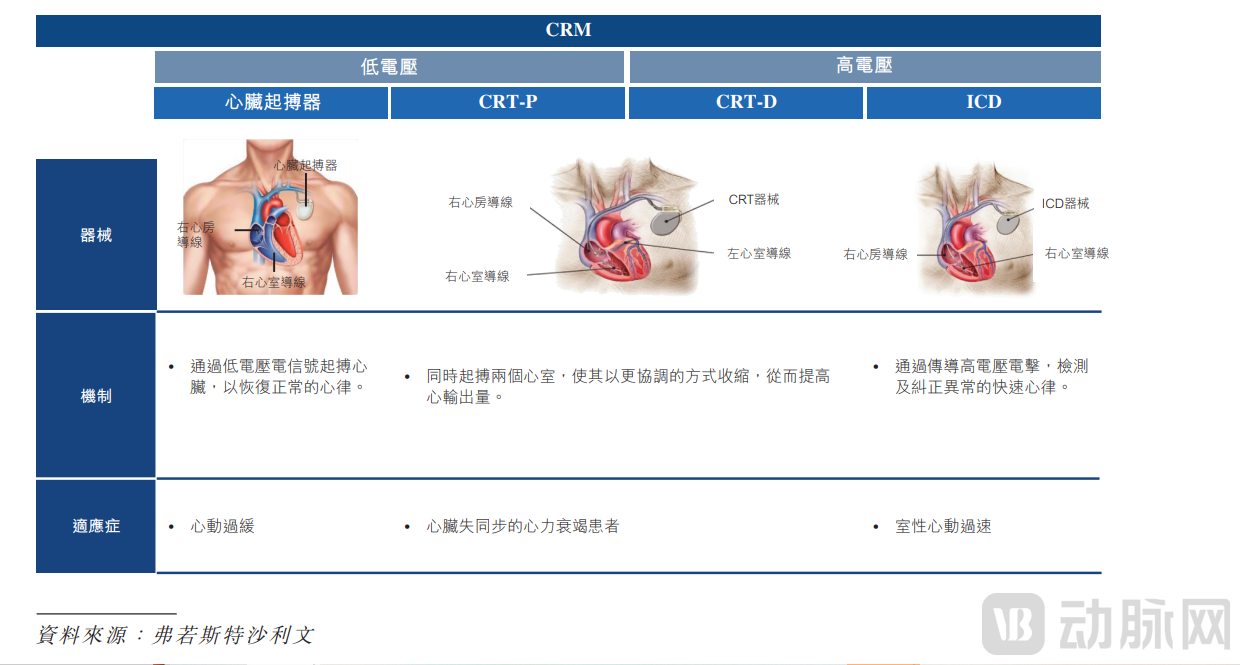
CRM Product Classification
CRM devices can also be divided into high-voltage electrical signal generating CRM devices and low-voltage electrical signal generating CRM devices. High-voltage electrical signal products mainly include ICD and CRT-D; low-voltage products mainly include pacemakers and CRT-P.
A pacemaker is a small device implanted subcutaneously in the chest, consisting of a pulse generator and electrodes. The electrodes are minimally invasively implanted into the heart through vascular puncture, while the pulse generator, connected to the electrodes, is embedded under the skin in the chest area to maintain an adequate heart rate. When the pacemaker detects a slow or missed heartbeat, it sends low-voltage electrical signals to help regulate the heart rhythm.
ICD is a small device implanted subcutaneously in the patient's chest. The principle of ICD is similar to that of an external defibrillator, delivering an internal shock to stop arrhythmia only when it detects dangerous irregular activity.
In simple terms, a pacemaker treats the problem of a slow heartbeat, while a defibrillator treats the problem of a fast heartbeat.
CRM is a highly representative high-tech barrier field in medical devices, which has not been completely localized in China for many years.Taking the ICD product with the highest technical difficulty as an example, both ICD and CRT-D consist of four parts: a sealed battery; a high-voltage capacitor that stores electrical energy and delivers shocks to the heart when needed to restore normal rhythm; electronic components that monitor the heart's electrical activity; and lead connectors. The ICD product is a complex system composed of many technically challenging individual technologies, including electrophysiology, biomedical engineering, biomaterials, precision machining, integrated circuits, wireless communication, high-energy battery capacitors, and ECG algorithms, all of which are highly demanding technologies.
Due to the high technical difficulty, imported products occupy the majority of the market share in China's CRM market, leading to high market prices and currently low product penetration rates.
China is the third-largest CRM device market globally, but the penetration of CRM is relatively low.LowIn 2021, the global number of pacemaker implant surgeries was 1.3 million, and the global number of ICD implant surgeries was 290,000. In the Chinese market, the number of pacemaker implant surgeries in 2021 was only 110,000; the number of ICD implant surgeries was only 8,200. In 2021, China implanted only 89.7 CRM devices per million people, while in Europe the same year, the number was 1,065.6 devices per million people.
VCBeat once interviewed to understand why the penetration rate of cardiac rhythm management products in China is low. First, there are few doctors who master pacemaker implantation technology, and currently, pacemaker implantation procedures in China are mainly concentrated in tertiary hospitals in large cities. Second, the unit price of the products is relatively high. Single-chamber pacemakers are low-end products, with domestic prices ranging from 20,000 to 30,000 yuan. Dual-chamber pacemakers are the main product type in the domestic market, with prices around 60,000 yuan. Triple-chamber pacemakers are the most high-end products, priced at about 100,000 yuan domestically, and currently, there are no domestically produced brands. The average price of ICD products before centralized procurement was 140,600 yuan per unit. Additionally, subsequent replacement of electrode leads, management, and maintenance all represent significant expenditures.
China's low-penetration market is also gaining growth momentum. The biggest driving force comes from the price reduction through centralized procurement, which will boost domestic market penetration. Several provinces in China have already initiated volume-based procurement for pacemakers, driving down their prices. Despite the drop in winning bid prices, the reduction in cost will increase the sales and penetration rate of cardiac pacemaker implants.
Centralized procurement benefits the continuous increase in the penetration rate of CRM series products in the Chinese market and further expands the market space.China is the third-largest market for CRM devices globally and the largest emerging market. According to the prospectus data, the domestic market size increased from US$393 million in 2016 to US$603 million in 2021, with a compound annual growth rate (CAGR) of 8.9%. It is expected to further expand to US$1.251 billion by 2030, with a CAGR of 8.4% from 2021 to 2030.
Low penetration rate and high technical barriers, these two characteristics have led to only a few companies entering the cardiac rhythm management (CRM) market. Most commercialized CRM products are developed by multinational corporations, including Medtronic, Abbott, Boston Scientific, Biotronik, and MicroPort Cardiac Rhythm Management. These five companies account for over 90% of the global market share.
How does MicroPort Cardiac Rhythm Management stand among the major global players?
When it comes to the subsidiaries under the MicroPort umbrella, the domestic substitution of various high-value products has always been a significant label. However, due to the early acquisition of LivaNova's cardiac rhythm management business, MicroPort Cardiac Rhythm Management (MicroPort CRM) operates in global markets and is truly a globalized company. MicroPort CRM has four production bases across three continents, located in Clamart, France; Saluggia, Italy; Santo Domingo, Dominican Republic; and Shanghai, China. In the Chinese market, MicroPort CRM implements a dual-brand strategy, offering both imported and locally produced products.
In the past three fiscal years of 2020, 2021, and 2022, MicroPort Cardiac Rhythm Management's revenue was $180 million, $220 million, and $205 million respectively, with corresponding net losses of $52 million, $89 million, and $107 million.
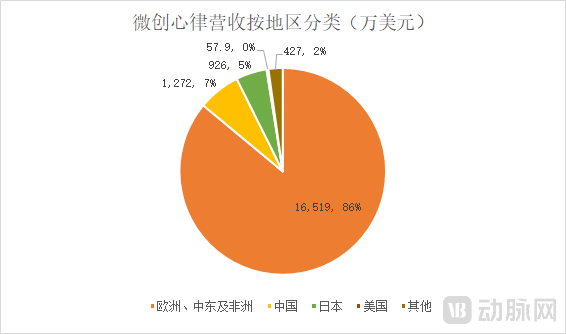
With the foundation of LivaNova's cardiac rhythm management business, MicroPort Cardiac Rhythm's core market remains in France.MicroPort Cardiac Rhythm Management is the largest pacemaker supplier in France. According to the 2022 revenue, the region with the largest revenue share for MicroPort Cardiac Rhythm Management is France, with 42.2% of income coming from the French market, followed by Southern and Northern Western Europe, contributing 24.0% and 11.4% of the revenue respectively. Revenue from the Chinese market accounted for 6.2%.
Although MicroPort Cardiac Rhythm Management has captured 26% of the market share in France, in MicroPort's home market of China, the cardiovascular sector is still dominated by several major industry giants.According to the MicroPort Cardiac Rhythm prospectus, Medtronic holds 44.2% of the market share in China; Abbott holds 26.8% of the market share; Boston Scientific's market share is 12.1%; MicroPort Cardiac Rhythm's market share in China is only 2.2%.
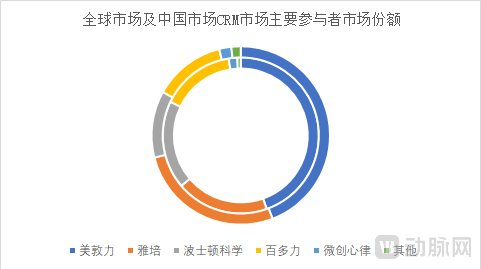
Outer circle: China market, Inner circle: Global market
In terms of product competitiveness, the development directions for pacemakers include miniaturization, leadless design, intelligence, full-body MRI compatibility, reduction of unnecessary ventricular pacing, and support for remote follow-ups. These key features also determine the competitiveness of pacemaker products.
MicroPort Cardiac Rhythm Management's core pacemaker product is the Alizea pacemaker. The Alizea pacemaker was launched in 2021, weighing 23.3 grams, compatible with 1.5/3T MRI, and equipped with automatic MRI monitoring and Bluetooth remote monitoring functions, boasting a lifespan of up to 13 years. To reduce unnecessary ventricular pacing, the Alizea pacemaker is equipped with the SafeR algorithm to minimize excessive ventricular pacing. Alizea also features adaptive rate response, adjusting the pacing rate based on the patient’s physical activity to meet changing metabolic demands, and can monitor for sleep apnea syndrome. Compared to other brands of leaded pacemakers, the Alizea pacemaker offers multiple advantages.
However, in the development of leadless pacemakers, MicroPort Cardiac Rhythm Management's product development progress has been relatively late. A leadless pacemaker is a capsule with a volume of approximately 1 cc, directly connected to the apex of the right ventricle, thus enabling cardiac pacing without the use of transvenous leads.
Medtronic is the leader in leadless pacemakers.In 2016, Medtronic's Micra leadless pacemaker received FDA approval. The Micra series is as small as a size 7 battery, with a volume and weight only one-tenth that of a traditional pacemaker. It can be directly inserted into the patient’s heart without the need for leads. Additionally, the Micra leadless pacemaker is compatible with 1.5 T/3.0 T full-body MRI scans and is equipped with Bluetooth functionality. This product was launched in China in 2019.
Abbott Launches Dual-Chamber Wireless Pacemaker: AveirThis product is comparable to Medtronic's Micra pacemaker and can be retrieved if the system needs replacement or adjustment during the patient’s treatment. The device provides on-demand pacing with reduced energy requirements.
MicroPort Cardiac Rhythm Management has also laid out a leadless pacemaker, planning to conduct clinical trials in 2026, with expectations to obtain the CE mark and approval from the National Medical Products Administration (NMPA) by 2028 at the earliest.
Overall, MicroPort Cardiac Rhythm Management's new products in the lead-based pacemaker field feature multiple functions, but its pipeline development in the leadless pacemaker field lags behind Medtronic and Abbott.
In the future, how will MicroPort Cardiac Rhythm Management increase its market share in the mature markets of Europe and America and in China's emerging market?
In mature markets, MicroPort Cardiac Rhythm Management's strategy is to consolidate its existing market share by continuously enhancing its advanced cardiac pacemaker portfolio and配套 arrhythmia diagnosis product offerings. The plan involves actively promoting newly approved MRI-compatible ICD devices and leveraging innovative leads that support high-voltage CRM devices to improve the competitiveness of high-voltage CRM devices.
In emerging markets, MicroPort Cardiac Rhythm Management aims to become the CRM device company with the largest market share in China and rapidly expand its market share in other emerging markets within the next decade.
MicroPort Cardiac Rhythm is the first IPO submission in China's cardiac rhythm market. What other potential companies are there in the Chinese market?
As mentioned above, the high barriers and high risks in the cardiac rhythm management sector have long allowed this market to be dominated by giants. Despite the significant barriers, currently, apart from MicroPort Cardiac Rhythm Management, multiple companies in China have also begun to enter the cardiac rhythm management sector.
Currently, several pacemaker and ICD products from Chinese manufacturers such as Lifetech Scientific, Lepu Medical, MicroPort, and Wonders Medical have been approved or are under development.
Among them, LePu Medical entered the cardiac pacemaker sector by acquiring Qinming Medical. In 2010 and 2012, LePu Medical acquired a total of 75.1% of Qinming Medical's shares in two separate acquisitions, becoming the controlling shareholder of Qinming Medical. In October 2016, LePu Medtronic's dual-chamber pacemaker, Qinming8631, was approved for marketing.
It is worth mentioning that the human pacemaker market is difficult to achieve domestic substitution in China. As a result, Lepu Medical began to expand into the animal pacemaker track. In 2021, Lepu established the Ledong Pukang Animal Medical Division, and in 2023, Ledong Pukang successfully assisted in the completion of China's first feline heart pacemaker implantation.
Lifetech Scientific's pacemaker products originated from a collaboration with Medtronic. In 2014, Medtronic transferred patents, equipment, and consulting services, and the products related to development and manufacturing by Lifetech Scientific’s facilities in Shenzhen, China, were marketed, promoted, and distributed primarily by Medtronic. In December 2017, Lifetech successfully launched the "Xintong" HeartTone series of implantable cardiac pacemakers. In 2021, the two parties deepened their collaboration again to develop MRI-compatible pacemakers.
The startup company Wushuang Medical enters the CRM field through the more challenging ICD product. The first-generation ICD product under development by Wushuang Medical is China's first ICD with fully independent intellectual property rights. Its performance has reached an internationally leading level and is the first to be equipped with Bluetooth functionality, enabling remote follow-up for patients in various scenarios. By controlling costs and innovating services, it accelerates the replacement of imported products. Currently, Wushuang ICD has passed type inspection.
Despite China being the third-largest pacemaker market globally, the penetration rate of CRM devices remains much lower than in developed countries. Each year, over one million people in China experience cardiac arrest, and the number of sudden cardiac deaths reaches 544,000 annually.
With the acceleration of the aging process in China's population, the implantation volume and penetration rate of CRM devices will continue to increase. The patient population in China's CRM market is large, holding immense growth potential. The vast demand within the country also calls for more products to meet the needs of patients with varying payment capabilities. As MicroPort Cardiac Rhythm Management submits its IPO application to the Hong Kong Stock Exchange, it brings more attention and confidence to the CRM industry. Expectations are high that domestic companies will step up efforts to deliver more innovative products.