

Complement Therapeutics Secures €72M Series A Financing to Advance One-Time Gene Therapy CTx001 for Geographic Atrophy

Complement Therapeutics
Drug Developer
On February 17 this year, Apellis announced that the complement C3 cyclic peptide inhibitor Pegcetacoplan, used for treating dry age-related macular degeneration (AMD) under the brand name Syfovre, became the first FDA-approved drug for geographic atrophy (GA). This also marksComplement Therapeutics Moves from Rare Diseases to Common Diseases
Age-related Macular Degeneration (AMD) is a chronic degenerative disease with complex pathophysiology and mechanisms, and is a leading cause of severe, irreversible vision loss. Among its forms, Geographic Atrophy (GA) represents the advanced dry stage of AMD. Until recently, dry AMD has remained in a state of having "no available treatment," posing a significant patient burden and public health challenge.
According to the "Technical Guidelines for Clinical Research of Drugs for the Treatment of Age-Related Macular Degeneration" issued by the Center for Drug Evaluation of the National Medical Products Administration, AMD has affected approximately 30% of the elderly population globally in the past decade, and about 8.7% of the blind population worldwide are blinded by AMD. The substantial clinical demand has made AMD drugs a hotspot and blue ocean market in new drug research and development. Earlier this year, Apellis' new drug was rated as one of the top ten most anticipated new drugs of the year by Fierce Pharma.
Complement Therapeutics is also a biotechnology company developing drugs for geographic atrophy (GA). Its therapeutic approach involves complement-mediated drugs for targeted treatment of GA. The company recently announced that it has secured €72 million in Series A funding.
Unlike other GA drugs under development, Complement Therapeutics has pioneered a new approach for GA drugs—A One-and-Done Gene Therapy. Unlike other medications that require frequent injections, CTx001 aims for a "once and for all" solution, reducing the treatment burden on patients. This novel mechanism of action has the potential to deliver superior efficacy compared to competing drugs, thereby transforming the treatment landscape for GA.
The complement system is part of the human innate immune system, consisting of approximately 50 proteins and protein fragments. It has the ability to enhance antibodies, promote phagocytic cells, eliminate microbes and damaged cells in the body, and attack invading pathogens.
When the complement-triggering mechanism is activated, the complement cascade works with other components of the immune system to eliminate foreign or damaged substances. As research progresses, dysregulation of the complement system has been found to be associated with the development of many diseases, leading to new therapeutic strategies and methods for disease monitoring.
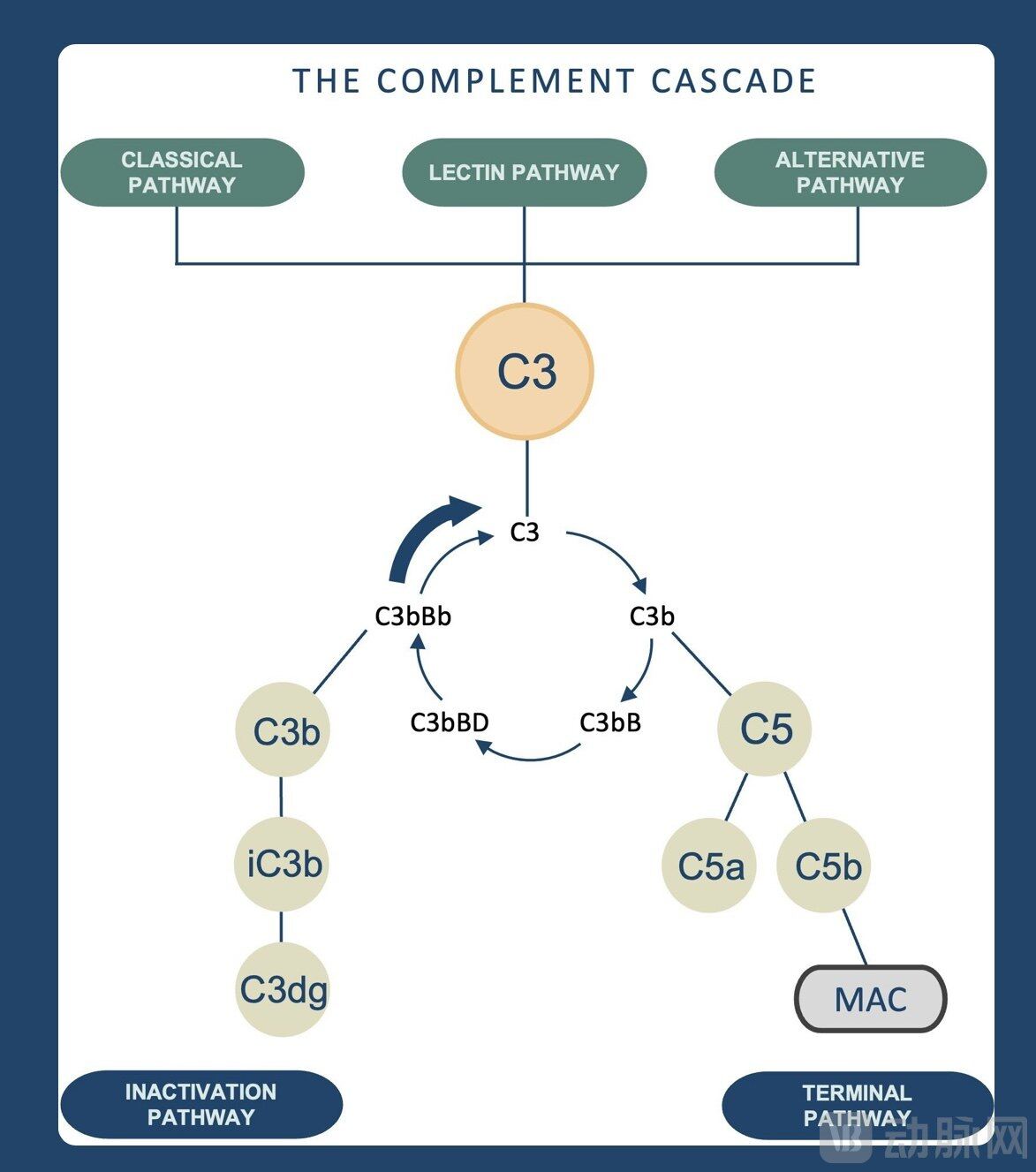
Complement Cascade Diagram
Source: Complement Therapeutics
Through extensive original research, Complement Therapeutics has gained new insights into the role of complement in the eye and its role in the pathogenesis of AMD.Especially, the research of its founder identified the key role of complement regulatory protein H factor-related protein (FHR) in the development of AMD, laying the foundation for the treatment strategy of its main product CTx001.
Complement Therapeutics focuses on studying the role of complement receptor 1 (CR1) in complement activation, considering CR1 as "one of the most effective cofactors in actually regulating C3 activity." Complement component C3 is a key part of GA pathology.
CTx001 packages a smaller version of CR1 into an adeno-associated virus (AAV) vector, which is delivered via subretinal injection, transforming the eye into a factory for this truncated CR1, with the ultimate goal of modulating complement activity within the eye.
Currently, CTx001 has completed the preclinical proof-of-concept stage,Preclinical proof-of-concept data to be presented at the 2023 Association for Research in Vision and Ophthalmology conference, with testing expected to commence in 2024.
Based on the characteristics of heterogeneous diseases with GA, Complement Therapeutics recently launched a non-interventional natural history study, i-GAIN (Investigation into Geographic Atrophy Insights). The study will collect the natural history of GA patients and evaluate the relationship between the genetics, blood biomarkers, and phenotypic changes in the patients' eyes.
Building on a deeper understanding of the role of FHR proteins, Complement Therapeutics has expanded the potential applications of its therapeutic strategies to a wide range of complement-mediated diseases. These include CTx002 for complement-mediated kidney disease, CTx003 for fetal heart dysfunction, and CTx004 for neuroinflammation.

Systematic Regulation of the Complement System Therapy
Source: Complement Therapeutics
In addition, Complement Therapeutics is developing systemic therapies to modulate the complement system, addressing the needs of patients with a wide range of complement-mediated diseases.
Complement Therapeutics has also developed a unique method for quantifying complement proteins — the novel Complement Precision Medicine Platform (CPM), which enables the accurate measurement of over 30 complement proteins from a single blood sample drawn from one system for the first time. While supporting disease monitoring, the CPM platform will help stratify patients with AMD and other diseases for future clinical monitoring, aiding drug development, clinical trials, and subsequent asset commercialization. It has currently entered the preclinical stage.
As a startup with a core team of less than 10 people, Complement Therapeutics has been actively seeking collaborations during its development process, joining multiple integrated platforms to extend its resources in the field, with the aim of accelerating product development and broadening the scope of application.
In 2022, CTx001 was granted the Innovative Licensing and Access Pathway (ILAP) by the UK Medicines and Healthcare products Regulatory Agency (MHRA). ILAP is an integrated platform provided for collaboration among research drug developers, MHRA, and its partners, including the National Institute for Health and Care Excellence (NICE), the Scottish Medicines Consortium (SMC), and the National Health Service (NHS).
Complement Therapeutics will collaborate with these institutions to establish the development objectives for CTx001 and create a roadmap for regulatory and development milestones. Additional benefits of ILAP include the potential for a 150-day accelerated Marketing Authorization Application (MAA) assessment, rolling review, and ongoing risk-benefit evaluation.
In addition, Complement Therapeutics has established a collaboration with CGT Catapult and received funding support from Innovate UK EDGE. This award enables CTx to benefit from the expertise of CGT Catapult's regulatory affairs and non-clinical safety teams to evaluate the company’s non-clinical, chemistry manufacturing and control, quality, and clinical development plans, maintain ongoing dialogue with regulatory authorities, and tailor regulatory strategies.
In 2023, Complement Therapeutics established a strategic partnership with Pharmaron.. This partnership will allow the delivery of clinical-grade products, with drug supply expected for human clinical trials in 2024. As part of the collaboration, Pharmaron has provided gene therapy clinical development and GMP manufacturing facilities located in Liverpool, UK, as well as a CMC team focused on ocular gene therapy drug development. This collaboration brings more cost-effective and development-efficient R&D to Complement Therapeutics.
Complement Therapeutics was founded in July 2020 and is headquartered in Germany. The company originated from the pioneering research of three founders from the University of Manchester: Professor Paul Bishop, Professor Simon J. Clark, and Dr. Richard Unwin, as a spin-off product of the university.
In 2015, Professor Simon J. Clark and Professor Paul Bishop co-founded the Manchester Eye Tissue Repository (ETR), collecting genotyped and phenotyped human eye tissues as an international resource for ophthalmic academic research and also providing research resources for complement-mediated development.

Founding Team
Source: Complement Therapeutics
At the beginning of 2021, Complement Therapeutics spun off from the University of Manchester with initial seed funding support from BGV. In February 2022, it received another 5 million euros in seed funding, which advanced its main product CTx001 through preclinical proof-of-concept.
After spinning off from Manchester University, Complement Therapeutics further built a professional and commercialized management team. In February 2022, Dr. Rafiq Hasan was appointed as the Chief Executive Officer. He previously served as the Senior Vice President at Bayer and Global Head of Ophthalmology, held senior positions in ophthalmology at Novartis, and achieved a leap in Eylea's business from zero to 2.5 billion yuan within five years. In August, Complement Therapeutics appointed Dr. Dennis Keefe as the Chief Scientific Officer, who has over 15 years of R&D and executive experience in the biopharmaceutical field.

Management Team
Source: Complement Therapeutics
Since Belgian immunologist Bordet discovered the complement system in 1890, research on the complement system and its therapeutic effects has never ceased. In recent years, an increasing number of pharmaceutical companies have been focusing on complement drug development. Just in the GA field, the FDA recently approved the first intravitreal C3 inhibitor Pegcetagoplan for marketing and granted priority review to Iveric Bio's complement C5 inhibitor Zimura.
In the rare disease field, Novartis, AstraZeneca, Sanofi, and Roche have all entered the market. AstraZeneca's first rare disease drug in the Chinese market, the C5 complement inhibitor Soliris (eculizumab), was approved for marketing in 2022, offering a new treatment option. Roche's C5 inhibitor Crovalimab (Crovalimab Injection) has been officially granted marketing approval in China and has been given priority review status.
The pace of complement drug research, development, and market entry is continuously accelerating, with the vast Chinese market already in focus. The future is here, and we look forward to complement drugs making an impact in more areas awaiting treatment.