

Magenta Medical Secures $55 Million Funding Seven Years Post-Founding Following Strategic Shift in Indication for Its Minimally Invasive pLVAD Elevate™

Magenta Medical
Clinical Venous Catheter Treatment Device Developer
In recent years, Israel has become the world's second-largest supplier of medical devices and is a breeding ground for advanced medical technology. According to research from Israel's IVC Research Center, there are approximately 750 life science companies in China, with 55% engaged in the research and development and production of medical devices.
Magenta Medical (hereinafter referred to as Magenta) is precisely such a homegrown Israeli innovative medical technology company. Founded in 2012, Magenta's two founders, Yosi Tuval and Ehud Schwammenthal, are both from Israel and currently serve as the company’s CTO and CMO, respectively.
Magenta Medical is currently developing a percutaneous left ventricular assist device (pLVAD) —— Elevate™. The device provides short-term circulatory support for patients by transferring blood from the left ventricle to the arterial system via a heart pump, without the need for open-heart surgery.
In May this year, Magenta secured $55 million in financing led by Orbimed. According to data from the Crunchbase website, Magenta has raised a total of $74 million in funding as of this round.

Magenta Financing History
Compiled by VCBeat
Compared with the previous rounds, the scale of this round of 55 million US dollars financing is unprecedented. This is due to Magenta's timely shift in product indication positioning in recent years and the successful completion of a first-in-human study (FIH) in high-risk PCI (high-risk percutaneous coronary intervention) in Georgia, USA in 2022.
So, why is Magenta changing its product strategy? What unique advantages does Elevate™ have to attract investors to increase their investment again?
Yosi Tuval and Ehud Schwammenthal founded a company named Ventor Technologies before establishing Magenta, which focused on developing a transcatheter aortic valve replacement (TAVR) product for treating aortic diseases. Ventor was acquired by Medtronic for $325 million in 2009.
It is precisely based on previous successful entrepreneurial and R&D experience that Yosi Tuval and Ehud Schwammenthal have conducted more in-depth thinking about the market prospects of the project as well as future profits and losses.
The heart pump developed by Magenta Medical at its inception was primarily aimed at treating heart failure (HF). According to CEO Dr. Israeli, the product was already quite mature at that time, and previous financing alone could sustain the company until the product received FDA approval.
Although the technology is mature and well-funded, due to the product being a Class III medical device, it faces a lengthy FDA approval process. Moreover, as the world’s first cardiac pump to replace diuretic drugs, Magenta Medical must work with the FDA to establish protocols from start to finish, and the operational status after its official market launch is also unpredictable.
As a startup, Dr. Israeli believes that Magenta's path to treating heart failure will be long and arduous, with an uncertain harvest period. At the same time, another area has drawn Magenta's attention: the use of interventional cardiac catheter pumps to provide temporary mechanical circulatory support for high-risk PCI and cardiogenic shock patients until the heart regains normal function—this is Magenta's new product, Elevate™.
In 2022, Johnson & Johnson acquired Abiomed (NASDAQ: ABMD) for $16.6 billion. The company's star product, the left ventricular assist device (LVAD) — Impella, received FDA approval in 2015. Currently, there are several products targeting different indications, with different sizes, rotation speeds, and flow rates, covering high-risk PCI and cardiogenic shock. Additionally, new series of Impella products are currently in clinical stages.
Therefore, the market trend for LVAD in high-risk PCI and cardiogenic shock is becoming clearer, with lower risks and easier predictability. According to data from Grand View Research, a U.S.-based market research firm, the global ventricular assist device market size was $1.8 billion in 2020 and is expected to grow at a compound annual growth rate (CAGR) of 17.6% from 2021 to 2028. Among this, the LVAD segment dominated the VAD market, accounting for the largest share of 80.5%.
It is worth noting that Abiomed was one of the B-round investors in Magenta Medical. Facing the rapidly growing market in the future and the remarkable growth point of LVAD, what unique technological innovations does Elevate™ have to secure a position in the future LVAD race?
Magenta Medical, Ltd. has changed the indication of its product, but its patented technology has been carried over to the new product, Elevate™. Elevate™ is a cardiac pump installed in the left ventricle via a catheter through percutaneous puncture, designed to provide temporary mechanical circulatory support for hospitalized patients undergoing high-risk PCI and cardiogenic shock.
The core technology of Elevate™ is its self-expanding impeller and pump head.Among them, the self-expanding impeller consists of a memory metal frame and blade bodies made of flexible material. When axial force is applied, the impeller elongates and its diameter decreases, allowing it to easily pass through the patient's blood vessels to reach the left ventricle. Once the device is properly deployed, the application of axial force ceases, and the memory metal frame re-expands to its initial state, with the flexible impeller also returning to its original working configuration.
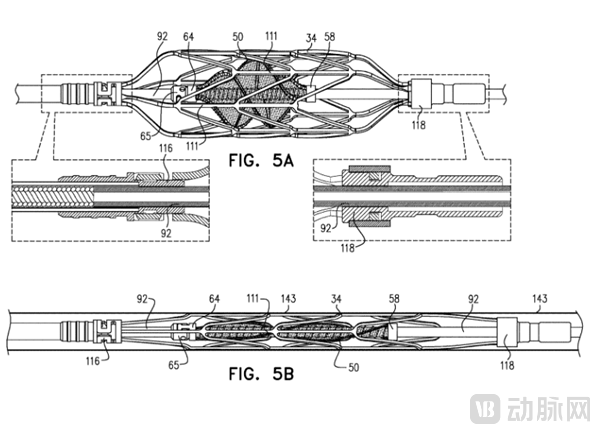
Self-expanding Impeller
Source: Magenta Patent Document
According to the Magenta official website, Elevate™ reduces the size of vascular punctures through a self-expanding delivery sheath, ensuring effective and safe cardiac output while minimizing trauma to the patient.
After the self-expanding impeller is deployed to the appropriate position within the patient's heart, the pump's diameter can expand from 8Fr to 30Fr (approximately 3.5 times), with an average designed blood flow rate of 5L/min from the left ventricle to the aorta, which is approximately equal to the normal cardiac output of an adult. The peak flow rate of Elevate™ can reach up to 7L/min.
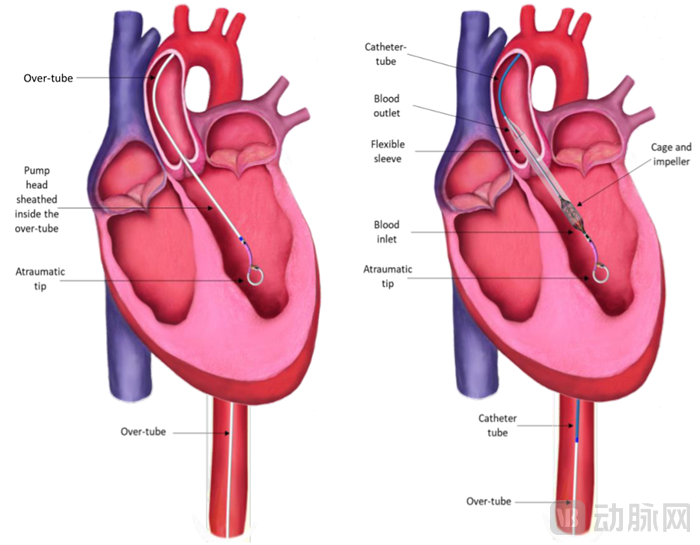
Self-expanding Impeller
Source: Magenta Official Website
According to Abiomed's official website, the Impella ECP, currently known as the world's smallest heart pump, has a diameter of 9Fr and can expand up to approximately 18Fr, with a peak flow rate greater than 3.5L/min. The device received the "Breakthrough Device Designation" in 2021 and is currently in the clinical stage.
How to achieve greater flow within a smaller size has always been a key trend and challenge in LVAD development. Therefore, Magenta Medical will gain market recognition in the future with its more advantageous patented technology.
Although the specific risks of PCI surgery for high-risk coronary heart disease patients vary depending on the patient's condition, there is a consensus that the patient's body during the perioperative period cannot withstand injuries such as arrhythmia and reperfusion during the operation. These risks will increase the probability of complications such as cardiogenic shock or cardiac arrest in patients.
pLVAD, an artificial left ventricular assist device implanted via puncture, provides more stable circulatory support to patients during high-risk PCI procedures. It improves coronary and distal organ perfusion while reducing the burden on the left ventricle, which helps stabilize the patient’s vital signs during surgery and promotes postoperative recovery.
The driving modes of pLVAD mainly include two types: one with the motor located inside the body and the other outside. Elevate™ adopts the same external motor as Impella ECP, which only requires percutaneous puncture to shunt the circulatory assist device into the left ventricle. The external motor can avoid risks such as poor heat dissipation of the internal structure during operation affecting efficiency or causing localized overheating of intravascular devices.
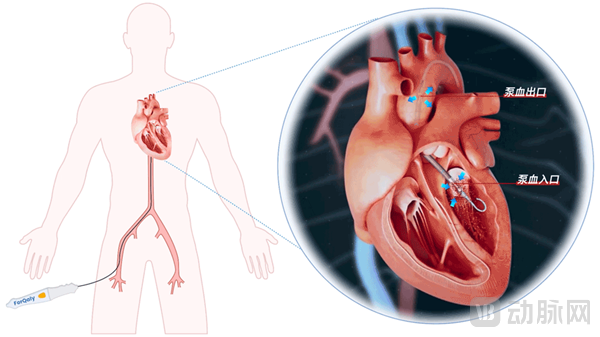
Elevate™ is introduced through a 10Fr peel-away sheath via the femoral artery at the groin, reaching the aorta and subsequently the left ventricle, where it generates forward blood flow assistance through impeller rotation. Blood is drawn from the left ventricle and discharged into the aorta, effectively reducing pressure in the left ventricle, lowering wall stress and overall myocardial oxygen consumption, allowing the patient’s heart to rest adequately. Additionally, the pump speed and flow can be adjusted according to the specific condition of the patient.
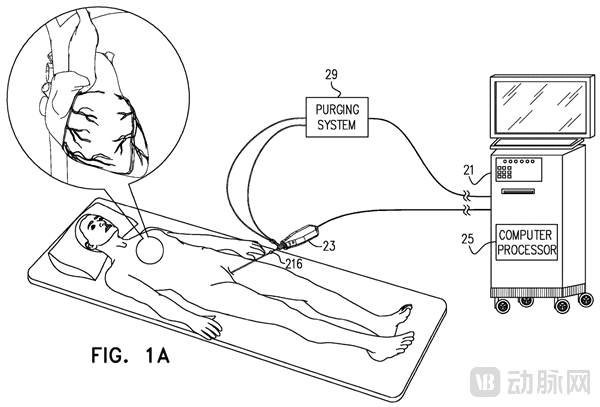
Elevate™ Surgical Indication
Source: Magenta Patent Document
Magenta Medical has successfully completed its first-in-human study and presented the results at the Cardiovascular Research Foundation (CRF)’s annual Transcatheter Cardiovascular Therapeutics (TCT) scientific symposium in 2022.
It is reported that Elevate™ can be safely and accurately deployed and unsheathed within the arteries of patients with thrombosis. Additionally, for silent angina pectoris (Rest Angina Prior) caused by insufficient coronary blood supply, Elevate™ can provide multiple sustained and effective treatments for left main artery dilation before patients undergo high-risk PCI surgery.
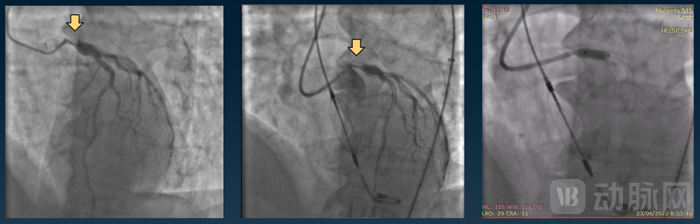
Elevate™ Dilation Therapy
Source: TCT official website
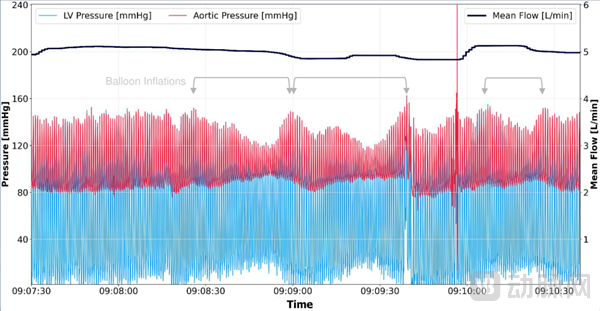
Hemodynamic Data
Source: TCT Official Website
Elevate™ has received FDA "Breakthrough Device Designation" for two indications: high-risk PCI and cardiogenic shock (CS). This means the FDA will prioritize the regulatory review process for Elevate™, including clinical trial protocols and PMA applications, potentially accelerating its market launch in the United States.
Magenta is currently preparing to launch its clinical program in the United States, starting with the early feasibility study for high-risk PCI (NCT05727059).
Talent barriers are one of the entry thresholds in the high-end medical device industry, and the interventional cardiac catheter pump is a technology-intensive sector. This requires the R&D team of startups to possess comprehensive knowledge in medicine, biology, materials, and even marketing in order to not only develop the product but also successfully bring it to market.

Magenta Management Team
Source: Magenta official website
As for Magenta's management team, CEO David Israeli holds a medical doctorate from the Hebrew University of Jerusalem and a Master of Business Administration degree from Harvard Business School. He has not only served as the Vice President of Medical Affairs at Rhythmia Medical but also acted as the General Partner (GP) for the life sciences team at Pitango, an Israeli venture capital firm. Pitango has been a steadfast supporter of Magenta through its various rounds of financing.
Co-founder and CMO Ehud Schwammenthal holds a Ph.D. in Cardiovascular Physiology from Tel Aviv University. In addition to founding Ventor Technologies, Schwammenthal also served as an associate professor of cardiology at Tel Aviv University.
Co-founder and CTO Yosi Tuval holds a Master of Science degree in Mechanical Engineering from Ben-Gurion University in Israel. He previously worked as an engineer at Israel Aerospace Industries (IAI) before co-founding Ventor Technologies with Schwammenthal.
COO Gilead Moiseyev holds a bachelor's degree in mechanical engineering and a Ph.D. in computational mechanics from the Israel Institute of Technology. He has served as the vice president of R&D and project manager at Medinol, a medical technology company.
In addition to its solid core patented technology, Magenta's management team also has rich and mature experience in goal decision-making and marketing. With the support of $55 million led by Orbimed, a U.S.-based capital firm, in this round of funding, it is believed that Magenta can accelerate its progress on the pLVAD path.
Turning our attention back to China, since the approval and market launch of China's first artificial heart product "Eternity Heart" in 2019, the mechanical circulatory support (MCS) device market has embraced a Chinese opportunity. SynFlow 3.0, independently developed by Fengkai Li Medical, successfully completed its first implantation on August 25, 2022, providing effective assistance for high-risk PCI surgeries. MoyoAssist by XinQi Medical®Extra-VAD has been conducting clinical trials in 12 centers across China. LifeShield Medical's pVAD system completed its first pVAD animal experiment by the end of April 2023.
SynFlow 3.0
Source: Fengkaili Official Website
VCBeat interviewed Tang Zhirong, the founder of Fengkaili, after SynFlow 3.0 was successfully used in high-risk PCI surgeries. According to Tang, the SynFlow 3.0 transvalvular ventricular assist device operates through an external motor driving the blood-pumping catheter, converting a single-use motor into a reusable product, significantly reducing costs. It also avoids the heating issues associated with a motor operating inside the body. Fengkaili plans to further reduce the product's size in the future to accommodate more vascular conditions.
In January this year, SynFlow 3.0 applied for the special review process for innovative medical devices through the National Medical Products Administration (NMPA) and entered the special review process, which is equivalent to entering the green channel.
The pLVAD market segment utilizing in-body motors already has several products on the market, but external motor technology remains in its infancy both domestically and internationally. Abbott's HeartMate PHP, which uses an external motor, was withdrawn from the market in 2021 due to risks such as pump stoppage. Additionally, the development of Impella ECP has been ongoing for eight years, yet its launch date is still unpredictable. Meanwhile, how will the late-starting Elevate™ progress to meet the demands of the nearly $20 billion ventricular assist device market in the future?