

Domestic Surgical Robot Makers Slash Prices to Challenge Da Vinci, Reshaping Market Landscape

H&H Healthcare
R&D and Producer of Interventional Medical Devices for Heart Disease

Jianjia Medical
Intelligent Orthopedic Surgery Robot Developer

RainMed
Developer of Vascular Interventional Surgical Robots

TINAVI
Orthopedic Surgical Robot Developer

VAS ROBOT
Developer of Vascular Interventional Surgical Robots

Sinovation
Neurosurgical Surgical Robot Developer
In 2023, the tide is finally turning for China's surgical robot market.
On the one hand, the da Vinci surgical robot, which has dominated the Chinese market for more than a decade, is no longer fighting alone, as a large number of domestically produced surgical robots have entered the market in batches. According to incomplete statistics, in 2022, at least 15 surgical robots were approved in China, including 3 endoscopic surgical robots, 10 orthopedic surgical robots, and 2 neurosurgical robots.
On the other hand, the number of surgical robot installations and robotic surgeries in China has repeatedly reached new highs and continues to grow rapidly. As of now, the surgical robots launched by companies such as MicroPort Robot, TINAVI, SIUI, JINGFENG Medical, EDAP Healthcare, Jianjia Robot, Sinovation, ZHUZHENG Robot, and HuaRuiBo have all achieved commercial installations.
Among them, TINAVI has occupied the major share of China's orthopedic surgical robot market and carried out more than 40,000 robotic surgeries; MicroPort Robotics' Toumai laparoscopic surgical robot and Honghu orthopedic surgical robot have achieved multiple bids, carrying out nearly 2,000 clinical validations and surgeon training procedures; HURWA’s HURWA robot, launched by HuaKe Surgical (Beijing) Medical Equipment Co., Ltd., has completed over 1,300 total knee replacement surgeries; Jianjia Healthcare's hip replacement surgical robot has been selected by six hospitals; Jingfeng Healthcare's MP1000 multi-port laparoscopic surgical robot, approved in December 2022, made its first sale in the same month; Sirui Zhe and Zhuzheng Robotics’ surgical robot products, approved in 2022, have also successfully completed multiple installations……
With the approval and collective commercialization of domestically produced surgical robots, China's surgical robot market is poised for significant transformation. How will the surgical robot market evolve in the future? What changes will occur in the market landscape? What strategies and actions will companies take to respond? To answer these questions, VCBeat interviewed multiple surgical robot companies and several industry experts to form this article for our readers.
For more than a decade, the domestic surgical robot market has been monopolized by the Da Vinci Surgical Robot. Because of this, Da Vinci has almost single-handedly undertaken the early market education for surgical robots. Currently, there is a consensus in clinical practice that robot-assisted surgery offers various advantages over traditional surgery.
At the same time, based on the early pioneering work of da Vinci, a large number of clinical doctors in China have become quite familiar with the concept of surgical robots. This has also laid a solid foundation for the rapid application of domestically produced surgical robots.
According to VCBeat's observation, since 2023, the installation volume of surgical robots in China and the number of surgeries performed by robots have both maintained rapid growth. "This is because, with the increase in domestic surgical robot manufacturers, the coverage of market education and promotional activities has expanded. Clinical doctors and patients are gradually becoming more aware of surgical robots. The clinical demand for minimally invasive and precise surgeries is increasing, thereby accelerating the penetration rate of surgical robot applications," said Sinovation.
Surgeon Perspective: Rapid Development of China-Made Surgical Robots and Growing Recognition Among Doctors
The support of policies is also particularly important. Since the beginning of this year, the state has issued a series of regulations and policies to encourage the innovative development of high-end medical equipment, and has expedited and simplified the review and approval of innovative medical devices. Among them, the "Implementation Plan for 'Robot+' Application Action" released in January and the "Catalogue of Licensing Management for the Configuration of Large Medical Equipment (2023)" released in March have all played a positive role in promoting the development of the industry.
It is worth mentioning that on April 13, the National Health Commission announced a new version of the draft standard for the allocation of large medical equipment. The requirement for hospitals to be equipped with laparoscopic surgical robots has been relaxed from being leading hospitals at the provincial level to having relatively strong surgical capabilities. The threshold for allocation has been significantly reduced, and it is expected that more hospitals will be able to install surgical robots in the future.
In addition to the continuous expansion of the market, the market pattern of surgical robots has also undergone significant changes: it is no longer a single dominant player, but has evolved into a competitive landscape with multiple players vying for dominance.
Fosun Pharma's annual report shows that in 2022, the domestic installation volume of da Vinci surgical robots in China was 55 units, with an average product price of about 23 million yuan. Compared with the installation volumes of 59 units, 54 units, and 73 units from 2019 to 2021, the sales growth rate of da Vinci began to slow down in 2022.
In contrast, a batch of domestically produced surgical robots have been approved for marketing. After undergoing mass production, promotional activities, doctor training, hospital bidding, and other processes, several Chinese-made surgical robots have finally achieved commercial installation.
In addition, domestic brands have also triggered a price war in the surgical robot field. According to existing bid information, compared with the Da Vinci surgical robot priced at 23 million yuan per unit, the prices of domestically produced endoscopic surgical robots from companies like Jinfeng Medical and MicroPort Robot range between 14 million and 17 million yuan.
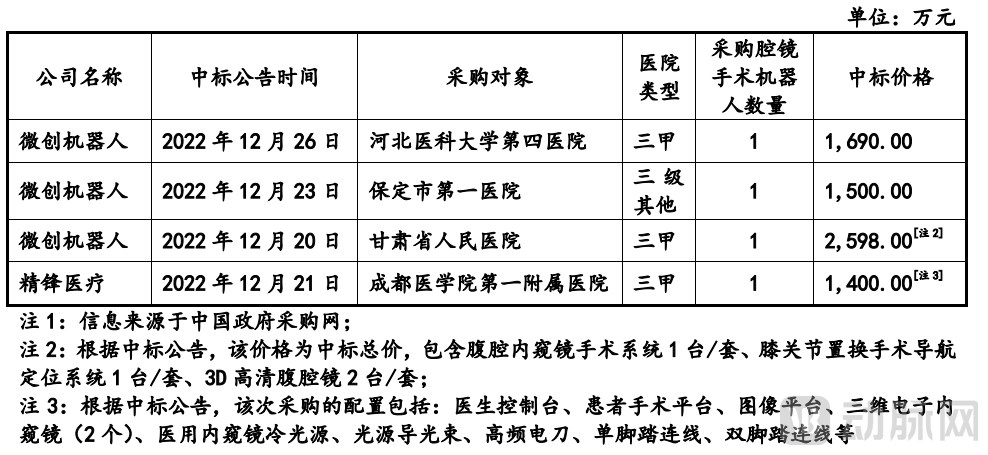
(Source: VCBeat Inquiry Materials)
More surprisingly, Sirui Zhe has also become the "price butcher" in the field of laparoscopic surgical robots. According to Sirui Zhe's prospectus, the ex-factory price of its laparoscopic surgical robot SR1000 ranges from 3.5 million to 9 million yuan, with a winning bid price of 5.38 million yuan at the First Affiliated Hospital of Heilongjiang University of Traditional Chinese Medicine, which is approximately one-fourth of the average price of the da Vinci Surgical Robot.
With the relaxation of configuration certificates and the outbreak of price wars, it is expected that surgical robots will see more installations in tertiary hospitals, including those in first-tier cities and third- and fourth-tier cities, truly promoting the decentralization of high-quality medical resources. In this process, domestically produced surgical robots are expected to achieve breakthrough development.
Nowadays, although several surgical robots have been approved for marketing and gained a first-mover advantage, companies with products in clinical trials or the R&D stage are not overly concerned.
Weijing Healthcare stated: "Being the first mover has its advantages but often comes with high risks. We respect and admire those who take the lead, but the market landscape for surgical robots is far from settled. As a follower, on one hand, we will accelerate the clinical trial process to obtain multi-department registration certificates as soon as possible; on the other hand, we will leverage our differentiated advantages to formulate a long-term sustainable market strategy. With the help of Kangji Healthcare's medical channel resources as a strategic shareholder, we will expedite the commercialization of our products."
By the end of 2021, there were 36,500 hospitals in China, including 3,275 tertiary hospitals (1,651 of which were top-tier tertiary hospitals), 10,848 secondary hospitals, and 12,649 primary hospitals.
Rough estimates suggest that the number of installed minimally invasive surgical robots in China is only over 300, with a relatively low penetration rate, indicating broad development prospects. The low penetration rate is due to the high cost of surgical robot equipment at this stage, which only a few large hospitals can afford to purchase and cover the subsequent consumables and technical service fees.
In response to the price (cost) issue that limits the large-scale application of surgical robots, domestic companies have also carried out targeted innovations. With a significant cost advantage, domestic companies dare to initiate price wars.
For example, EDDA Healthcare has built a comprehensive precision surgery solution portfolio through the IQQA software platform and intelligent surgical robots, enabling intelligent preoperative planning, intraoperative navigation, and postoperative evaluation required for precision surgeries. Strategically, EDDA Healthcare plans to leverage the overall clinical solution advantages of intelligent surgical navigation robots and precision preoperative planning systems to support the implementation of the "Thousand County Project," assisting doctors in performing various precise minimally invasive interventional surgeries for thoracic and abdominal tumors.
Sinovation has launched the Q300 micro surgical robot. It believes that while the neurosurgery departments of Class A tertiary hospitals represent a significant market, the clinical demand for precise positioning in grassroots hospital neurosurgery cannot be overlooked. Moreover, surgical robots targeting large Class A tertiary hospitals are expensive, often exceeding the budget of grassroots hospitals. In response, Sinovation closely aligns with the needs of grassroots hospitals and has specifically developed the Q300 micro surgical robot.
According to Sinovation, the product is only palm-sized and can achieve frameless, automated precise positioning of intracranial targets, effectively assisting neurosurgeons in performing safer and more accurate minimally invasive surgeries. At the same time, the hospital admission price of the Q300 micro surgical robot matches the budget level of grassroots hospitals. Once it was launched in 2022, it attracted significant attention from numerous grassroots hospitals and regional distributors. To date, the product has achieved dozens of sales.
In addition, Ruilong Meditech has innovatively launched "HaiShanYi," the first domestically produced modular surgical robot in China. The product adopts a modular design, with a smaller footprint for the standardized modular trolley, and the modular trolley is easier to control costs. Hospitals can configure the number of trolleys as needed and flexibly pair different instrument combinations. At the same time, HaiShanYi also features high compatibility, which will significantly reduce usage costs.
Although most companies in the market choose to cut costs without affecting the high-quality performance of their products to expand their market, some companies choose a different path.
For example, Surui Robotics insists on complete domestic independent innovation and hopes to meet market challenges with high-quality services and reliable products. They stated, "Domestically produced does not equate to low price, nor does it mean low quality. Surui Robotics provides a single-port robotic surgery platform with high cost-effectiveness. We will work with hospitals at all levels to promote Chinese products, Chinese technology, and Chinese medical expertise to the world."
Rosenbot also stated: "Creating products and solving disease pain points based on clinical needs is our 'path'; pricing, business models, and indication promotion are all 'methods' built upon this foundation. As long as we meet clinical recognition, comply with medical insurance policies, and align with market expectations, we are confident in achieving better and more installations."
Previously, a surgical robot was generally used in only one department and could perform a limited number of procedures, greatly restricting the value of surgical robots.
Nowadays, the "involution" differentiation of domestic brands in China is driving the accelerated innovation of surgical robots. Among these innovations, expanding the indications for products is an important direction for surgical robot development.
Currently, many companies are developing innovative surgical robots that can be used across multiple departments and for various surgical procedures. For instance, after the approval of JINGFENG Medical's MP1000 multi-port endoscopic surgical robot in December 2022, the company continued to expand its application in general surgery and thoracic surgery. It has also completed patient enrollment for registration clinical trials in urology, gynecology, general surgery, and thoracic surgery.
The single-port endoscopic surgical robot independently developed by Shurui Robot can already be applied in various clinical fields such as urology, gynecology, general surgery, thoracic surgery, and cardiac surgery. According to reports, the Shurui single-port endoscopic surgical robot adopts the revolutionary design of "dual continuum mechanism." It has completed the world's first randomized controlled multi-center registration clinical trial for urological surgery using a single-port snake-arm surgical robot and has carried out more than ten innovative surgical procedures in fields such as gynecology, general surgery, and thoracic surgery.
The first laparoscopic surgical robot launched by Weijing Medical, a strategic investment of Kangji Medical, covers all procedures in the field of urology, including high-difficulty procedures such as radical prostatectomy, nephrectomy, partial nephrectomy, adrenalectomy, and ureteroplasty.
Not only laparoscopic surgical robots, but also orthopedic surgical robots are accelerating innovation and expanding indications. For example, the new generation of intelligent orthopedic surgical robot system developed by Rosonbot has the function of fracture reduction, filling the gap in robot-assisted closed reduction of pelvic fractures, and achieving intelligent surgical operation for the entire surgical process from closed fracture reduction to minimally invasive fixation.
Geri Technology has taken the lead globally in proposing the concept of a full spinal endoscopy minimally invasive surgical robot for orthopedics and has pioneered the "Newton" master-slave orthopedic endoscopy minimally invasive full surgical robotic platform. Reportedly, this product is the world’s first orthopedic endoscopy minimally invasive full surgical robotic platform featuring “force feedback master-slave control + high-precision image guidance” in the orthopedics field. In late May 2023, "Newton" successfully completed the world's first 5G remote orthopedic endoscopic surgical robot research procedure, breaking through various new surgical techniques.
It is worth mentioning that, in this surgery, "Newton" completed image acquisition and processing, remote surgical planning, remote automatic guidance, remote establishment of surgical access, as well as remote master-slave control of the robotic arm, working cannula, endoscope, surgical forceps, electrocoagulation, and other surgical instruments' multi-axis compound movements under commercial 5G conditions, achieving all core surgical steps of the surgical objective.
Noitom Continues to Expand the Application Scope of HoloSight Orthopedic Trauma Surgery Robot, Enabling It to Progress from Minimally Invasive Reduction and Internal Fixation Procedures for Pelvic Fractures, Various Minimally Invasive Reduction and Internal Fixation Procedures for Femur, Various Minimally Invasive Reduction and Internal Fixation Procedures for Tibia, to Other Long Bone Minimally Invasive Reduction and Internal Fixation Procedures.
In addition, Yuanhua Intelligence has launched the first domestically-produced hip-and-knee integrated Kunwu orthopedic surgery robot in China; Huarui Bo released the Hua joint surgery robot, which is hip-and-knee integrated and features both femoral and tibial osteotomy functions; and TuoDao Medical developed an ultra-fusion spinal surgery solution combining its fully self-developed Tuoshou orthopedic surgery robot with a mobile C-arm X-ray machine.
Expansion into Multiple Departments and Surgical Procedures Will Significantly Enhance the Usability of Surgical Robots. In the past, if robotic surgeries were to be performed in departments such as general surgery, thoracic surgery, and urology, hospitals would need to separately purchase surgical robots designed for corresponding indications. This not only occupied a large area but also incurred extremely high procurement costs. However, a multi-indication surgical robot requires only one unit to perform various procedures across different departments. This reduces the procurement and operational costs for hospitals and increases the range of applicable patients for a single surgical robot, which is expected to boost the number of robotic surgeries.
On May 10, Siemens Healthineers announced that its vascular interventional surgical robot would cease operations in the cardiology field and focus on neurointerventional surgery in the future. The company stated: "We believe that after this adjustment, Siemens Healthineers will more clearly push the future development of interventional surgical robots in the right direction."
In fact, as early as 2017, VAST Medical, a domestic surgical robotics company in China, had already proactively positioned itself in the field of neurointerventional surgery. Currently, its product VAS HERO received approval in March 2023, becoming the first vascular interventional surgical robot to gain NMPA approval in China.
According to the introduction, the founding team of VCBeat was very clear from the beginning: to start with neurointerventional surgery.
First, cerebrovascular vessels are characterized by tortuosity and fragility, making surgeries difficult and highly risky. There is an urgent need for intelligent and precise robotic operations to enhance safety and outcomes.
Secondly, cerebrovascular interventional surgeries take longer and involve greater radiation exposure. The duration of a neurointerventional surgery is more than twice that of a coronary interventional surgery, making the demand for robotic-assisted surgery even stronger among doctors.
Finally, doctors have longer training cycles, shorter professional lifespans, and face greater difficulties in learning as new doctors. However, with robotic simulation training pods, doctors can be trained more quickly.
Based on the above considerations, WanSi Healthcare believes that neurointerventional surgery has more urgent and pressing clinical pain points. It decided to start with neurointervention and, under the guidance of a clinical expert team mainly from Beijing Tiantan Hospital affiliated with Capital Medical University, determined that the first robot for vascular interventional surgery should focus on angiography as the research and development direction.
Vascular interventional surgery relies on angiography as its foundation. Taking neurointerventional surgery as an example, among the approximately 500,000 neurointerventional surgeries performed annually in China, 60% of cases require cerebral angiography to be conducted first, followed by scheduled implantation surgeries. Even in clear-cut implantation surgeries, a significant proportion still require the insertion of medical devices after angiography. Such procedures, which share similar workflows and involve a large number of cases, are highly suitable for machines to replace human assistance.
Moreover, compared with robots that can only deliver stents, robots capable of performing angiography encompass all basic operations in vascular interventional surgery, such as the delivery, rotation, and manipulation of catheters and guidewires, laying the foundation for the expansion of therapeutic robots.
Based on a forward-looking judgment made five years ago, Vascular Medical successfully obtained approval for a vascular interventional surgical robot capable of performing full-process and whole-brain angiography. In the future, Vascular Medical plans to start with neurointervention and gradually build a pan-vascular interventional surgery ecosystem. It will integrate innovative methods such as 5G, multi-device fusion in operating rooms, and image fusion, ultimately transforming clinical needs in the vascular intervention field into a robotic precision treatment platform.
In the field of vascular interventional surgery robots, companies such as Suzhou Rainmed Medical Technology Co., Ltd., Aibo Medical Robot, Openg Medical, Weimai Medical, Mayo Heart Magnet, Ruixin Healthcare, Weiya Medical, and HuiHe Healthcare have also made their presence known in China. Although Siemens Healthineers has shifted the focus of vascular interventional robot applications to neurointervention, domestic vascular interventional robot companies remain committed to their own paths.
Suzhou Rainmed Medical Technology Co., Ltd. stated: "At present, we will continue to focus on the pan-vascular direction. This is because vascular interventional surgeries are faced with numerous challenges, such as complex procedures, non-standardized operations, high rates of complications, time-consuming processes, and significant radiation exposure. To address clinical needs, Suzhou Rainmed Medical Technology Co., Ltd. has innovatively developed FlashBot, a carrier-grade platform product in the form of a vascular interventional surgical robot. In addition to performing traditional PCI operations, FlashBot offers a variety of specialized diagnostic and therapeutic capabilities.
Currently, FlashBot has made significant progress in its development stages. Its core product in the digital functional diagnostics module, the caFFR system, has taken the lead in the FFR market; while the caIMR system, as the world’s first non-invasive IMR measurement product, received approval and achieved commercial implementation in April this year. The organic integration of the caFFR system with the caIMR system can significantly enhance the macro and micro functional diagnostic capabilities for myocardial ischemia, providing precise preoperative diagnosis.
At the same time, FlashBot not only provides precise preoperative diagnosis but also reduces surgical complications through standardized intraoperative procedures, enhancing clinical benefits for patients. FlashBot enables doctors to perform remote surgeries, reducing the risk of cross-infection. Relying on remote operation and 5G technology, FlashBot can alleviate the current scarcity of medical resources in China. Additionally, FlashBot effectively reduces X-ray exposure for both operators and patients, minimizing physical harm.
Compared with overseas products, Suzhou Rainmed Medical Technology Co., Ltd.'s vascular interventional surgery robot, FlashBot, also focuses on the angiography and diagnosis process, which accounts for 70%-80% of the entire interventional procedure. FlashBot integrates multifunctional interventional catheters, surgical navigation, ECG monitoring, contrast injection systems, and functional diagnostic evaluation. It can achieve an automated full-process workflow including angiography, diagnosis, intervention, and evaluation. Additionally, it can standardize the operation of various types of catheters and guidewires, assisting in performing PCI, neurointervention, peripheral intervention, aortic intervention, and other procedures, making it more aligned with clinical needs.
In addition to cardiovascular interventional surgical robots, neurointerventional surgical robots, and pan-vascular interventional surgical robots, there are also companies in China developing vascular interventional surgical robots for other types of procedures.
For example, the cardiac interventional surgical robot developed by HuiHe Healthcare is mainly aimed at heart valve regurgitation surgeries, especially for patients with tricuspid and mitral regurgitation. This surgical robot can perform surgeries using innovative devices such as the K-CLIP Transcatheter Tricuspid Annuloplasty System developed by HuiHe Healthcare. At the same time, the surgical robot empowers surgeons through intelligent and automated functions, making remote surgery possible.
Opportune Medical has expanded the application of vascular interventional surgical robots to structural heart disease. Its endovascular interventional surgical robot, ALLVAS, has successfully conducted the world's first robot-assisted aortic stent graft intervention, peripheral vascular stent intervention, and transcatheter aortic valve replacement surgeries.
Currently, most vascular interventional surgical robots are still in the research and development or clinical trial stage and have not been widely applied. Which development path of vascular interventional surgical robots will be more popular in the market remains to be verified. The only certainty is that in the field of vascular interventional surgical robots, companies in China are at the forefront globally.