

Beijing University of Technology Professor Launches BCI Startup 'Starwish Intelligence', Secures Millions in Angel Funding
BRAINTHINK
Developer of Auxiliary Diagnosis and Screening Products for Mental Disorders

Brinc
A Hong Kong-based early-stage venture capital firm
Text|Hu Jialin
Editor|Wei Wen
36Kr learned that Hangzhou Xingyuan Intelligent Biotechnology Co., Ltd. (hereinafter referred to as "BRAINTHINK") has obtained millions of yuan in angel round funding, with the investors beingBrinc, Linrun Ventures & Qingrong Ventures. The funds from this round of financing will be mainly used for product development and market promotion.
BRAINTHINK, founded in 2021, is an innovative technology company that uses wearable devices such as brain-computer interfaces based on scalp electroencephalogram (EEG) and heart rate variability (HRV) for auxiliary diagnosis, treatment, and screening of mental illnesses. The products focus on patients with mental disorders, providing rapid screening for depressive moods, anxiety, motor imagery, and attention.
According to data released by MedTech, the number of patients with various brain diseases in China reached nearly 130 million in 2021, including more than 2 million children under 12 with autism and over 50 million with depression. Additionally, according to QYResearch, the global brain-computer interface market size was $1.2 billion in 2019 and is expected to reach $3.6 billion by 2027. The promising market has attracted a group of startup companies.
"At first, seeing that nucleic acid could be tested with a kit made me think about whether mental illnesses could also be screened through simple methods," said Wang Zhuozheng, founder of BRAINTHINK, who specializes in intelligent signal processing. He told 36Kr, "The traditional way to assess mental health is through questionnaires and scales, but since the questions and answers are rather fixed, the results aren't objective enough. Moreover, EEG technology on the market is mainly used for treatment, skipping the screening stage."
There is market demand, and the industry also has pain points. BRAINTHINK has taken this as an entry point, broken through scene limitations, and developed a brain-computer interface for mental health screening, bringing technological achievements from research into the market. Currently, the product is mainly deployed in the To C market through large psychological counseling institutions, and the company has also established cooperation with major universities to provide psychological state assessments for suspected patients.
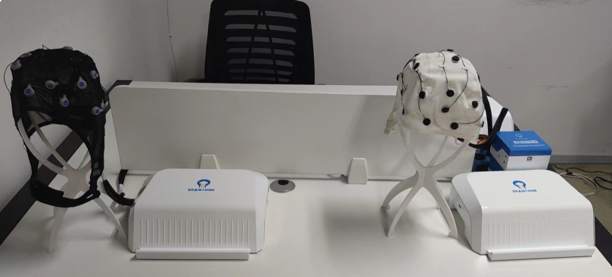
Hardware Products
According to Wang Zhuozheng, the workflow of BRAINTHINK's brain-computer interface is as follows: The subject wears a non-invasive electrode cap to collect EEG signals. After analog-to-digital conversion, the signals are transferred to a PC. Advanced AI models are then used to match different signals with indicators of various mental disorders, enabling precise classification and screening into four categories: "asymptomatic, mild, moderate, and severe."
The highlights of the brain-computer interface product are, first, an innovative model training method that employs a classification diagnostic approach based on a "semi-supervised learning model" to address the issues of inefficiency and insufficient accuracy in manual assessments by rehabilitation physicians. Currently, the product demonstrates high data processing precision, with clinical trial average accuracy exceeding 85%-90%.
Specifically, to address the classification of various mental disorders, the medical community often uses a "labeling" approach. "Binary classification is used to label each indicator and symptom level, such as '0' representing 'yes' and '1' representing 'no.' The semi-supervised learning model combines both labeled and unlabeled patterns to train AI models, achieving more accurate screening," said Wang Zhuozheng. "The semi-supervised learning model can solve diagnostic and classification challenges caused by small sample sizes and imbalanced samples in the medical field."
The second highlight is process innovation. The product is designed as a portable EEG signal acquisition and analysis device, solving the problem of existing EEG signal acquisition and analysis devices being not easy to carry and difficult to use in EEG monitoring scenarios. While miniaturizing the product, data acquisition has also become more convenient, reducing detection time to 3-5 minutes.
In addition to brain-computer interfaces, BRAINTHINK has also developed an HRV platform for detecting heart rate signals. Wang Zhuozheng shared, "EEG can be used for qualitative analysis of mental illnesses, while monitoring heart rate signals captures patients' emotional information and mental stress, allowing for quantitative analysis."
Currently, the company has successfully launched products based on both EEG and HRV technologies. In the future, BRAINTHINK will integrate EEG and HRV to develop a multimodal wearable device for the comprehensive detection of mental illnesses.
The founding team of BRAINTHINK is mainly composed of professors from Beijing University of Technology. Wang Zhuozheng, the project founder and a professor at Beijing University of Technology, has long been engaged in research on intelligent signal processing and deep learning, and has been granted six national invention patents. The chief scientist, Jia Kebin, also a professor at Beijing University of Technology, is an academic leader in the field of multimedia information processing.
Capital's Viewpoint:
Ma Xianrong, head of Linrun Venture Capital & Qingrong Venture Capital, stated: "In the post-pandemic era, mental health issues have gained significant attention, especially in China, where there is a large population suffering from suboptimal mental well-being. Early screening and treatment are crucial. BRAINTHINK innovates and optimizes through EEG-assisted diagnosis combined with AI algorithms, offering precise, effective, and convenient support for diagnosing and treating mental illnesses. We have been tracking this project for two years, and the founder's perseverance and vision deeply moved us. We are optimistic about its development in the mental health field and the innovative products brought by its technology. We hope that, with the support of our capital and acceleration services, we can grow together with BRAINTHINK."
Brinc, an international venture capital accelerator focused on early-stage investment and incubation, has invested in more than 250 companies to date. According to Manav Gupta, CEO of Brinc, healthcare is a crucial sector, with increasing attention being paid to conditions like depression and Alzheimer's disease. BRAINTHINK’s technology can break through traditional methods of examination, diagnosis, and treatment plans, enabling earlier detection and awareness of potential health risks, as well as facilitating timely treatment for potential patients. This is highly meaningful and holds significant potential value.