

Phase III ATTRACTION-5 Trial of Opdivo Plus Chemotherapy Fails to Meet Primary Endpoint in Adjuvant Treatment of Pathological Stage III Gastric or Gastroesophageal Junction Cancer
Bristol-Myers Squibb
Biopharmaceutical and Nutritional Product R&D and Sales
Recently, Bristol-Myers Squibb (BMS) presented the results of its Phase III clinical trial investigating the PD-1 drug nivolumab (Opdivo, abbreviated as "O drug") in combination with chemotherapy as adjuvant treatment following surgery for locally advanced (pathologic Stage III, pStage III) gastric or gastroesophageal junction (G/GEJ) cancer at the 2023 ASCO Annual Meeting. The study, named ATTRACTION-5, is led by Principal Investigator Professor Masanori Terashima (Terashima Masanori) from the Department of Gastric Surgery at Shizuoka Cancer Center in Japan.
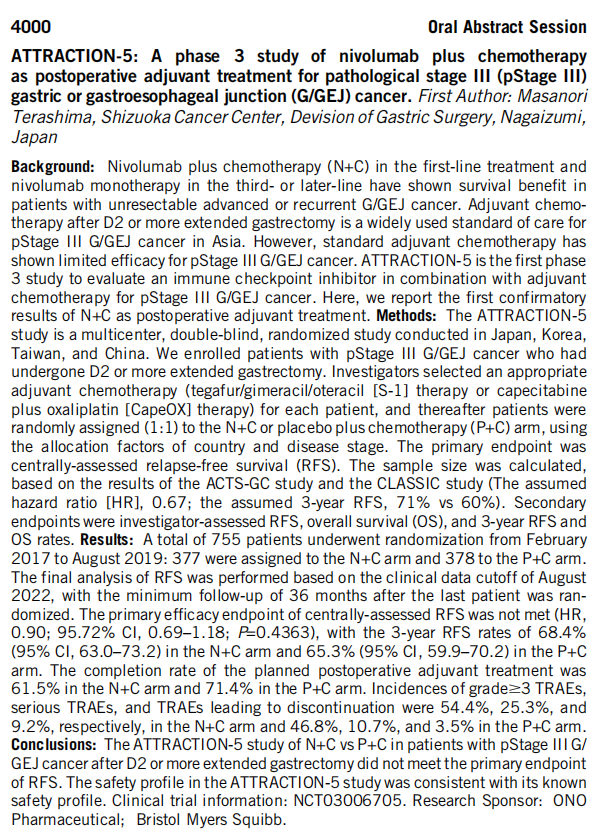
In Asia, adjuvant chemotherapy after D2 radical surgery (the current standard surgical treatment for gastric cancer, where standard D2 radical surgery should involve the resection of more than 2/3 of the proximal or distal stomach or even total gastrectomy based on tumor size and location, along with D2 lymph node dissection) or more extensive gastrectomy is a widely used treatment standard for patients with pathological stage III G/GEJ tumors. However, the efficacy of standard adjuvant chemotherapy for pathological stage III G/GEJ tumors remains limited.
ATTRACTION-5 is the first Phase III study to evaluate the adjuvant treatment of immune checkpoint inhibitors combined with chemotherapy for pathological Stage III G/GEJ tumors.
The ATTRACTION-5 study is a multicenter, double-blind, randomized trial conducted in Japan, Korea, Taiwan, China, and mainland China, enrolling patients with pathological stage III G/GEJ tumors who underwent D2 or more extensive gastrectomy.
Researchers selected appropriate adjuvant chemotherapy (S-1 [tegafur/gimeracil/oteracil potassium] or CapeOX [capecitabine + oxaliplatin]) for each patient. Then, based on country and disease stage as allocation factors, patients were randomly assigned (1:1) to either the nivolumab plus chemotherapy (N+C) group or the placebo plus chemotherapy (P+C) group.
The primary endpoint of the study was centrally assessed relapse-free survival (RFS). The sample size was calculated based on the results of the ACTS-GC and CLASSIC studies (assuming a hazard ratio [HR] of 0.67; assuming 3-year relapse-free survival rates of 71% vs. 60%). Secondary endpoints included investigator-assessed RFS, OS, and the 3-year RFS and OS rates.
The results showed that from February 2017 to August 2019, a total of 755 patients participated in the clinical trial, with 377 patients assigned to the N+C group and 378 patients assigned to the P+C group. As of August 2022, when the last enrolled patient reached 36 months of follow-up, the final analysis of RFS was conducted.
According to the primary efficacy endpoint (RFS) assessed by the research center, it was not reached (HR, 0.90; 95.72% CI, 0.69–1.18; P=0.4363). The 3-year RFS rates for the N+C group and P+C group were 68.4% (95% CI, 63.0-73.2) and 65.3% (95% CI, 59.9-70.2), respectively. The completion rate of planned postoperative adjuvant treatment was 61.5% in the N+C group and 71.4% in the P+C group.
In terms of safety, the incidence rates of grade 3 treatment-related adverse events (TRAEs), serious TRAEs, and TRAEs leading to discontinuation in the N+C group were 54.4%, 25.3%, and 9.2%, respectively, while those in the P+C group were 46.8%, 10.7%, and 3.5%, respectively.