

AstraZeneca Emerges as a Major Winner at ASCO 2023 with Breakthrough Data for Tagrisso and Enhertu

AstraZeneca
Biopharmaceutical Manufacturer
According to convention, the American Society of Clinical Oncology (ASCO)Annual MeetingThe first weekend of June in Chicago.
For ASCO, this is the second return to an in-person meeting since the pandemic. But that doesn't mean the excitement of returning to normalcy or the "new normal" has faded. People remain enthusiastic about being able to communicate face-to-face once again.
Last year, more than 42,000 attendees participated in the conference, with 73% of them attending the ASCO conference in person for the first time since 2019.This year, some attendees estimated that the number of people attending in person would reach or exceed 40,000.They were all placed in McCormick Place, the largest convention center in North America, which has more than 2.6 million square feet of booth space and offers views of Lake Michigan.
ASCO is a conference for Big Pharma, and 2023 seems to be no exception.The major news two days before the conference was all about AstraZeneca's Osimertinib.
ADC remains the focus of the conference and is also a highly anticipated hot track.TROP2 is another potential target,Ranked second in the popularity of ADC drug targets,Several major pharmaceutical companies have already engaged in fierce competition. Moreover, AstraZeneca and Daiichi Sankyo's star ADC drug, Enhertu, have even greater ambitions.
AstraZeneca appears to be a big winner at this conference.The abstract of anticancer drug development data released at this year's ASCO meeting increased by 40% compared to 2019. Pascal Soriot, CEO of AstraZeneca, has been attending ASCO for the past 20 years, but he told investors that this year's conference was "very special" for the company he has led since 2012. Not long ago, AstraZeneca lagged behind leading companies in the oncology field such as Merck and Roche, but now it has four blockbuster anticancer drugs and a series of promising drugs.
1
Survival data for AstraZeneca's lung cancer drug osimertinib was presented on June 4 at a plenary session, marking the fifth consecutive year that AstraZeneca has been highlighted at the meeting.
Three years ago, at a plenary session of ASCO, AstraZeneca presented the preliminary results of a study called "ADAURA." The trial was stopped two years ahead of schedule, with data showing that the use of osimertinib significantly reduced the risk of lung cancer recurrence in certain patients after surgery. Osimertinib soon received FDA approval.
But the question left by these data is whether this "disease-free" survival benefit will translate into overall survival time for patients. This question was answered in the data reported on the 4th. The data shows that the adjuvant use of osimertinib after surgery reduced the risk of death by 51% over five years in patients with completely resected EGFR-mutated stage 1b to 3a NSCLC.
In absolute terms, five years later, 88% of patients taking osimertinib were still alive, compared to 78% of those taking the placebo.Osimertinib reduced the risk of death by 10%, which means that for every 10 patients treated with this drug, one additional patient will survive after five years.
This is a significant discovery, and it may further encourage oncology clinicians to combine osimertinib with surgery when treating early-stage lung cancer, as early-stage lung cancer often carries EGFR gene mutations, which are the exact target of this drug.
Invited ASCO expert Dr. Nathan Pennell, MD, PhD, from the Cleveland Clinic, stated in a declaration that, considering osimertinib adjuvant therapy has "clearly improved survival rates," it should become the new standard of care for EGFR-mutated non-small cell lung cancer (NSCLC).
As AstraZeneca's best-selling drug, osimertinib generated nearly $5.5 billion in sales last year, with $1.4 billion in the first quarter of this year alone, partly due to increased use in adjuvant therapy.
2
Despite Gilead, AstraZeneca, and Pfizer having spent billions of dollars to acquire expertise in antibody-drug conjugates (ADCs), Merck has taken a different path. Two low-profile deals with Kelun have given Merck an early presence in ADCs.portfolio。Among the most significant deals, the innovative TROP2-ADC (SKB264, MK-2870) co-developed by Kelun-Biotech and Merck has just disclosed its first set of human data.
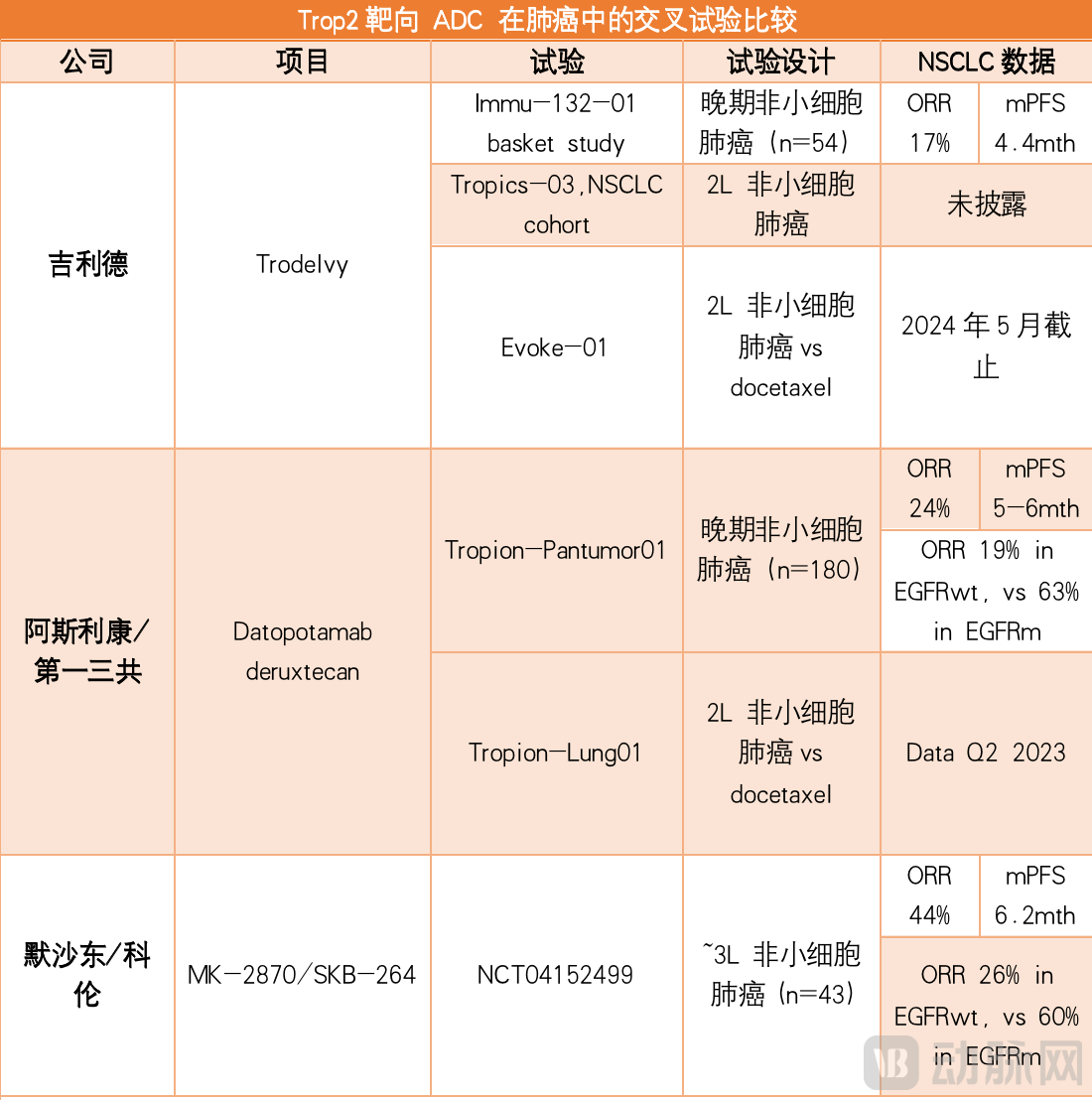
On the morning of June 4, the ASCO poster presentation focused on Phase II expansion study data for MK-2870 in previously treated patients with locally advanced or metastatic non-small cell lung cancer (NSCLC). The data showed that, compared to Gilead's Trodelvy and Daiichi Sankyo/AstraZeneca's datopotamab deruxtecan, two of the most advanced Trop2-targeting ADC drugs in the industry,At least the data for MK-2870 looks as good as theirs.
Gilead's $21 billion acquisition of Immunomedics secured Rodelvy, which became the first and currently only TROP2 ADC on the market. However, unlike Trodelvy's initial focus on triple-negative breast cancer, Daiichi Sankyo and AstraZeneca have also placed significant bets on Trop2-targeted projects, but are instead targetingLung cancer is the focal indication for datopotamab.Biopharmaceutical CompanyAll are eagerly looking forward toData Readout from the Tropion-Lung01 Study of Datopotamab Deruxtecan in Second-Line Non-Small Cell Lung Cancer, it is also a test of whether Trop2 inhibitors really have an effect.
Against this backdrop, Kelun released Phase II clinical data on June 4 for Chinese patients with end-stage NSCLC. Among 39 evaluable patients, the objective response rate (ORR) was 43.6% (17/39), the disease control rate (DCR) was 94.9% (37/39), the median duration of response (mDoR) was 9.3 months, and the 6-month DoR rate was 77%. The median overall survival (mOS) has not yet been reached, and the 12-month OS rate was 70.6%.
Merck now has MK-2870, and datopotamab will provide crucial Tropion-Lung01 data; NSCLC may soon become a key battleground for Trop2-targeted therapies.
In May 2022, Merck paid Kelun $47 million for the ADC project, which later disclosed including MK-2870. In December last year, the company spent another $175 million to purchase seven other different preclinical ADC candidate drug projects under research. Foreign media commented that if Kelun could eventually provide Merck with a complete ADC platform, it would be astonishing. It could even be said that,The Trop2 target has already proven that Merck and Kelun have reached a very smart deal.
3
Not just lung cancer, Daiichi Sankyo and AstraZeneca have bigger ambitions.
Enhertu has made waves in the field of breast cancer treatment. Now, they are leveraging data that researchers find highly compelling to expand into other tumor types.
At the ASCO meeting on June 5, two companies announced the latest results of the clinical trial Destiny-Pantumor02 for the HER2-targeted antibody-drug conjugate Enhertu in treating various HER2-expressing solid tumors. The investigator assessment of the phase 2 clinical trial showed that 37.1% of patients with HER2-positive solid tumors had tumor shrinkage, increasing to 61% in patients with the highest HER2 expression levels (IHC 3+); the average duration of treatment response was 11.8 months, extending to 22.1 months in IHC 3+ patients. The trial enrolled a total of 267 patients and was open-label, with these patients being very difficult to treat or having no other treatment options available.
This is very convincing data. Early data was "very compelling" and represented "a shift in our view of cancer treatment," said Bradley McGregor, MD, from the Dana-Farber Cancer Institute and an expert at ASCO, during a press conference. Funda Meric-Bernstam, MD, from the University of Texas MD Anderson Cancer Center and the principal investigator of this study, also described Enhertu's anti-tumor activity as "very compelling."
AstraZeneca's Chief Medical Officer and Chief Development Officer for Oncology, Cristian Massacesi, said,Data from the DESTINY-PanTumor02 trial validated HER2 as an actionable biomarker across a wide range of tumor types. Enhertu is the first treatment to demonstrate broad activity in HER2-expressing solid tumors.”
The results appear to justify an accelerated approval. These latest data might lead AstraZeneca to pursue the approval of Enhertu as a tumor-agnostic treatment, meaning it could be used for any HER2-positive tumors regardless of their location.
Mark Rutstein, Global Head of Oncology Clinical Development at Daiichi Sankyo, did not comment externally on the company's submission plans to regulatory authorities but stated in an interview with foreign media that the response rate and durability of responses are clinically meaningful and meet the standards for a pan-tumor indication based on precedent.
But there are some uncertain factors. For example, trial data showed that the tumor response rate of Enhertu in pancreatic cancer patients was only 4%. The trial also included biliary tract cancer, bladder cancer, cervical cancer, endometrial cancer, ovarian cancer, and other cancers, with effective response rates of 22%, 39%, 50%, 57.5%, 45%, and 12%, respectively.
Reference Article:
Closing ASCO: AstraZeneca’s ‘very special’ meeting, more CAR-T survival data and Pfizer’s PARP play, BIOPHARMADIVE
Asco 2023 – Trop2 could validate Merck’s savvy deal with Kelun, Evaluate Vantage
Asco 2023 – Enhertu hits with pan approach,Evaluate Vantage