

JiaYu Science and Technology secures tens of millions in angel round to advance open-architecture magnetic particle imaging toward clinical

VCBeat
Internet Medical Health Media
CASVC
Venture Capital Management Service Agency
Throughout the century-long evolution of medical imaging, each technological leap has expanded the physician's "visual field." From ultrasound and CT to MRI and PET-CT, imaging systems have continuously advanced, yet they have never fully resolved the fundamental trade-offs between imaging speed, tissue penetration, and radiation safety. Now, a new technology called Magnetic Particle Imaging (MPI) is making its entrance. With its unique advantages of being dynamic, targeted, and completely radiation-free, MPI directly addresses the core limitations of conventional imaging modalities.
In this frontier field—still in the early stages of global R&D and not yet clinically implemented—a company from Shenyang, China, called JiaYu Science and Technology, is emerging as a pioneer. Leveraging its comprehensive full-chain technology platform and open innovation approach, JiaYu is advancing MPI into a critical phase of industrialization.
JiaYu announced that it has completed a tens of millions of yuan angel round. The round was led by Cas Holdings, with participation from Hefei Industry Investment Group. Blue Bell Capital acted as the exclusive financial advisor. The proceeds will be used to accelerate the registration, application, and clinical promotion of its core product—a handheld Magnetic Particle Imaging (MPI) system. Concurrently, the company has initiated its Pre-A round to further solidify its leading position in the field of magnetic medicine.
Magnetic Particle Imaging (MPI) is a novel medical imaging modality. It utilizes biologically functionalized Superparamagnetic Iron Oxide Nanoparticles (SPIONs) as tracers and employs a holographic, dynamic 3D tomographic weak-magnetic imaging system to generate functional images in humans. Compared to other mainstream imaging technologies, MPI offers several unique advantages.
Unlike MRI, which relies on nuclear magnetic resonance signals to reveal anatomical structures, MPI directly images nanoparticles, offering superior specificity.
In contrast to CT and PET-CT, MPI involves no ionizing radiation, resulting in a superior safety profile.
While ultrasound is limited by tissue acoustic impedance, MPI provides deeper penetration and more precise spatial resolution.
Furthermore, MPI targets the distribution of magnetic nanoparticles directly, rather than the properties of the surrounding tissue, thereby delivering exceptionally high specificity and contrast. These attributes underscore its broad potential in applications such as vascular imaging, tumor diagnosis, cell tracking, and treatment monitoring.

After two decades of development, MPI technology has progressed from initial concept to the stages of prototype manufacturing and animal testing. However, its clinical translation faces a critical bottleneck: the traditional closed-field magnetic structure inherently limits spatial freedom during imaging and constrains its applicable scenarios.
To break through this limitation, the JiaYu team has successfully developed China's first open-architecture MPI prototype. Their pioneering Narrow-band MPI theory for open 3D space not only fills a critical technology gap in China but also significantly expands the clinical applicability and commercial value of MPI. This innovation liberates MPI imaging from the confines of a bore, delivering an open, flexible, and clinically integrable spatial imaging solution.
"MPI is safe, dynamic, and targeted—precisely the traits most needed in clinical practice," stated Xinxuan Zhao, Vice President of JiaYu. He acknowledged that traditional closed-bore MPI holds advantages in 3D scanning and resolution, but emphasized that the open architecture creates possibilities for broader clinical adoption.
JiaYu's technology roadmap is unfolding progressively along the "Research-Translation-Application" pathway.
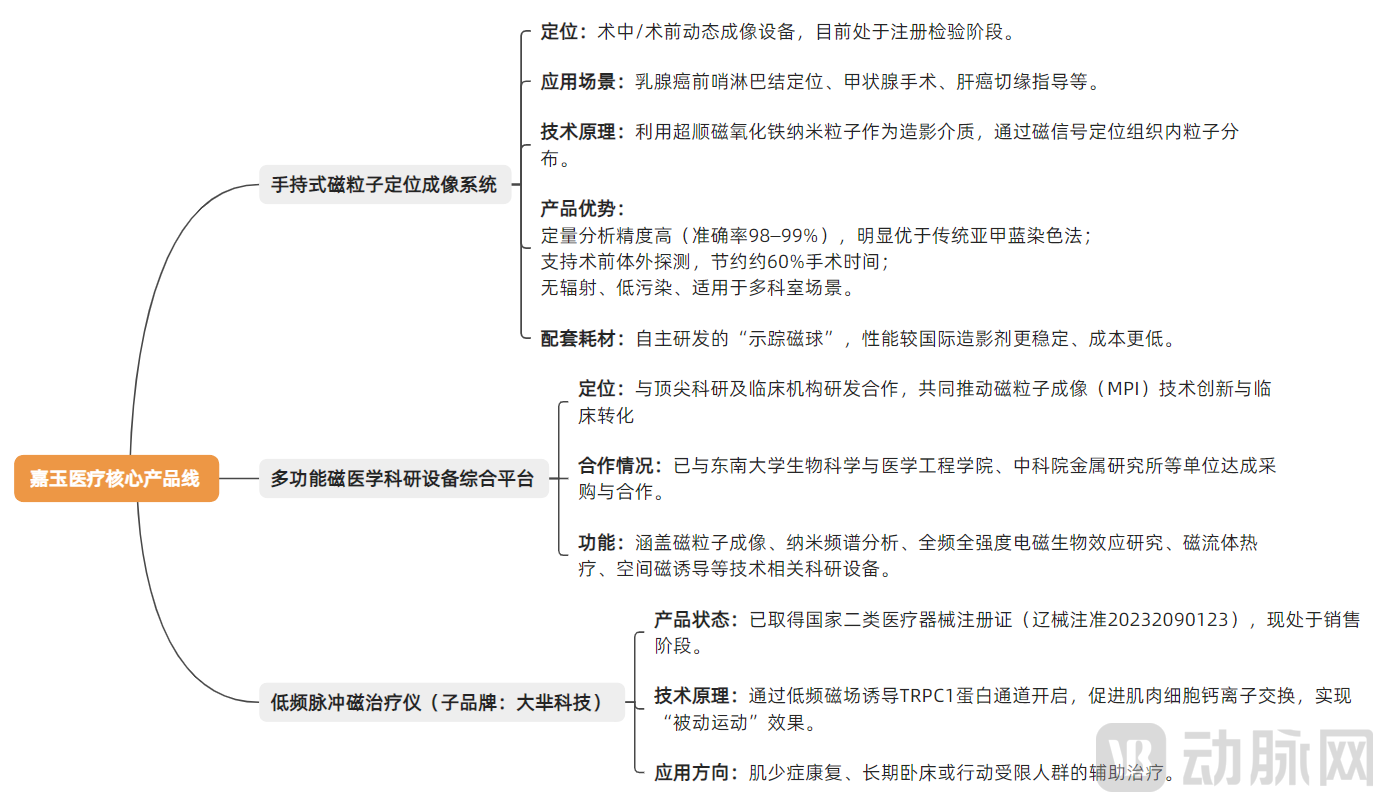 JiaYu's Pipeline Layout
The Handheld Magnetic Particle Imaging System (Handheld MPI System) is JiaYu's most representative product and also the "vanguard" of its clinical application.

JiaYu's Handheld MPI System
This product was developed to address the clinical challenge of "sentinel lymph node localization" in breast cancer. The commonly used methylene blue staining method has an accuracy of only about 80%, with results being highly operator-dependent. While the international gold standard, radioisotope labeling, achieves over 98% accuracy, it involves radiation exposure and regulatory hurdles.
JiaYu's handheld MPI device integrates a proprietary array of weak magnetic sensors and supports both single-point scanning and localized area imaging. By employing heterodyne narrowband technology, it achieves nanogram-level sensitivity with low noise, enabling real-time visualization of 4-cm lesions through 5-cm of tissue for precise pre- and intra-operative navigation.
Designed for point-of-care and intraoperative use, the device completes breast tumor margin localization in just three minutes, providing immediate imaging support for biopsies. For superficial lesions like thyroid nodules and skin melanoma, it delivers submillimeter resolution for precise boundary mapping, effectively overcoming the acoustic interference limitations of traditional ultrasound.
The device has completed a 60-patient Investigator-Initiated Trial (IIT) with the First Affiliated Hospital of China Medical University and is now in the registration testing phase, positioning it to potentially become the world's first MPI device to reach the market. Clinical data demonstrate a localization accuracy of 98-99%. Unlike methylene blue staining, it eliminates issues of dye diffusion and intraoperative contamination, while offering the distinct advantages of being radiation-free, reusable, and easy to operate, making it suitable for breast, thyroid, and liver surgery.
Concurrently, JiaYu is developing a matching consumable—the "Tracer Magnetic Bead" contrast agent. This agent demonstrates superiority over imported alternatives in signal strength, carrier stability, and production cost.
This integrated platform is designed for leading research institutions and hospitals, serving as a vital technology showcase and a driver for scientific collaboration. It provides specialized research equipment for a range of advanced fields, including Magnetic Particle Imaging (MPI), nanoparticle spectral analysis, full-spectrum/high-intensity electromagnetic bioeffects research, magnetic fluid hyperthermia, and spatial magnetogenetics. Through R&D partnerships with top-tier academic and clinical centers, the platform aims to accelerate MPI technology innovation and its clinical translation, establishing a leading hub and a core ecosystem that drives the progress of magnetic medicine.
Leveraging this platform, JiaYu has already established collaborations with prestigious institutions like the Institute of Metal Research, Chinese Academy of Sciences, and Southeast University. It provides these pioneers with cost-effective, China-developed tools for frontier exploration, thereby fostering a virtuous cycle of innovation from basic research to clinical application.
The Low-Frequency Pulse Magnetic Therapy Device (Liaoning Medical Device Approval No. 20232090123) is marketed under the company's sub-brand, Dami Technology. It leverages low-frequency pulsed magnetic fields to induce beneficial biological effects. Its mechanism involves activating the TRPC1 protein channels on cell membranes, which enhances mitochondrial respiration and promotes cellular proliferation and differentiation in muscle tissue. This process creates an effect akin to "passive exertion," providing a form of exercise while at rest. The device is indicated for the auxiliary rehabilitation of muscle atrophy and sarcopenia. It also serves as an adjunctive therapy for osteoporosis by helping to alleviate pain, increase bone density, and improve overall bone quality. A key advantage of this therapy is that it is non-invasive, painless, passive, and requires no conscious effort from the user.
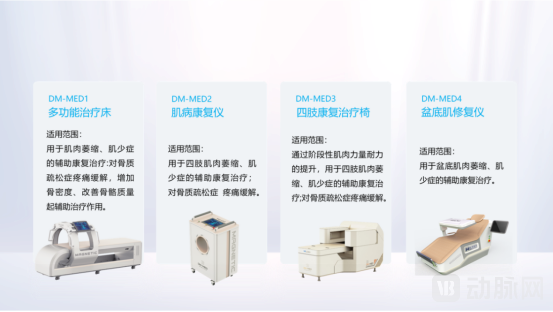
The product series provides patients with comprehensive and personalized rehabilitation solutions, ranging from systemic treatment to localized enhancement, and from medical institutions to home applications.
From closed to open, from imaging to treatment, and from equipment to materials, JiaYu has built a full-chain Magnetic Particle Imaging (MPI) technology system. Zhao Xinxuan, Deputy General Manager of JiaYu, stated that JiaYu's goal is to "establish an application system for magnetic medicine." From magnetic particle contrast agents and imaging equipment to magnetic field-induced technology and magnetic fluid hyperthermia on the treatment side, Jiayu Medical aims to connect the entire chain from diagnosis to intervention, achieving deep integration and value release of "magnetism" in the medical field.
This global perspective stems from the cross-integrated team gene. JiaYu was co-founded by Guo Dake and Bai Shi, two alumni of Northeast Yucai School Dr. Bai Shi, as the technical lead, has been deeply involved in the field of magnetic particle imaging for many years, and his R&D experience during his studies in Japan laid a solid foundation for breakthroughs in MPI technology; Guo Dake focuses on strategy and management, driving the rapid transformation of technical achievements and industrial implementation.
The core team members cover multi-disciplinary backgrounds such as magnetism, materials science, and biomedical engineering, and have received strategic guidance from Academician Gu Ning, a key expert in China's magnetism field, forming a deeply integrated R&D model of "industry, academia, research, and medicine."
A strong team and clear strategy have enabled the company to gain repeated recognition on its path to innovation. Since its establishment, JiaYu has successively won the first prize in the 2024 China Overseas-Educated Scholars Association Innovation and Entrepreneurship Competition, as well as the top prize in the biomedicine category of the 2023 China Innovation and Entrepreneurship Competition (Liaoning Region) organized by the Ministry of Science and Technology.
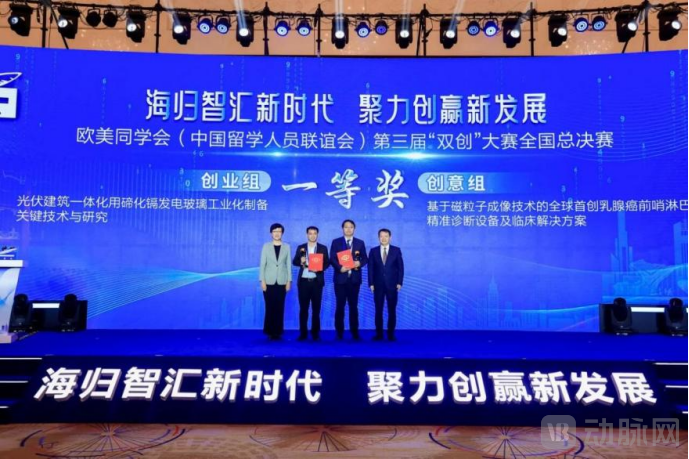
JiaYu R&D Director Professor Baishi (2nd from the right) won the first prize in the Creative Group of the 3rd "Mass Innovation and Entrepreneurship" Competition organized by the United Front Work Department of the Western Returned Scholars Association (China Association of Returned Overseas Students) in 2024.
Looking ahead, Zhao Xinxuan emphasized the need for collaborative efforts to advance the clinical translation and industrialization of Magnetic Particle Imaging (MPI) technology. Moving forward, JiaYu will focus on securing market approval for its handheld MPI device at the earliest opportunity, initiating the registration process for a whole-body MPI system, and expanding the commercial reach of its scientific research platform to establish a leading hub for magnetic medicine technology.