

Alkeus Pharmaceuticals Files for IPO: Vertex Founder Joshua Boger Returns to Lead Breakthrough Stargardt Therapy Gildeuretinol Toward Commercialization
Alkeus Pharmaceuticals
Developer of Ophthalmic Disease Therapeutics
Mentioning the most impressive biotech companies of the last century, it's hard not to recall the once "dark horse" of the pharmaceutical industry — Vertex Pharmaceuticals. Under the leadership of founder Joshua Boger, the company took only three years to complete the journey from inception to going public, creating a highly successful business legend.
This founder, with an impressive resume, joined pharmaceutical giant Merck after earning his Ph.D. in Chemistry from Harvard University. He later left his senior executive position in Merck's basic chemistry division to establish Vertex Pharmaceuticals. Starting with $10 million in initial funding, he went on to develop three drugs each with annual sales exceeding $1 billion. Boger himself shines as a brilliant rising star in the history of pharmaceutical enterprise development.
It is regrettable thatSince Boger stepped down from Vertex in 2017, he has not held a position in any other biotech company. However, in June, Alkeus Pharmaceuticals, Inc., a U.S.-based clinical-stage ophthalmology startup, announced that Boger would serve as the Executive Chairman.What's so special about this company that it can attract Boger to come out of retirement?
Alkeus Pharmaceuticals, Inc. was co-founded by Dr. Leonide Saad and Dr. Ilyas Washington in 2010.The company was founded with the goal of treating degenerative eye diseases in a completely new way, reducing the possibility of toxicity caused by the dimerization of vitamin A in the eyes.
Regarding this appointment, while the outside world is surprised, there are also inevitable doubts. Is it really not an empty position for Boger, with his qualifications, to take on a role at such a startup? In response, Boger stated: "I am very serious about my work at Alkeus. If I don't do this job, it would be like wasting all the knowledge I've gained from my past experiences."
Along with the announcement of his appointment, Alkeus successfully completed a $150 million Series B financing round.This round of financing was led by Bain Capital Life Sciences, with participation from TCGX, Wellington Management, and Sofinnova Investments.
Dr. Leonide Saad, CEO, President, and Co-founder of Alkeus Pharmaceuticals, Inc., said: "The funds raised from this financing round will be used to support the submission of an NDA for gildeuretinol (ALK-001), a pipeline drug for the treatment of the hereditary eye disease Stargardt, as well as to obtain FDA approval and expand the team."
He also emphasized that Joshua has extensive experience in leading the development and commercialization of drugs, which will be of great value to the future organized growth of Alkeus and the successful launch of gildeuretinol.

▲ Dr. Joshua Boger (Source: Alkeus)
Currently, the major markets for common ophthalmic diseases at home and abroad focus on four key areas: Age-related Macular Degeneration (AMD), Diabetic Retinopathy (DR), Dry Eye (DE), and Glaucoma. Over the past decade, numerous professionals have conducted extensive development work in ophthalmic treatments at both preclinical and clinical levels. In addition to FDA-approved drug therapies (gene therapy, FDC, small molecule drugs, etc.), modern ocular drug delivery (ODD) systems are also advancing technologies such as intravitreal implants, punctal plugs, hydrogels, liposomes, and nanoparticles.
However, due to the irreversible nature of certain eye diseases that cause pathological changes in the eye structure and the unclear pathological mechanisms, the main challenge in current drug treatments is the inability to completely cure eye diseases. Long-term medication can only slow disease progression, control deterioration, and reduce the occurrence of severe complications. Therefore, surgical treatment remains the first-line option for certain eye conditions.
Despite the limited developed indications and high technical barriers in drug development, Alkeus Pharmaceuticals, Inc. has successfully developed gildeuretinol (ALK-001), which received FDA Breakthrough Therapy Designation and Orphan Drug Designation.This is also the first and only treatment for Stargardt disease in clinical development that reduces vitamin A dimerization in the eye without affecting normal vision.This also makes gildeuretinol simultaneously possess the potential to becomeFirst-in-class and Best-in-classThe potential of the drug, Alkeus plans to submit the NDA in 2024.
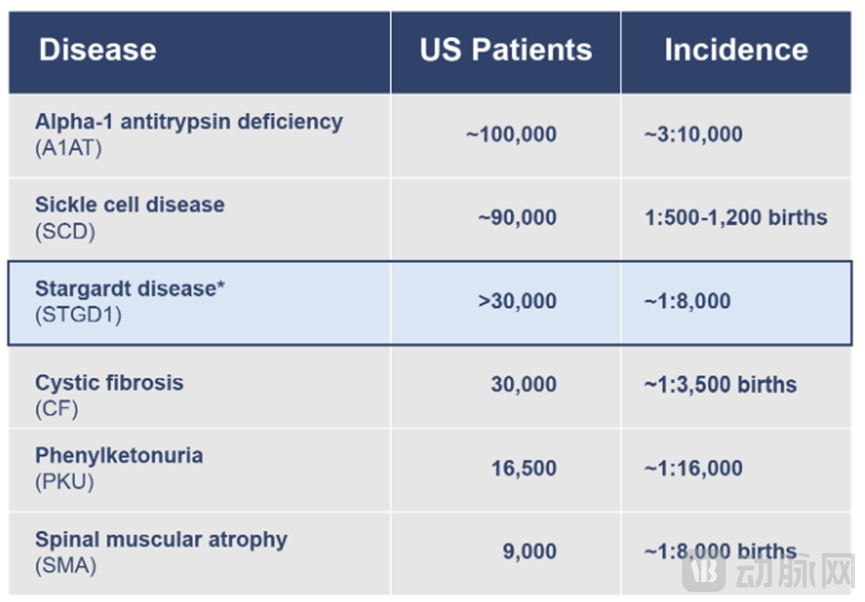
▲ Number of People with Different Eye Diseases in the United States (Source: Alkeus)
Stargardt disease is an autosomal recessive inherited macular atrophy degenerative disease, clinically characterized by the degeneration of retinal cells (rod and cone cells). This disease is a leading cause of blindness in children and young adults, affecting over 30,000 people in the United States and more than 150,000 people worldwide. Patients are usually born with normal vision, but mutations in the ABCA4 gene cause accelerated dimerization or clumping of vitamin A in the eye, leading to retinal damage and subsequent progressive vision loss.
Gene therapies for monogenic retinal diseases, including Stargardt disease, are under development. However, the standard AAV2 vector has limited loading capacity and cannot accommodate larger genes such as ABCA4. Therefore, some teams are attempting dual AAV strategies and lentiviral treatments. Although the genetic cause of the pathology is well understood, there is currently no effective treatment available for Stargardt disease. At this stage, ophthalmologists can only encourage patients to wear sunglasses and hats in bright light to reduce lipofuscin accumulation.
"Stargardt is a progressive disease that inevitably leads to devastating vision loss, leaving people unable to live independently," said Dr. Boger.
Gildeuretinol, developed by Alkeus, is designed as a novel deuterated form of vitamin A, where three hydrogen atoms are replaced by deuterium atoms. This modification significantly reduces the dimerization rate of vitamin A.Expected to slow down or halt the process of vision loss in Stargardt disease patients without disrupting the visual cycle. Phase II clinical trials have been completed.
Since the FDA approved the first tritium-labeled drug, deuterated tetrabenazine, in 2017,The application of deuterium in drugs has exploded.Deuterated drugs can not only improve the pharmacokinetic properties of drugs, but also potentially enhance metabolism-mediated toxicity and address issues of low oral bioavailability.Pharmaceutical giants such as Pfizer, Novartis, Merck, AstraZeneca, and Roche have also begun applying deuterium technology to develop new drugs.
The current research and development focus has shifted to applying deuterium technology to novel drugs.FDA Approved Deucravacitinib, a Groundbreaking New Deuterated Drug, in 2022. Other applications include Donafenib, approved for the treatment of unresectable or metastatic liver cancer and advanced renal cell carcinoma, and VV116 for COVID-19; the former was obtained by introducing three deuterium atoms onto the pyridine ring secondary amide of sorafenib, while the latter was obtained by deuteration of the soft spot of GS-441524.
In preclinical in vitro trials, gildeuretinol slowed the dimerization rate of vitamin A by 4-5 times. In in vivo trials, gildeuretinol reduced vitamin A dimerization by more than 80% and prevented blindness in a genetic animal model of the disease.
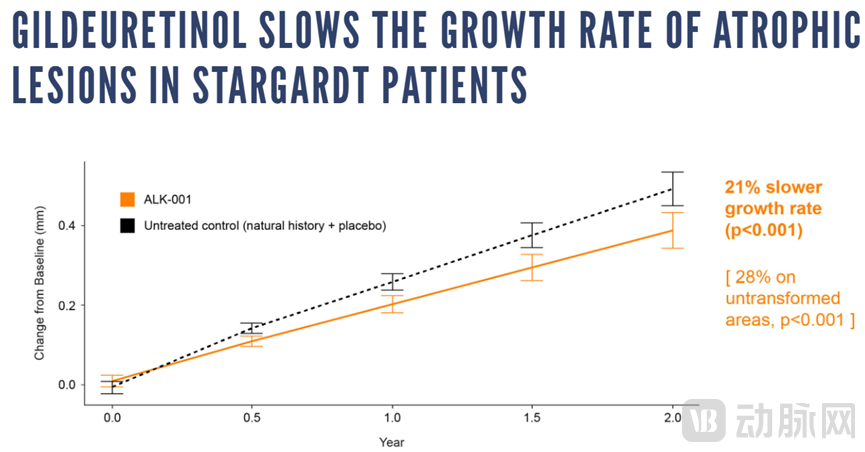
▲ Gilderetinol Phase II Clinical Placebo-Controlled Trial (Source: Alkeus Pharmaceuticals)
Alkeus has also completed the 2-year, double-blind, placebo-controlled "TEASE-1" (the code name for the ALK-001 Phase II clinical trial) study, in which 50 patients with advanced Stargardt disease were randomly assigned to receive either ALK-001 (30 patients) or a placebo (20 patients). These patients were scheduled to receive one gildeuretinol tablet daily for 24 months, and after one year, 10 randomly selected patients from the placebo group were switched to the treatment group. The primary efficacy endpoint of the study was the growth rate of well-defined atrophic lesions.
The trial results showed that the growth rate of lesions in the treatment group was 21% slower than in the placebo group (P < 0.001), based on measurements of atrophic lesion growth using fundus autofluorescence (FAF). This corresponds to an estimated annual difference in mean growth area of 0.35 mm² between the two groups.
Moreover, importantly, gildeuretinol is comparable to natural vitamin A in terms of safety.No dark adaptation delays, night blindness, or significant changes in vision were observed during the treatment. This is better than adopting a strategy that intervenes in the visual cycle. In children and young adults with early-stage Stargardt disease, gildeuretinol has shown the ability to halt disease progression, preventing further retinal damage and vision loss.
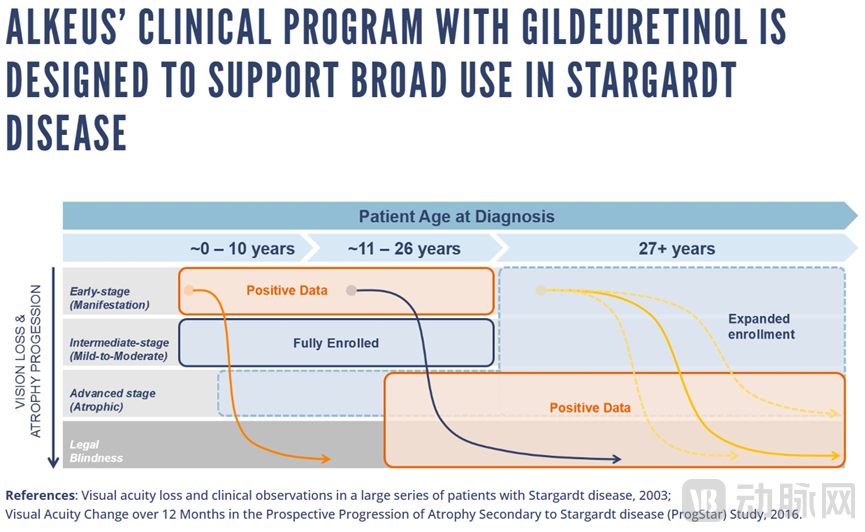
▲ Four clinical trials of gildeuretinol in Stargardt disease are ongoing or have been completed, with the first two data reads showing positive clinical treatment results (Source: Alkeus Pharmaceuticals).
In addition, other clinical trials of gildeuretinol are also underway, including a fully enrolled, randomized, placebo-controlled clinical trial (n = 80) conducted in patients with mid-stage Stargardt disease. This study is expected to yield pipeline data by 2025.
Another Phase 3 study (n=200) on gildeuretinol for the treatment of geographic atrophy (GA) secondary to dry age-related macular degeneration (AMD) has completed full enrollment of participants, but this trial requires more time, with results expected later in 2023.
Faced with such a large patient population but a market still lacking effective therapies, the clinical trial results of gildeuretinol seem to predict its outstanding efficacy. Even if operable gene therapies emerge in the future, the high treatment costs would limit their widespread adoption.Boger clearly saw the commercial potential of gildeuretinol, and once the NDA approval is granted, Alkeus Pharmaceuticals might secure a leading position in the Stargardt market.
"I'm not really an entrepreneur," Boger said, but he is confident about the future of Alkeus: "I can see a clear path for the patient's future treatment, and with the support of data, this path becomes even clearer."We are now ready to make gildeuretinol, this transformative drug, capable of curing all Stargardt patients in the future, a reality."
Notably, unlike most biotech startups with high-profile founding teams, Alkeus has been operated by Saad alone for the majority of its existence. This former venture capitalist and consultant licensed a drug invented by Ilyas Washington, a former Columbia University professor, in 2010, after which they co-founded Alkeus around the drug.

▲ Dr. Leonide Saad and Dr. Ilyas Washington, founders of Alkeus Pharmaceuticals (Image source: Alkeus)
The development of a successful drug is destined to be full of hardships, especially when there is no prior experience to refer to. To create a first-in-class drug, one must face new indications and new clinical trial requirements. This process means "basically uninterrupted work, no vacations, no personal life, and several years without income," Saad said, "I wouldn't have the energy to go through such a process again."
As the clinical trial proceeds smoothly, the company is in urgent need to expand its workforce. Saad stated that the company's size would soon increase to 5 employees, and once the NDA for gildeuretinol is successfully filed, it may expand to 50 or even more.