

Over 100 AI-Designed Drug Candidates Enter U.S. IND Submissions: Why Isn’t Overseas Focus on AI-Driven Drug Discovery Intensifying?
Evergreen Therapeutics
Innovative Drug Developer
"10 years, 1 billion US dollars, 10% success rate," this is how people described new drug development 10 years ago.
In the past few years, AI technology has gained significant attention in the global innovative drug sector, attracting numerous players to enter the field, causing "AI-powered drug discovery" to rapidly undergo emergence, saturation, and intense competition.
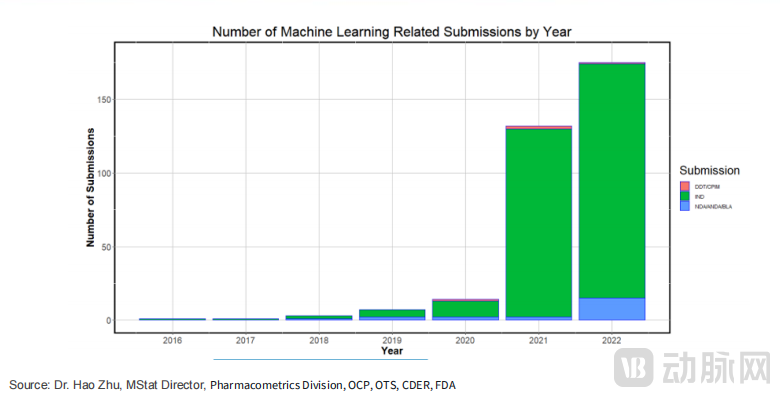
Number of FDA-Received IND/NDA Applications Based on Machine Learning (Data Source: As Shown in the Figure)
Since 2021, the FDA has seen a sharp increase in IND applications for AI-enabled drug development.More than 10 times the number of AI pipeline IND applications in 2020 heralds a "new era" for global innovative drug development.
Data from the FDA also shows that the number of AI new drug NDA applications received in 2022 has "skyrocketed," marking a significant stride into the highly regulated clinical trial phase for global AI-driven drug development.
The "cost reduction and efficiency enhancement" role of AI technology in the drug discovery phase has gained unanimous recognition from the industry. As the overall advancement of AI-driven drug pipelines continues, people are also becoming curious about whether AI can continue to play a role in reducing costs and increasing efficiency during the clinical trial phase.
The application of AI technology in the pharmaceutical industry needs to be scientifically qualified. That is, AI cannot directly produce drugs but requires a systematic integration with interdisciplinary fields such as chemistry, biology, and medicine. Empowered by AI, more scientifically efficient clinical trial solutions can be identified to truly achieve "cost reduction and efficiency enhancement" in new drug development.
Specific to the application of AI technology in the clinical stage, the FDA summarized the technology's"6 Major Types of Analysis"And"Nine Major Analysis Objectives"。
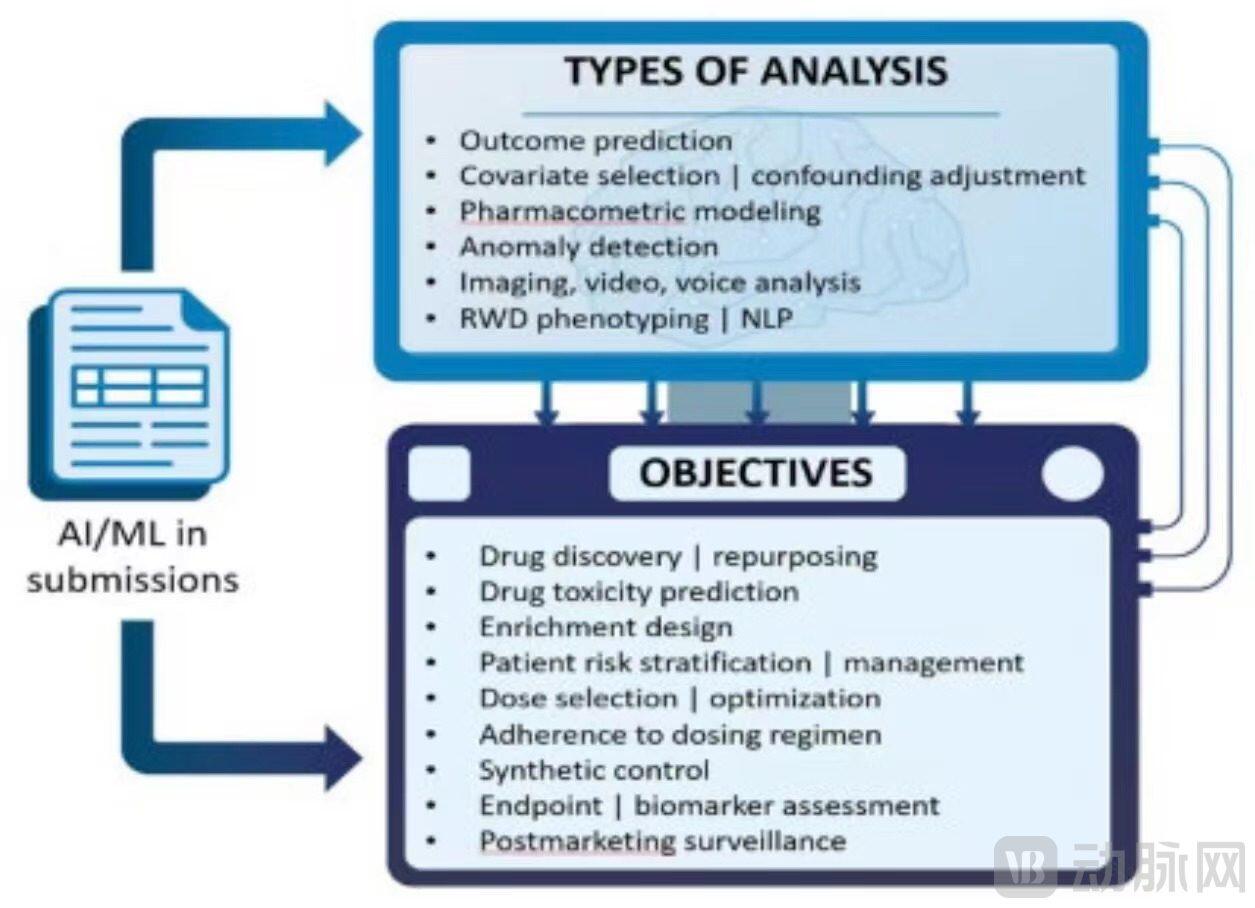
Types of Analysis and Analysis Objectives of AI in Clinical Research (Data Source: FDA Official Website)
In the analysis types, there are outcome predictions related to experimental design methods, covariate selection and confounding variable adjustment, drug dosage modeling, as well as auxiliary clinical trial processes including anomaly observation and result detection, image/video/audio analysis, real-world data phenotyping, and natural language processing (NLP).
Through the above approaches, AI can assist in building a participant cohort before trials by designing patient enrichment, risk stratification/management, and synthetic control groups. It can also predict drug toxicity in advance, select/optimize doses, design medication adherence/compliance with dosing regimens, and evaluate endpoints/biomarkers. Additionally, AI can facilitate post-marketing surveillance of drugs and discover repurposing opportunities through data.
In the context of specific clinical trial processes, AI can assist in the preliminary screening of precise eligible patients and, by integrating evaluations of drug efficacy and toxicity, propose a trial plan with high compliance and reasonable dosage. On one hand, this can help ensure that clinical trials are carried out smoothly, safely, and effectively, guaranteeing a higher success rate for the trials. On the other hand, it also avoids "futile participation" by patients who are not suited for the therapy, as time is more precious than money for patients.
At the same time, clinical trials assisted by AI have high digital characteristics, and various data information and models may be reused. This not only helps pharmaceutical companies continue to monitor various data after the drug is marketed, but also provides comprehensive introductory information to doctors when innovative drugs are commercially sold. It can even serve as a valuable real-world data model for pharmaceutical companies and the industry, assisting in the development of more innovative drugs in the future.
In the past five years, clinical CROs in China have begun to develop awareness of digital transformation, laying a solid "foundation" for the application of AI technology. However, compared with the global landscape, there are still relatively few clinical CROs or drug pipelines in China that truly apply AI technology to clinical trials.
Led by Apple, overseas technology giants have successively entered the market, giving rise to innovative companies involved in AI-optimized clinical trial solutions, patient screening, trial data management, and digital twin synthetic control groups. Innovative AI clinical technology companies such as Unlearn AI, Mondel, Deep 6 AI, Notable Health, Quris, Trials.ai, and Phastar have gained widespread favor from overseas capital markets, with the majority securing tens of millions of dollars in funding during their Series A rounds.
In terms of the current competitive landscape in China, the vast majority of companies are still concentrated in the drug discovery and preclinical research stages.The companies in the clinical trial stage are mainly represented by AI-driven innovative pharmaceutical enterprises such as Evergreen Therapeutics, Insilico Medicine, and Accutar Biotechnology, as well as innovative companies like LinkDoc Technology, YSDT (CloudDeep Intelligence), HuanYi Bio, Precision Clinical Research, and Starlight Technology, which partially focus on optimizing clinical trial design.It can be found that,Companies focusing on the application of AI technology in clinical trials are not common.
Is China's AI technology crowded into the drug discovery and preclinical research stage? Is the global innovative drug development also like this?
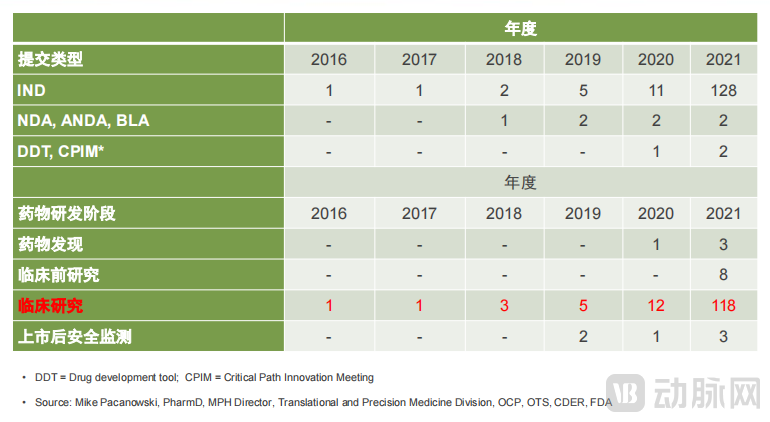
Specific Application Scenarios of AI Technology in IND/NDA Applications for AI New Drugs Received by the FDA (Data Source: As Shown in the Figure)
According to statistics from the FDA, surprisingly,In the AI new drug pipelines submitting IND/NDA, most applications are concentrated in the clinical research stage.From 2016 to 2018, all IND/NDA applications were AI drug pipelines that applied AI technology during the clinical trial phase. Although the number of pipelines began to increase in the following years, the proportion of applications in clinical research remained high. The sharp rise in AI drug pipelines in 2021 can be entirely attributed to the widespread use of AI technology during the clinical research phase.
So why is there such a huge gap between the relevant data disclosed by the FDA and the current atmosphere of AI drug development in China?
"The reverse transformation science" and "regulatory science" are currently two major significant shortcomings.
The traditional R&D pathway is the process of putting basic research findings into practice, typically starting with understanding the pathogenesis of a disease, then identifying the corresponding target, followed by developing targeted drugs based on the characteristics of the target, and finally applying them to patients. This process is quite time-consuming and costly.In contrast, "reverse translational science" takes a different approach, starting directly from patients. By utilizing genomics and clinical phenotype analysis, it elucidates the mechanisms underlying clinical observations, thereby developing effective therapies.By contrast, the latter has higher R&D efficiency but requires developers to possess extensive clinical experience and medical knowledge.
With the help of AI technology, it is now possible to achieve precise selection of preclinical models and patient stratification. This helps calculate feasible dose gradients, dosing frequencies, and safety ranges for human trials based on data from in vitro testing systems and animal studies before entering clinical trials, reducing discrepancies between preclinical and clinical trial stages for candidate drugs. Additionally, under conditions of patient variability within the same disease, it is crucial to use AI technology to accurately screen suitable candidates for a given therapy, establish reasonable clinical endpoints, and design scientifically sound clinical protocols. This also requires foundational medical and biological research driven by reverse translational science.
To ensure the safety, efficacy, and ethical compliance of drug development, "regulatory science" provides the guidelines and standards.The ever-evolving high-regulatory environment, along with the constant emergence of new technologies and methods, has added a layer of "mystery" to regulatory agencies that were already difficult to comprehend. Whether building an in-house regulatory team, collaborating with CROs that have international regulatory expertise, or leveraging AI technology for its advantages in informatization, efficiency, and real-time capabilities, regulatory science is undoubtedly a "mountain" that new drug development must climb.
From June 16 to 19, 2023, the authoritative international Drug Information Association (DIA) conference in the clinical field was held at the Suzhou International Expo Center. During the conference, Dr. Changqing Li, Chief Medical Officer of Evergreen Therapeutics, a well-known AI pharmaceutical company in China, shared insights on "The Application of AI in Clinical Research."
Dr. Li Changqing emphasized that the future clinical research of innovative drugs will rely on the three pillars of "AI," "Medicine," and "Regulatory Science."Only by combining AI methods with solid medical and biological technologies, while strictly adhering to regulatory science guidelines, can the drug development process be significantly improved, time costs reduced, and the likelihood of successful outcomes increased. Moreover, the integration of these three elements can also promote the advancement of personalized medicine. Tailored treatment plans can be designed for individual patients based on their genetic and phenotypic characteristics, which is especially crucial for emerging therapies such as gene therapy and immunotherapy, offering greater potential for developing effective and safe innovative treatments.
This year, Evergreen Therapeutics has continuously promoted the application of AI technology in clinical settings in China through conceptual innovation and practical actions. Not long ago, Evergreen Therapeutics reached a strategic cooperation with Boji Pharmaceuticals, a well-established CRO with over 20 years of history, marking a milestone in accelerating the application of AI technology during the domestic clinical trial phase. This collaboration also establishes a new model of cooperation between AI pharmaceutical companies and CROs. The two parties complement each other's strengths: Evergreen leverages its proprietary AI platform to empower the clinical design of CROs, while Boji utilizes its substantial clinical trial resources to serve clients both domestically and internationally. In this way, Evergreen can continuously refine its models to achieve higher precision, and Boji can enhance its competitiveness in the CRO industry through AI empowerment. Together, they will use AI technology to advance the efficient clinical development and commercialization of innovative drugs in China.
At present, the application of AI technology in the drug discovery phase has become relatively common, with continuous news of AI discovering new targets and new molecules. It is also hoped that as China-produced innovative drug pipelines "soar" into the clinical trial stage today, more AI pharmaceutical companies and clinical CROs will gradually begin to pay attention to the significance and importance of AI technology in clinical applications.
Promote China's innovative drug industry from "AI-empowered drug discovery" to a complete "AI-empowered drug development".